

Bullets:
Skyrocketing costs for diesel fuel are pushing municipal governments and fleet operators to switch to electric buses.
The same supply chain monopolies that China enjoys in electric passenger vehicles, are deployed in the electric bus segment.
China was the first country to electrify the bus fleets in urban mass transit, with mass adoption completed in the early 2020’s.
Leading Chinese electric bus makers BYD, Yutong, and Higer are rapidly expanding in Europe, Asia, and South America, and winning large contracts over legacy brands.
Inside China / Business is a reader-supported publication. To receive new posts and support my work, consider becoming a free or paid subscriber.
Report:
Good morning.
Most of the buses on the road across the world burn diesel fuel. Buses used in public transport average between 100 and 150 miles per day. That’s a function of stop-and-go driving, and that alone is a strong incentive for city planners to switch to electric buses. Electric motors don’t draw power when stopped; “regenerative braking” means that braking the vehicle charges the battery.
So run a city bus for 125 miles a day for a year, the cost savings of an electric bus compared to diesel runs about 67 cents per mile, or $25,000 per bus, per year. Cities that electrify their bus fleets realize savings of millions of dollars per year. And for the world’s largest cities, the annual fuel cost savings is hundreds of millions of dollars.
China was the first country to electrify cars at scale, and was the first to do so for public buses. By 2021, Shenzhen had already deployed 16,000 electric buses. Consider what that means, from the perspective of electric bus manufacturers: China has over a hundred cities with a population of over a million. Guangdong—where Shenzhen is—has 17 cities with over a million people.
And as those cities phased out fossil fuels, and switched to electric, that represents a huge, immediate demand, and long-term contracts for service and repair, and upgrades at the end of the useful life. And the same supply chains that China was building for electric cars—all the suppliers along those chains—therefore also realize new, vast markets in the electric bus segments.
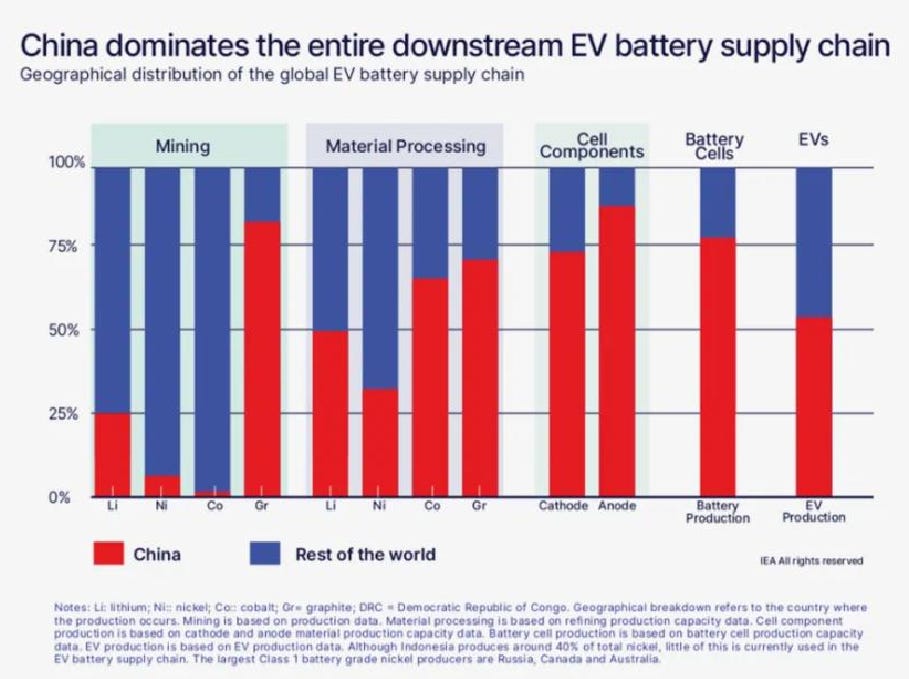
So what we’re watching today in electric buses, is the same story as we’ve already seen in everything else. Chinese factories scaled up to learn how to build electric buses for the domestic markets. Then just a few years later they were opening up big export markets. This was a small, but highly competitive field about five years ago—there were European and other Asian companies that manufactured electric buses. But by 2022, Chinese companies had a 34% market share in Europe.
Chinese firms are moving even faster in Asia. Chinese buses have dramatically improved in quality, compared to just a few years ago. Transjakarta, in Indonesia, already runs more than 400 electric buses, and will buy 10,000 more in the next five years.
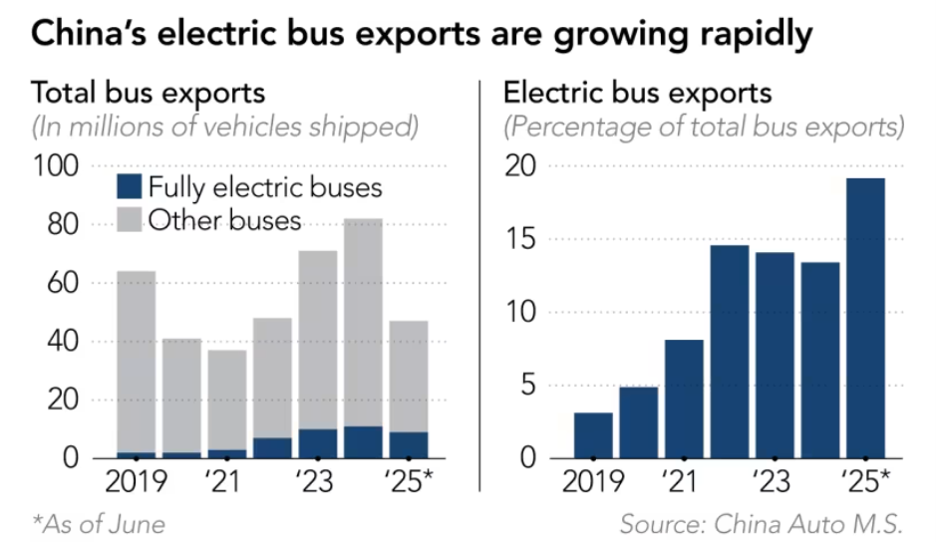
In 2025, China exported just over 40 million buses, which is a sharp decline since 2024. But Chinese exports of electric buses are booming, more than doubling last year, over 2024.
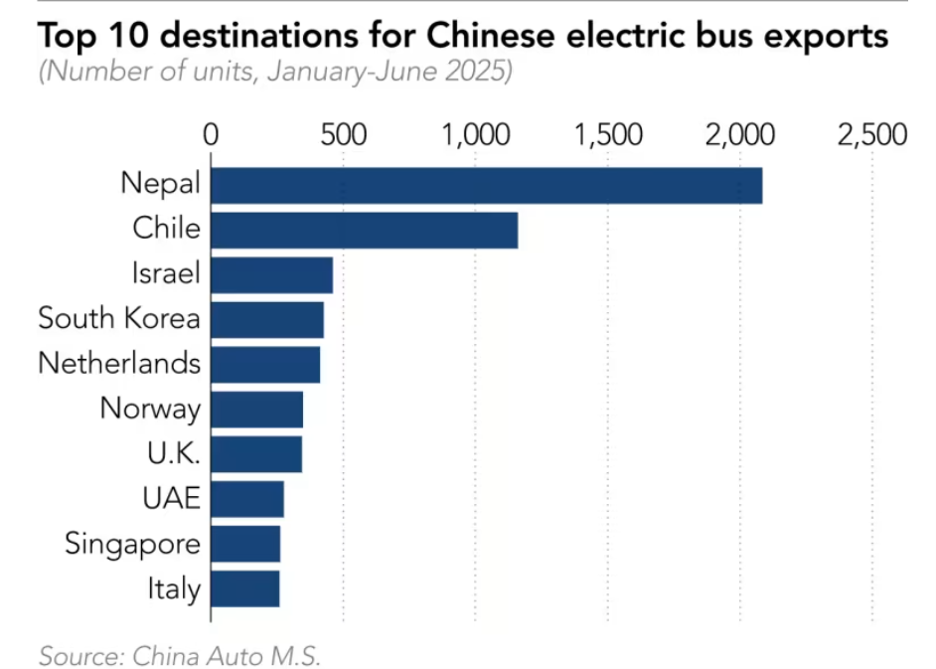
Top 10 export destinations: the top five countries are on three different continents.
Back to Europe, who does have domestic manufacturers who compete against Chinese brands for the market. But the Chinese models cost less. On average, an electric bus from BYD is 100,000 euro less expensive, compared to MAN or Daimler. Beyond the price, though, the operators insist that Chinese offerings are better made:
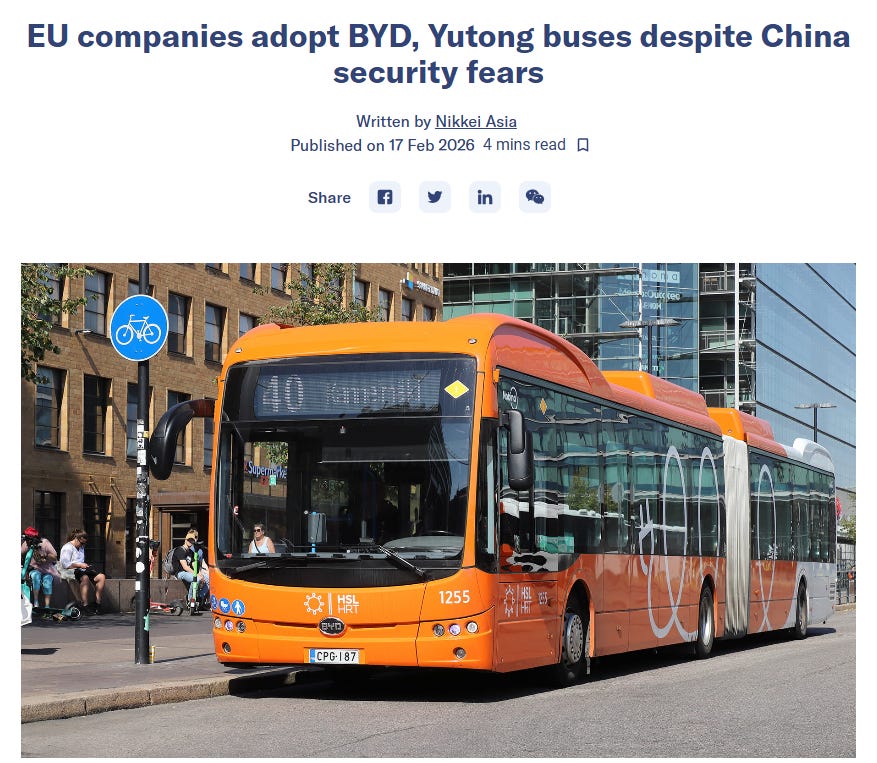
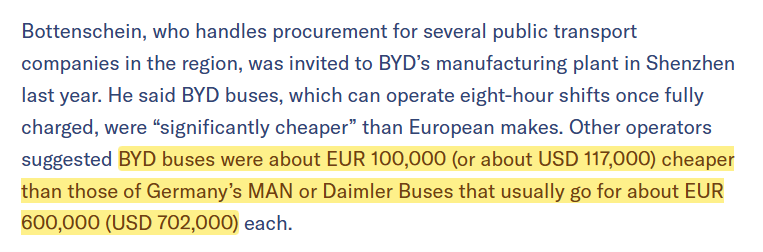
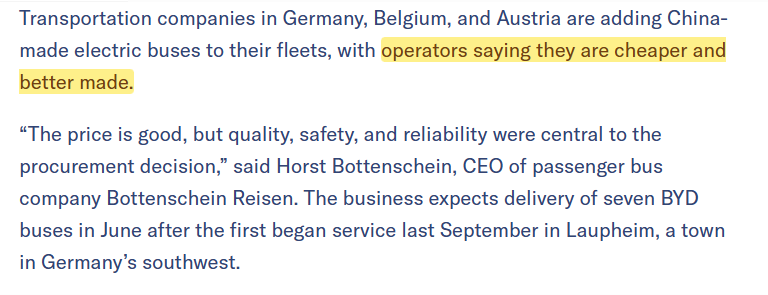
Transportation companies in Germany, Belgium, and Austria are buying the Chinese buses. This firm in Germany bought BYD, because the bus design is more practical and safer, by virtue of where the batteries go.
Another group in Belgium bought 500 electric buses from BYD, and for them BYD was the better option with respect to lifecycle cost and engineering. European fleet buyers test the buses over months, and Chinese companies are winning contracts over manufacturers in Europe. This operator in Germany went with Yutong.
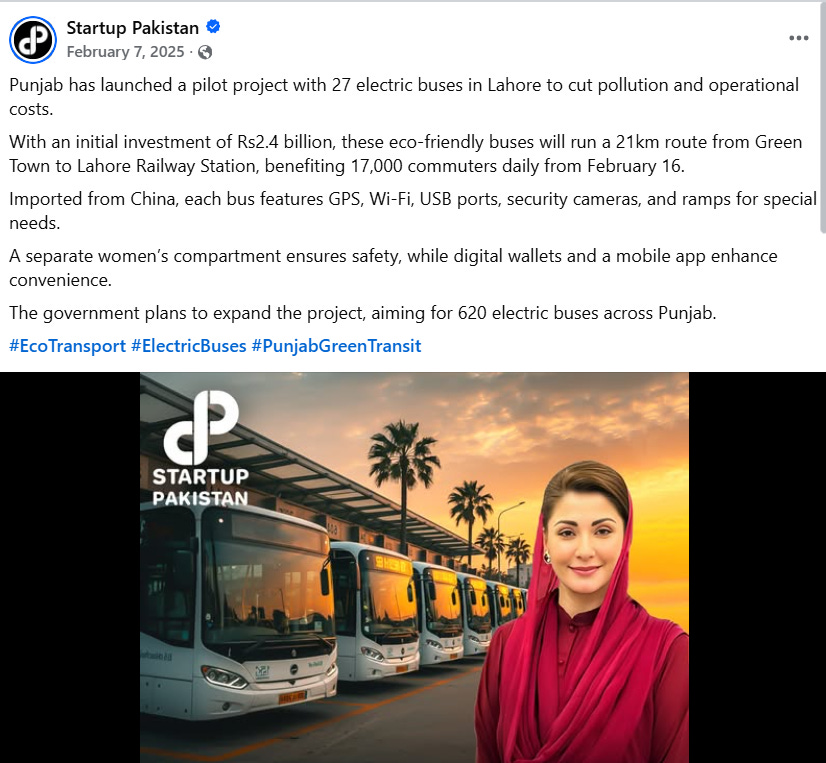
Yutong is also growing market share in Pakistan, by setting up partner factories there, for final assembly. That allows them to customize their buses, to conform to local laws and customs. For example, Chinese buses built for the Pakistani market allow women and men to board and be seated separately. The local government in Lahore is buying 620 of them.
So these trends were firmly in place before this year. In the first half of 2026, Chinese exports of light buses jumped by over 26%, to more than 11,000 units. Over 30,000 large and medium electric buses were exported.
And there’s good reason to believe that this is just the beginning. The historical comparisons of diesel vs electric, or gasoline vs electric, are on fuel price baselines that are far below what we see in the market today.
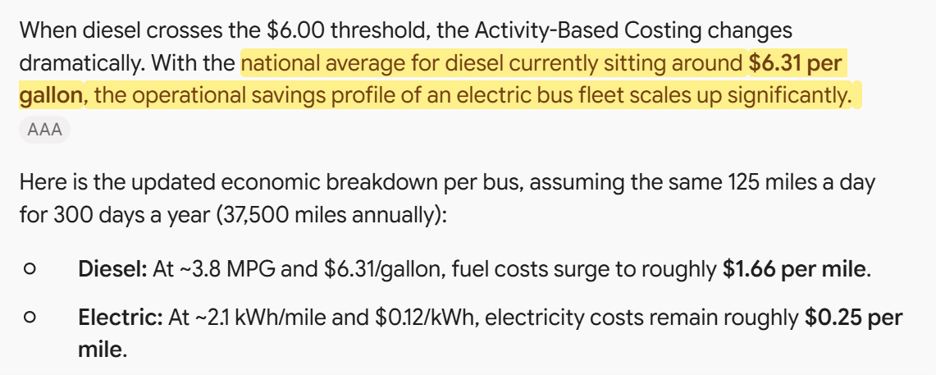
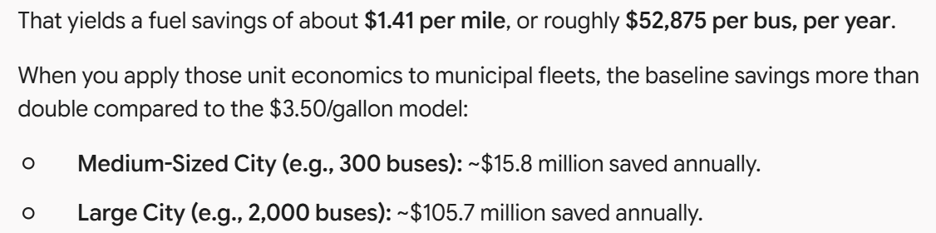
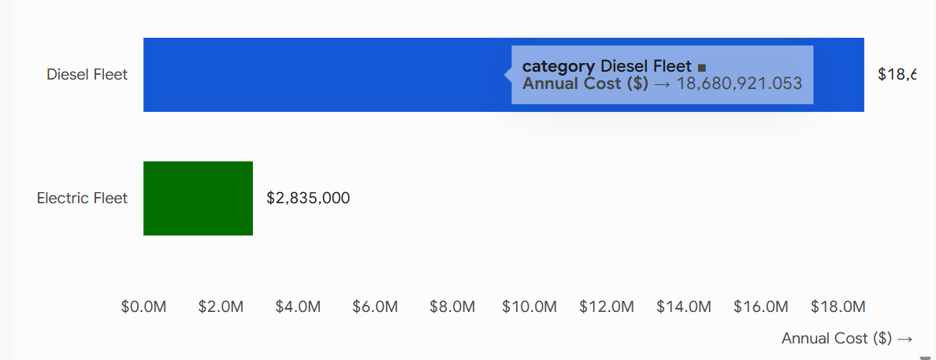
Diesel prices are at all-time highs, and that makes the math even more compelling. In the United States, the average price of diesel, nationwide, is $6.31 per gallon. At these levels, the differentials blow out; fuel costs $1.66 per mile for diesel, but for the electric hold steady. Public transit and fleet managers running diesel buses now realize cost savings of $52,000 per bus, per year, by switching over, with fleet savings of over $100 million for large operators:
The War on Iran is pushing economies away from fossil fuels, and toward renewables, for electricity generation. China is a primary beneficiary of that shift, by virtue of their dominance of solar and wind technologies.
The high gas prices – which are also a result of the War – are pushing households to move to electric cars, where again China enjoys huge advantages in cost, and in surplus capacity to ramp up production to meet the new demand.
The electric bus industry is going the same way, and for the same reasons. Crude oil trade routes are falling apart, refineries are either running at record-high rates of capacity utilization, or getting blown up completely—depending on location.
And most of those worries go away when households, or city governments, just switch over to vehicles that just plug in at night.
Be Good.
Resources and links:
THE REASONS FOR CHINA’S LEAD IN ELECTRIC BUSES: the world’s largest domestic market, supportive policies and technological innovation
https://www.basco-t.com/en/mercato-autobus-elettrici-cina/
China’s EV Makers Are Powering Southeast Asia’s Bus Revolution
https://www.zerohedge.com/markets/chinas-ev-makers-are-powering-southeast-asias-bus-revolution
Chinese electric buses receive warm welcome in Southeast Asia
https://asia.nikkei.com/spotlight/asean-money/chinese-electric-buses-receive-warm-welcome-in-southeast-asia
EU companies adopt BYD, Yutong buses despite China security fears
https://www.kr-asia.com/eu-companies-adopt-byd-yutong-buses-despite-china-security-fears
China drove global electric truck, bus sales above half a million in 2025
https://www.reuters.com/world/china/china-drove-global-electric-truck-bus-sales-above-half-million-2025-2026-08-19/
Generating a net profit of 26 billion yuan from overseas customers in one year, why have Chinese buses witnessed explosive order surge in overseas markets?
https://eu.36kr.com/en/p/3926094322301056
27 E12PRO Battery Electric Buses Delivered to Pakistan
https://en.yutong.com/pressmedia/news/1894656411271565312.shtml
Iran, Ukraine wars deliver worst hit in years to oil refining output
https://www.reuters.com/business/energy/iran-ukraine-wars-deliver-worst-hit-years-oil-refining-output-2026-05-13/
Solar, Wind, and E.V.s Rise from Shadow of Trump’s Iran War
https://www.circleofblue.org/2026/opinion/solar-wind-and-e-v-s-rise-from-shadow-of-trumps-iran-war/
The Iran war has pushed some countries away from oil and toward clean energy
https://www.npr.org/2026/07/09/nx-s1-5872786/iran-war-evs-solar-energy-transition
Over 65% of cars sold in China are now EVs as Iran war drives electric shift
https://www.scmp.com/business/china-business/article/3366961/over-65-cars-sold-china-are-now-evs-iran-war-drives-electric-shift
White House Weighs Defense Production Act as U.S. Refineries Maxed Out
https://oilprice.com/Latest-Energy-News/World-News/White-House-Weighs-Defense-Production-Act-as-US-Refineries-Maxed-Out.html
Inside China / Business is a reader-supported publication. To receive new posts and support my work, consider becoming a free or paid subscriber.
From Inside China / Business via This RSS Feed.