

By Ernesto Stephen C. Gordovez
On September 23, 1972, the day Martial Law was announced, Ferdinand Marcos was certain — or, at the very least, he was determined to sound like it.
In Proclamation No. 1081, the intelligence had been “carefully evaluated and verified.” The conspiracy was “definitely established.” The enemies had been identified, the danger had been mapped, and the contours of the crisis had been drawn.
In this world the would-be dictator painted, the Philippines was a country riddled with communist infiltration and armed separatist insurgencies, where seemingly innocent organizations allegedly served secret revolutionary ends, recruiting intellectuals and students into subversion and waging “propaganda assaults” against a government besieged on all sides by chaos. Dramatically, by Marcos’s telling, it had all the makings of a paranoid Cold War thriller.
Marcos says he tried.
I have already utilized the first two courses of action, first, by calling upon the armed forces to suppress the aforesaid lawless violence, committing to that specific job almost 50% of the entire armed forces of the country. . . and, second, by suspending the privilege of the writ of habeas corpus on August 21, 1971 up to January 11, 1972. . .
Marcos says he failed.
In spite of all that, both courses of action were found inadequate and ineffective to contain, much less solve, the present rebellion and lawlessness in the country . . .
the rebellion and armed action undertaken by these lawless elements . . . have assumed the magnitude of an actual state of war against our people and the Republic of the Philippines;
Whether every threat was quite as Marcos described it was almost beside the point. What ultimately mattered was what the would-be dictator made them mean. Each failure narrowed the field. Each danger pointed toward the same conclusion.
To say: I have no choice.
And so, on September 23, 1972, Ferdinand Marcos announced the only conclusion his proclamation had left standing: Martial Law, imposed supposedly “to save the Republic and reform society.”
Never mind that this “last resort” had apparently been years in the making.
Never mind that, as written in his very own diary more than two years earlier on January 28, 1970, Marcos had already considered allowing the crisis to “develop naturally,” until terrorism, killings, an assassination attempt, or a coup could make Martial Law acceptable to the public. And lest his ambitions be mistaken for mere concern for the Republic, in the very same entry Marcos contemplated another route and wrote: “If I want to be perpetuated in power, this is the easier way to it.”
Never mind that, as Juan Ponce Enrile admits in his memoir, Marcos had already ordered a confidential legal study on the nature and extent of Martial Law, which Enrile’s group submitted by the end of that very same January.
Never mind that, on February 11, 1971, Marcos himself wrote of a growing opinion that “what the Philippines needs is a benevolent dictator,” before adding: “Some day soon I must make a decision on this.”
Never mind that, on September 21, 1972 itself, Marcos privately admitted to U.S. Ambassador Byroade that plans for Martial Law were already at an advanced state — and, in the same conversation, conceded that he did not consider the government to be in significant danger of being toppled at the time.
Never mind, too, that September 21 was itself part of the story. The proclamation that would forever fix that date in history was not put into effect until the night of the 22nd — and historical accounts indicate that Marcos backdated it to the 21st, reportedly because of his superstition about the number seven.
Never mind these facts inconvenient to the story the dictator wanted — needed — to tell.
By September 23, 1972, Marcos had his story straight: the crisis was intolerable, every measure thus far had failed, and, if he were to be believed, he had no choice.
And that was the sleight of hand.
Marcos did not need to invent every threat. He only had to arrange them into a world in which his dictatorship appeared to be the only reasonable response. The lie of Martial Law was not simply that there was no crisis, nor that every danger was invented.
Rather, the damning lie was that the crisis could mean only one thing: Marcos.
The dictatorship that followed is rightly remembered and denounced for the countless terrors and abuses it inflicted on the Filipino people. Imprisonment. Torture. Disappearance. Censorship. Plunder. Suffering. Death.
But today we must also remember how such violence was made thinkable in the first place.
A critic must first become a threat.
Dissent must first become disorder.
Resistance must first become subversion.
A citizen must first become an enemy.
An enemy must first become fair game.
Dictatorship must first seem like the only choice.
Violence, after all, becomes easier to tolerate — becomes “right” — once its victim has been marked as “Other” — as dangerous, disloyal, subversive, someone no longer one of “us.”
And power, after all, rarely admits what it is doing. It gives coercion a nobler name. It borrows the language of virtue. It does not merely conceal what is ugly; it teaches us instead to admire it as beautiful.
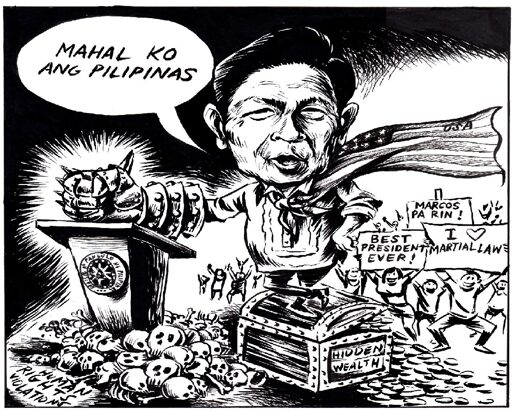
Emilio Jacinto, as it happens, already had a word for this decades before Marcos: ningning. “Ang ningning ay maraya,” he wrote. It is dazzling, it is blinding, it is deceptive. It is a glaring brightness that obscures rather than reveals; that makes vice pass for virtue; that makes oppression look like salvation. It is the opposite of liwanag — a light that illumines, that strips away false appearances, that helps us see things as they really are. Jacinto illustrates ningning through the example of a shard of glass glittering under the burning sun, beautiful enough to tempt the hand that reaches for it, only to wound the person who picks it up.
Thus, the dictatorship sought power not only over what Filipinos could do, but, perhaps far more importantly, over what things could mean. Marcos called his project “Bagong Lipunan.” He spoke of revolution while ruling from Malacañang. He invoked democracy while dismantling the institutions that held him accountable. In Proclamation 1081, the government whose powers he began concentrating in himself remained the “duly constituted government,” while those who challenged it became enemies of the democratic way of life. By 1973, Marcos had even declared September 21 to be “National Thanksgiving Day,” asking Filipinos to give thanks for the very dictatorship imposed upon them.
This was Jacinto’s ningning made political: dictatorship made to glitter as democracy, repression as reform, and blind obedience as national renewal.
There is something remarkably obscene in a dictator presenting himself as democracy’s defender, all while destroying democracy in its name.
But there is also a lesson.
A dictatorship does not begin and persist only when soldiers enter the streets, when newspapers are shuttered, or when prison cells begin to fill. Long before violence can be normalized, people must first be taught how to see it — whom to fear, whom to distrust, whose rights may be ignored, and how we should understand the violence that is thereafter inflicted.
The threat is not only that dictators and autocrats lie — we know they do. The threat is that they make their version of the world seem natural. They make their violence seem reasonable. They make their cruelty look like necessity. They make the unjust look just. From Martial Law to the War on Drugs and red-tagging today, the trick is much the same. The struggle is over more than facts — though facts still matter. It is also over what those facts are made to mean, over the world those meanings make possible, and what we can therefore be made to accept.
Fifty-four years after the declaration of Martial Law, the work remains the same: to break the spell before it becomes “common sense.” To expose the trick before it passes for “truth.” To call repression, repression; to call cruelty, cruelty; to call violence, violence; to call dictatorship, dictatorship — before power works its alchemy and teaches us to call them necessary, justified, the only choice.
Remembrance today demands something more from us. It demands we speak the truth. Again. And again. And again. And again.
So ningning gives way to liwanag.
So power is seen for what it is.
So no dictator can again make himself seem necessary.
The post Truth be Told (Again) | To make a dictator (un)necessary appeared first on Bulatlat.
From Bulatlat via This RSS Feed.