


By Nikos Mottas
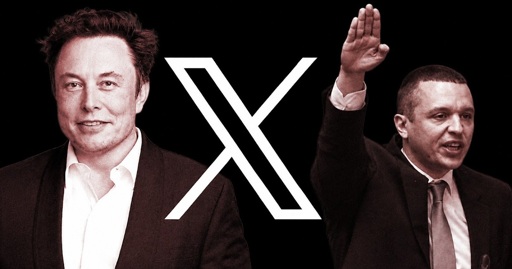
When Elon Musk publicly intervened in defense of Greek neo-Nazi Ilias Kasidiaris, the significance went far beyond another provocative post by one of the world’s richest men.
Kasidiaris was not an obscure dissident punished for an unpopular opinion. He was a leading figure and former spokesman of Golden Dawn, the Greek neo-Nazi organization whose leadership was convicted of operating as a criminal organization.
In March 2026, an Athens appeals court upheld the convictions of 42 Golden Dawn members and associates, including Kasidiaris, who was again **found guilty of directing a criminal organization.**Yet in July, Musk amplified a post portraying Kasidiaris as the victim of political persecution and added: “This is messed up”. The convicted neo-Nazi immediately seized on the intervention as support for his claim that he was being denied political rights.
This was not an isolated excursion into European far-right politics. Musk had already thrown his weight openly behind Germany’s Alternative for Germany (AfD). In January 2025, he hosted party leader Alice Weidel for a lengthy conversation on X and, later that month, appeared by video at an AfD campaign rally in Halle, praising the party as Germany’s “best hope.”
The discussion with Weidel was particularly revealing. In an extraordinary piece of historical falsification, she claimed that Hitler had been a “communist”(!!!) and an “antisemitic socialist”. Musk responded “Right,” later described Weidel as a “very reasonable person” and once again urged Germans to support the AfD. The historical record could hardly be clearer: Nazism defined Marxism and communism as mortal enemies, destroyed the Communist Party of Germany, crushed the trade unions and physically annihilated large sections of the workers’ movement. Yet on Musk’s own platform, Hitler could be shifted toward the left while the AfD presented itself as the antithesis of Nazism.
The pattern deserves more than speculation about Musk’s personality. The more serious question is why a billionaire who embodies an extraordinary concentration of private economic and communicative power repeatedly chooses to legitimize forces of the far right.
The answer begins with history. Fascism has always been capable of borrowing the language of revolt while leaving the foundations of class rule intact. It may attack parliamentarism, corruption, “globalists,” decadence or selected elites, but its radicalism reaches a very definite frontier: capitalist property and class power.
Bertolt Brecht expressed this with exceptional clarity in 1935, describing fascism as “the nakedest, most shameless, most oppressive, and most treacherous form of capitalism”. His point went much deeper than rhetoric. Fascism, he argued, could not be treated as some external barbarism descending upon capitalism from outside; it had to be understood as a historical form arising from capitalist society itself.
This distinction matters. Capitalism is a socio-economic system; fascism is a political form of bourgeois rule. Fascism does not merely coexist with capitalist power or leave it undisturbed. Under definite historical conditions it becomes one of the most aggressive and coercive means through which that power is exercised: smashing communist organization, destroying independent trade unions, disciplining labour, militarizing society and reorganizing the state for repression and war.
This is why the relationship between fascism and capital must be understood politically, not conspiratorially. Hitler was not simply invented by German industrialists. Nazism had its own organization, mass base and ideological momentum. But once it had become a force capable of destroying communism and breaking the independent organization of the working class, leading sections of German industry understood perfectly well what was being offered.
On 20 February 1933, only weeks after Hitler became chancellor, leading bankers and industrialists met him in Berlin. Hitler spoke extensively about the communist threat and the need to secure political power; after his speech, Hjalmar Schacht proposed raising three million Reichsmarks for the Nazi election campaign. The episode is important because it reveals how quickly decisive sections of capital recognized the advantages of a movement promising the destruction of organized labour and the left.
What followed mattered far more than the meeting itself. The Communist Party was suppressed, independent trade unions were destroyed and the organized power of labour was smashed. Capitalist ownership survived. German industry became deeply integrated into rearmament and the Nazi war economy.
The same broader affinity appeared beyond Germany. Henry Ford used The Dearborn Independent to spread antisemitic conspiracy theories on a mass scale. Hitler openly admired him and, in 1938, Nazi Germany awarded him the Grand Cross of the German Eagle.
William Randolph Hearst offers a different but equally instructive example. Hearst was not a Nazi, but his fierce anti-communism was accompanied by a willingness to give European fascist leaders access to his enormous media empire. He met Hitler in 1934, while his newspapers carried material from Hitler and Mussolini and tones of anti-Soviet propaganda.
The historical circumstances are different, but the political function is recognizable. Hearst owned newspapers. Musk owns a global communications platform. That gives today’s billionaire something the old press barons could only have imagined: the ability to take a political narrative from one country and give it global visibility in seconds.
In the Kasidiaris case, a convicted leading member of a neo-Nazi criminal organization could suddenly be reframed not through the record of Golden Dawn, but through the language of censorship, persecution and “free speech.” The political content remains intact; only the packaging changes.
This is particularly useful to the contemporary far right, which increasingly dresses authoritarian nationalism in the language of dissent. Reaction presents itself as rebellion; nationalism as “anti-establishment” politics; historical revisionism as free inquiry. The old symbols may change, but the class function does not.
Golden Dawn never threatened capitalist ownership. Quite the opposite: politically, it functioned as one of capital’s attack dogs, directing its violence against migrants, communists, trade unionists and political opponents while leaving the foundations of economic power untouched. Its supposed “anti-system” politics translated social anger into nationalism, racism and authoritarian discipline rather than class struggle.
That is why the meeting point between billionaire power and far right supposed “rebellion” is not as contradictory as it first appears. Reaction works upon real grievances—economic insecurity, declining living standards, alienation, social dislocation—but changes their target. The grievance remains; the enemy is reassigned.
Fascism, then, should not be treated as a separate socio-economic order standing opposite capitalism. It is a political form that can arise from capitalist society when its contradictions sharpen and sections of the ruling class seek more aggressive means of preserving their domination. In that sense, fascism operates as capitalism’s long arm: more openly coercive, more violently anti-working-class, more militarized and more prepared to dispense with bourgeois-democratic restraints when these become inconvenient.
Capitalism produces the crises, insecurity and antagonisms on which fascist reaction feeds. Fascism takes those contradictions, falsifies their meaning and redirects their victims against one another. It turns class anger into nationalism, social despair into racism and political discontent into obedience to a more authoritarian form of bourgeois rule.
That is why Musk’s interventions matter. The billionaire and the fascist, neo-Nazi demagogue need not share every conviction. They do not need a formal alliance. It is enough that one commands enormous private economic and communicative power while the other offers a politics that diverts anger away from that power. The struggle against fascism therefore cannot stop at exposing the fascist, condemning his symbols or denouncing his crimes. It must reach the social relations that repeatedly make fascist reaction possible, useful and politically employable.
Fascism is one of the political weapons capitalism can bring into the open when crisis deepens and class conflict sharpens — its long arm turned against the working class, the communist movement and every force capable of challenging the rule of property and profit.
The struggle against fascism and neo-Nazism therefore, is inextricably linked with the struggle against the barbaric, exploitative system that breeds them.
* Nikos Mottas is the Editor-in-Chief of In Defense of Communism.
From In Defense of Communism via This RSS Feed.