

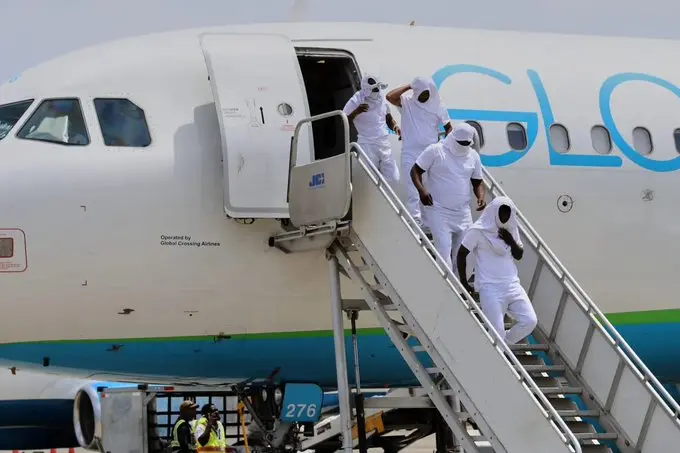
More than 400 Haitians have returned since mid-August, with aid groups reporting limited assistance and difficult conditions upon arrival.
More than 400 Haitian migrants have been deported to Haiti on weekly U.S. flights since mid-August, leaving many without their belongings, adequate assistance or a safe way to reach their destinations, according to Haitian civil society organizations.
RELATED: Haitian Peasant Movement Marks 40 Years Of Resistance Amid Deepening Crisis
The deportations follow the U.S. Supreme Court’s June decision to end Temporary Protected Status (TPS) for Haitians, putting more than 330,000 people at risk of deportation after losing protections that allowed them to remain and work in the United States.
Katia Bonté, coordinator of the Support Group for Returnees and Refugees (GARR), said Haitian migrants were being detained before being expelled from the country.
“They are detaining people on the street, at work, anywhere … and taking them to a detention center,” Bonté said, adding that authorities take migrants’ mobile phones and personal belongings before deportation.
Text Reads: 📌 On Monday, July 27, more than 300,000 Haitian migrants and thousands of Syrian citizens lost their Temporary Protected Status (TPS) in the United States as the court-mandated deadline arrived. This marks the largest expiration of this benefit since the Donald Trump administration implemented its restrictive immigration policy.
🔴 The termination follows a Supreme Court ruling issued last month, which upheld the end of TPS for Haiti and Syria and set July 27 as the final deadline following the expiration of temporary injunctions issued by lower courts.
Many of those arriving in Haiti had lived in the United States for five, 10 or more years. According to GARR, some return with little more than the clothing provided by U.S. authorities.
The Haitian government provides deportees with $80 upon arrival, but GARR says the amount is insufficient to cover safe transportation to southern parts of the country.
The organization has called for an emergency fund to cover transportation costs and for talks between the Haitian and U.S. governments to establish procedures for receiving deportees under dignified conditions.
Haiti struggles to receive returnees
The deportations are taking place as Haiti continues to face severe security problems. Following the 2010 earthquake, paramilitary gangs took control of large areas of Port-au-Prince and major roads, restricting movement and contributing to forced displacement.
The U.S. deportation campaign follows the closure in March 2025 of the CHNV humanitarian program, which allowed citizens of Cuba, Haiti, Nicaragua and Venezuela to enter the United States legally on a temporary basis. The Family Reunification Program was also closed in December 2025.
Haitian civil society organizations have criticized the treatment of migrants during deportation. Women Haitians for Haitian Refugees (HWHR) has described the U.S. immigration measures as evidence of institutional racism and xenophobia within the country’s political leadership.
The criticism intensified after the U.S. Department of Homeland Security published a social media video showing migrants in chains in the rain.
The measures have also raised concerns about their economic impact. An analysis by FWD.us cited in the press release estimates that Haitians benefiting from TPS contributed about $5.9 billion annually to the U.S. economy and paid $1.5 billion in taxes. The community supported sectors including agriculture, commerce and care services.
Legal and political efforts to challenge the deportations are continuing. Specialized law firms are seeking avenues for migrants to remain in the United States, while Democratic lawmakers in Congress are advocating for the restoration of TPS.
New York Mayor Zohran Mamdani has also publicly criticized the White House’s immigration measures, confronting the federal government’s agenda.
From teleSUR English via This RSS Feed.