

By Misión Verdad – Sep 14, 2026
With this instalment, we conclude this series titled “Chronicle of an Economic and Financial Siege” in which we document all the aggression against the Venezuelan economy that have had harmful effects on the functioning of the state and negative, even lethal, consequences for society as a whole.
Reviewing all the aggression by agents, both external and internal, state or corporate, as well as the methods employed to economically asphyxiate Venezuela since Chavismo assumed power, has allowed us to determine that every available resource was used with the aim of blocking the country’s income until its total paralysis and consequent collapse.
Nevertheless, the Bolivarian government has been able to overcome the economic war that has only intensified over the last ten years. The recovery process, very slow but upward, began even when the financial and commercial blockade had entered its most aggressive phase.
This economic rebound succeeded because the primary objective of the National Council of Productive Economy, formed by the union of efforts between the state, the country’s productive sectors, and organized entrepreneurs, was the search for joint solutions and the creation of a more inclusive and resilient economic system.
However, the attacks continued and escalated to unprecedented levels when the US imperial military threat in the Caribbean began. Once all fronts to collapse the country were exhausted, the US entity used its last available resource: direct military intervention and a naval blockade.
The US military deployment in the Caribbean represented the greatest threat of this century to Venezuela. What was officially presented as an anti-narcotics campaign—justified by designating Latin American cartels as “organizaciones terroristas extranjeras” and backed by an executive order—amounted to a multifaceted maneuver of coercive pressure against the Venezuelan state.
It was all constructed rhetoric whose substance carried a political agenda focused on attacking the Venezuelan government. Thus, the narrative of the “narco-state” became the central axis of a new doctrine of regional intervention. Behind fictional labels such as “Cartel de los Soles” or the “Tren de Aragua” hid a carefully orchestrated discursive machinery aimed at building an apparent legitimacy that justified more sanctions, military harassment, and other punitive policies that culminated in the brutal invasion of Venezuela on January 3 of this year, during which more than 100 people were murdered and US imperial forces carried out the kidnapping of President Nicolás Maduro.
Chronology of the harassment of Venezuela
Below we present how, in 2025, the events that constituted a blockade that prevented the functioning of the state and slowed the relative stabilization process achieved through the joint efforts of all of the country’s economic actors were concatenated. We highlight the most important actions:
• August 14. The US empire ordered the deployment of its air and naval forces in the southern Caribbean Sea to combat the “drug cartels.”
• August 19. 4,000 US soldiers were deployed to the Caribbean, near Venezuela. The forces were distributed on three ships, whose objective, according to the administration of President Trump, was to try to stop “tons of drugs leaving the south for North American soil.”
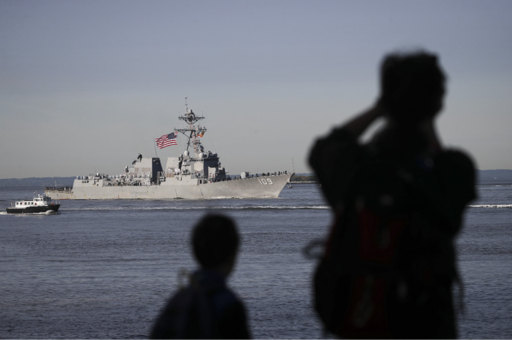
• The role of the USS Gravely, the USS Jason Dunham and the USS Sampson—all equipped with the Aegis guided-missile system—was to detect any possible threat near Venezuelan coasts.
• August 26. Washington stepped up the pressure and ordered a larger deployment. It later became known that by the first week of September Washington would expand its presence in the Caribbean with a greater number of ships.
• This new deployment included the USS Lake Erie, a guided-missile cruiser, and the USS Newport News, a nuclear-powered fast-attack submarine.
• September 2. The US empire announced that it had carried out a “lethal attack” against a “vessel loaded with drugs” coming from Venezuela and killed “11 terrorists.” Trump released images of an operation in which he stated they had destroyed a “vessel” of the so-called Tren de Aragua gang in the Caribbean Sea.
• September 3. The US colonial secretary of war, Pete Hegseth, warned President Maduro that “debería estar preocupado” after the lethal attack in Caribbean waters and reiterated the narcotrafficker accusation.
• September 5. The US entity ordered the deployment of 10 F-35 aircraft to an airfield in Puerto Rico, increasing Washington’s military presence in the Caribbean.
• September 12. The US imperial navy destroyer USS Jason Dunham (DDG-109), equipped with powerful cruise missiles and crewed by 380 marines, boarded the Venezuelan vessel “Carmen Rosa,” manned by nine tuna fishermen, while it was sailing 48 nautical miles northeast of La Blanquilla Island, in Venezuelan waters belonging to the Exclusive Economic Zone (EEZ).
• September 14. Venezuela condemned the fact that US military aircraft were frequently violating its airspace in the Caribbean without notifying their flight plans, increasing the risk of accidents. Operations tripled in August, shifting from a daylight pattern to night and early-morning operations.
• September 15. US forces stationed in the Caribbean carried out another attack against a boat in which three people died.
• October 15. Two US Air Force B-52 strategic bombers made approach flights toward Venezuelan airspace from the Caribbean. The aircraft flew directly toward Caracas before turning and repeating the maneuver, representing a direct provocation and an increase in military pressure against the government.
• October 26. A US imperial destroyer docked in Trinidad and Tobago. The governments involved stated that it was a training exercise within the framework of bilateral military cooperation. The next day, Venezuela suspended all energy agreements with Trinidad and Tobago. This announcement broke off negotiations on an agreement that would have allowed Trinidad and Tobago, a country with gas shortages, to extract and refine Venezuelan gas for export.
• October 29. Hegseth announced another attack against a vessel in the Eastern Pacific, in which four people were murdered.
• November 4. Hegseth reported an attack on a vessel suspected of narcotrafficking in the Eastern Pacific that left two dead. With this, the total number of announced attacks rose to 16.
• November 11. The United States Navy announced the arrival of the USS Gerald R. Ford, the world’s largest aircraft carrier, to the area covered by US Southern Command.
• The designation of the Cartel de los Soles as a Foreign Terrorist Organization came into effect on November 24.
• November 29. President Trump warned that the airspace over Venezuela should be considered closed.
• December 10. The US military seized an oil tanker off the coast of Venezuela. They released a video of US forces descending by fast-rope from a helicopter onto the ship.
• After confirming the measure to reporters at the White House, President Trump added that “other things are happening” with Venezuela and suggested that the United States would keep the tanker’s oil.
• December 15. Venezuela accused Trinidad and Tobago of helping the United States seize a Venezuelan tanker and ended all cross-border cooperation on natural gas with the island country.
• December 16. Trump ordered a total and complete blockade on sanctioned tankers entering and leaving Venezuela. In a post on Truth Social, he accused Venezuela of using oil, lands, and other assets previously “stolen” from the United States to finance criminal activities and declared that he designates the “Maduro regime” as a foreign terrorist organization.
• This measure put pressure on Venezuelan oil exports, which had already suffered a setback after the US seizure of a tanker on December 10.
• December 20. The United States Coast Guard boarded another tanker departing from Venezuela. The ship Centuries was catalogued as “suspected of carrying oil subject to US sanctions” even though it was not on the US Treasury sanctions list.
• December 26. President Trump mentioned in a radio interview a previously unreported attack against “a large facility” in Venezuela. It was the first announced attack on Venezuelan territory.
• December 30. The US military attacked three small boats allegedly dedicated to narco-trafficking in international waters, causing three deaths. An indeterminate number of people aboard two of the vessels survived by jumping overboard before their boats were hit. US Southern Command reported that the Coast Guard received instructions to perform search-and-rescue operations.
• December 31. Five more people died in US attacks against two small boats.
• All the attacks on small boats raised reasonable doubts because there was no evidence of the drug shipments they were said to carry, nor were there detainees or bodies identified and, above all, the “vessels” observed were not the large ships Trump described but rather small boats with several outboard motors.
• January 3. Around 2 a.m. in Caracas, the US military carried out Operation Absolute Resolve, which Trump described as “a large-scale attack against Venezuela and its leader.”
If financial sanctions drove away anyone who might establish commercial relations with Venezuela, the military deployment in the Caribbean marked an unprecedented milestone of aggression and total economic isolation.
The economist Luis Vicente León, director of Datanálisis, at the start of the US military deployment near the coasts, explained what the economic consequences would be.
While he noted that at that time oil production remained active, with flows to the US and China, and that foreign currency continued to enter through traditional and alternative payments, he also said that the pressure could result in a step back in the economic opening strategy that had previously worked for the government.
“Perceptually, the political noise and the threats of intervention raise uncertainty. A military invasion is not foreseen (beyond the insistence of some journalists and influencers interested in the issue), but doubts persist about how far US pressure can go to complicate and make Venezuelan exports more expensive on the informal market or to push personal sanctions, seizures, protests and targeted surgical actions that increase the noise and pressure on Venezuelan decision-makers,” he added.
Trump Celebrates Maduro’s Kidnapping With Misleading Video as Deportation Crackdown Empties Doral
The real objective of the deployment
On August 8, The New York Times revealed that the President of the United States, Donald Trump, had secretly signed an executive order directed at the Pentagon authorizing the use of military force against Latin American drug cartels.
The executive order was, in reality and in principle, a projection of power with broader political aims. Behind the façade of “hemispheric security” an agenda driven from certain centers of power in Washington was outlined with the aim of pushing an openly confrontational policy in the region.
The accumulation of US military assets in the Caribbean exceeded the initial narrative and was inscribed in a scheme of sustained pressure on Venezuela. The underlying plan was to continue weakening the country’s economic and political conditions by militarizing a key space for its exports and naval communications, a dynamic intended to create a permanent state of tension that served as a basis to justify new aggression.
The Southern Command’s deployment to the Caribbean should never have been interpreted as a pseudo-police security operation, but as a projection of power with clear geopolitical aims: to weaken Venezuelan sovereignty, control a strategic maritime space, and reassert an updated Monroe Doctrine, in which security rhetoric served as a pretext for the reaffirmation of an imperial sphere of influence.
Translation: Orinoco Tribune
OT/JRE/AU
From Orinoco Tribune via This RSS Feed.