

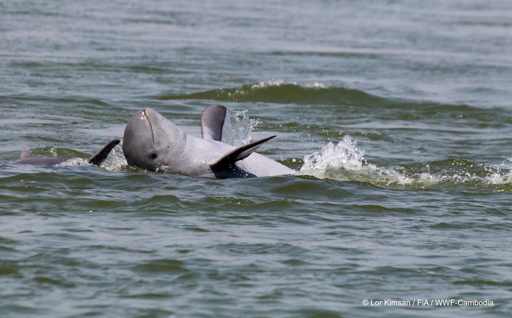
KAMPI, Cambodia — At nine in the morning, the sun beats down on the Mekong River as Heang Koeurn turns off the motor of his boat and bobs on the water. He has done this every morning for 11 years, and he still leans forward the same way when he waits: elbows on his knees, eyes scanning the water for a gray curve to break the surface. Finally, he spots what he’s looking for: Irrawaddy dolphins, the river’s sole cetaceans. Just meters away, a boat carries about half a dozen foreign tourists who squint and point as, one after another, the dorsal fins of a group of Irrawaddy dolphins (Orcaella brevirostris) crest above the water. “Irrawaddy dolphins are very important for our community,” Koeurn says, drifting his boat slowly on the water. “People here can make more income from tourists by driving them to see the beauty of Irrawaddy dolphins.” But the Mekong River, a lifeline for millions of people across Southeast Asia, is in ecological crisis, threatening the survival of Irrawaddy dolphins — and with it the livelihoods and traditions of communities along the river. Every morning, boat driver Heang Koeurn takes tourists for dolphin sightseeing at Kampi pool. Image by Eung Sea for Mongabay. Habitat in tatters The Mekong River cuts through northern Stung Treng province along Cambodia’s border with Laos, where deep pools shelter unique aquatic species such as the giant freshwater stingray. The Kampi pool, a 60-meter- (nearly 200-feet-) deep stretch of the river in Cambodia’s…This article was originally published on Mongabay
From Conservation news via This RSS Feed.