

By Jim Byrne and Bri Smith
At the end of August, Venezuela signed a major oil deal with the U.S. Because President Trump is widely viewed as a thief, liar and a braggart, the nature of the agreement is difficult to grasp at first glance. But we can and must seek truth from facts, which requires sifting through Trump and Rubio’s statements, the media’s framing, and the reality of the situation.
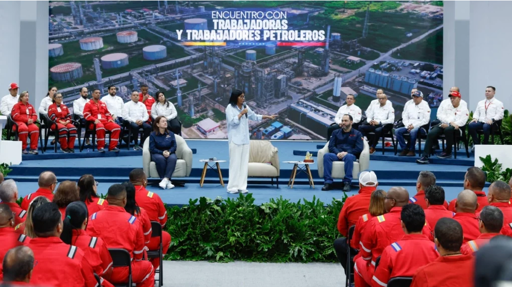
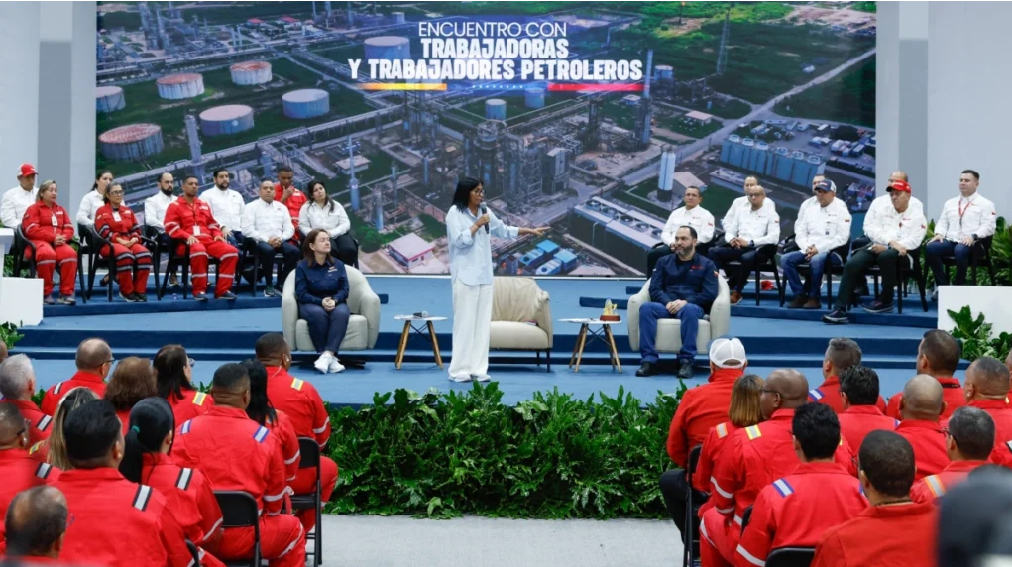
After a decade of punishing sanctions, Venezuela has endured invasion by the U.S., the bombing of its capital city, the kidnapping of its elected president and first lady, devastating earthquakes, and eight months of constant threats and blackmail. Delcy Rodríguez remains loyal to the Bolivarian Revolution, but she is locked in a delicate and existential negotiation for the future of Venezuela. It requires a sober grasp of reality to see that Venezuela is attempting to navigate an asymmetrical balance of power with a blood-thirsty pack of ghouls hell-bent on claiming dominance over the entire Western Hemisphere.
Eight months after the U.S. raid that kidnapped democratically-elected President Nicolás Maduro and his wife and National Assembly Deputy Cilia Flores, Trump bragged that he ”refills U.S. oil reserves with Venezuelan oil.” While his followers might believe this claim, the reality is very different. A major part of the new deal is a $100 billion investment so that North American Blue Energy Partners can expand its existing production from three oil fields to 17. Building infrastructure, extraction and refining are not quick operations, and will not be filling U.S. oil reserves in the near future. They are, however, recognized by oil workers and trade unionists throughout Venezuela as a major step forward to return to previous production levels and beyond.
While the Bolivarian Revolution has used oil revenue to invest in other sectors to diversify its economy, its main economic engine is still petroleum. It has been the golden goose that funded so many important, transformational achievements, like alleviating super-poverty and illiteracy while creating access to free health care and education. The involvement of U.S. oil companies in Venezuela is not unprecedented; the U.S.-based Chevron Corporation has continued to operate in Venezuela under Chavez, Maduro, and now Rodríguez.
Speaking to the weekly videoconference of international trade unionists on September 4, Jorge Arreaza, a deputy of the National Assembly and head of the National University of the Communes, shared how this deal aligns with exactly what President Chavez had said for years. “Even on his hospital bed in 2013, El Comandante said: we need to increase oil production, we need to be selling to the U.S. market.” Fellow National Assembly deputy and past president of the Venezuela Transport Workers Union, Francisco Torrealba, added this deal “achieves concrete results that will benefit the working class, improve our telecommunications sector, provide funding to improve our national electrical infrastructure, hospital and care services.”
A poll on September 7 by the Venezuela firm Hinterlaces showed 82% of Venezuelans support the deal. Acting President Delcy Rodríguez also highlighted the potential of $200 billion in tax revenue for Venezuela over the 25 years of the deal. With a goal of yielding an added 1.5 million barrels per day (bpd), the oil deal would more than double current production.
To put this into context, since 1965, Venezuela has produced 3 million-plus bpd 20 times, and 2.5 million bpd another 12 times. In fact, production had not dropped below 2.5 million bpd since 1993, until 2014. That is when the Obama administration started sanctions that have only ramped up year after year. This was a major factor that caused Venezuela to lose its biggest oil export market, some 40% of its total global oil exports, as exports to the U.S. went from 300,000 barrels to zero by 2020. This constituted a loss of over $200 billion in revenue and the equivalent to 213% of Venezuela’s GDP.
In addition to economic warfare, the U.S. also deployed political interventions. Both the Obama and Trump administrations supported the wealthy opposition in their hoarding and price gouging, fomenting unrest and violence, declaring self-selected presidents, and assassination attempts. All of these attempts, to either force regime change or bring Venezuela’s government to the negotiations table to privatize its oil sector, failed.
With the U.S. market closed to it, Venezuela adapted and shifted the majority of its exports to China. After 2020, Venezuela experienced a remarkable recovery in which the economy grew, achieving some of the highest GDP growth in Latin America from 2022 to 2024. This recovery screeched to a near halt in 2025 when the U.S. invaded the South Caribbean with 15,000 military personnel, hundreds of aircraft, and dozens of warships; began extrajudicial killings of fisherpeople; and resorted to piracy, as naval vessels seized tankers carrying Venezuela oil headed for Cuba and China.
Even as the U.S. Southern Command (SOUTHCOM) built up its forces clearly to engage Venezuela, President Maduro and the PSUV made sure that the masses had access to democratic organs to participate in their own self-defense and defense of the revolution. This effort to deepen the revolution created more communal councils, restructured top leadership with gender balance, aligned trade unions in the military-civic union, and nearly doubled the numbers of citizens in the militias and provided military training. This level of preparation demonstrated to the whole world that a traditional invasion and land battle would be a difficult one for the U.S. So that option for the U.S. was off the table; instead they resorted to kidnapping President Maduro and First Lady Flores.
After January 3, the U.S. did not simply withdraw all of its military forces back to the states. The U.S. SOUTHCOM has stayed nearby and quickly moved 2000 troops, allegedly to support earthquake relief. And it continues to use force to flex its power in the region. Recently, the U.S. conducted its 68th extrajudicial killing, bringing the death toll up to 227.
With an elected president kidnapped, a capital city bombed and that military threatening further destruction and higher toll, what was Venezuela to do? As yet, no international or domestic movement has been strong enough to force the U.S. to drop its sanctions on Venezuela, to allow Venezuela full access to its $5 billion in assets in the IMF, or to compel the Bank of England to return Venezuela’s $5 billion in gold. Venezuela remains a country dependent upon oil production for economic, social and political maintenance of daily life and future progress. Now, it stares down the barrel of U.S. imperialism stalking its shores and airspace. What other options remained?
The Bolivarian Revolution needed to adjust, endure a setback, and yet still benefit from a deal that aligns with their goals and needs in both the short and long term.
The PSUV is still in power, and the Bolivarian Revolution continues to roll on. Trump and Rubio must go through the people’s government to get deals. Marina Corina Machado and the reactionaries are not in power. This all signals that the revolution remains popular, and that it can endure setbacks, overcome obstacles, and seek a rebirth.
#Venezuela #International #NicolasMaduro #DelcyRodriguez #Trump #PSUV #Oil
From Fight Back! News via This RSS Feed.
Where are the Collectivos? WTF happened to the Bolivarian Revolution?
