

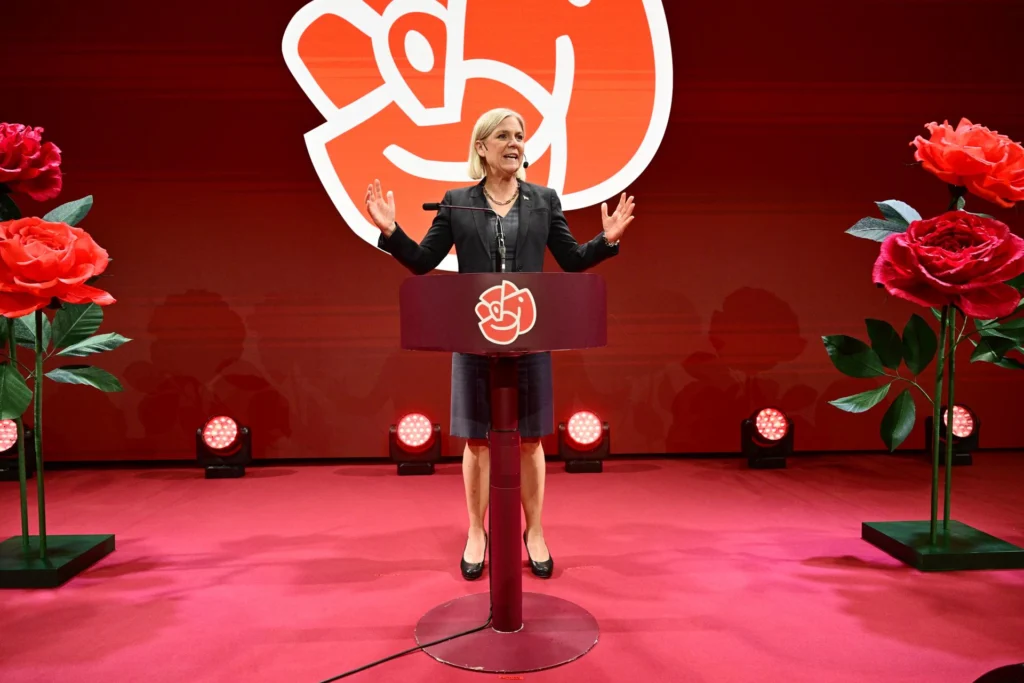
Sweden’s opposition center-left bloc has won the country’s legislative elections, held last Sunday, after the count of overseas ballots concluded Thursday.
The coalition, led by Social Democratic leader Magdalena Andersson, secured 49.5% of the vote against 48.8% for the right-wing bloc, translating into a 176-to-173 seat advantage and a margin of more than 50,000 votes.
The results were announced by the Electoral Authority on September 17, 2026, following the completion of the overseas vote count. Following the release of the results, conservative Prime Minister Ulf Kristersson conceded defeat and announced his resignation from the post he had held since 2022.
RELATED: Sweden Sends First Four Prisoners to Estonia Under Prison-Leasing Agreement
In a letter posted on social media, Kristersson asked to be dismissed from office to allow Parliament Speaker Andreas Norlén to immediately begin consultations and meetings with party leaders to form a new government. “The Speaker of Parliament must now lead the next steps toward forming a new government. For that work to begin immediately, I am requesting to be dismissed as prime minister,” the letter read.
With the outgoing government’s departure now set in motion, Andersson will seek to unify the opposition bloc to build a new cabinet -a negotiation expected to be complicated by internal ideological differences.
Svenska folket har röstat för att ta Sverige framåt. pic.twitter.com/bgFWNxfIaZ
— Magdalena Andersson (@magdandersson) September 17, 2026
Text reads: “The Swedish people have voted to move Sweden forward.”
A Delicate Coalition Puzzle
The Social Democratic leader’s main challenge will be reconciling the positions of the Left Party, which is demanding a place in the cabinet, and the Centre Party, a liberal formation that opposes granting the Left Party ministerial posts. Talks to structure the new government could stretch on for weeks, since Parliament will not name a new Prime Minister to lead the negotiations until after September 29. Should center-left negotiations collapse, the right-wing bloc would have an opening to pursue a parliamentary majority of its own.
On the results themselves, the Social Democrats emerged as the most-voted party with 28%, despite posting their weakest showing in nearly a century. The Conservative Party followed with 19.8%, while the far-right Sweden Democrats lost three percentage points and were knocked from their position as the second-largest party in parliament. Voter turnout for the election stood at 84.5%.
The count of overseas ballots and late-arriving advance votes did not change the seat distribution between the two blocs set on Monday across Sweden’s 6,312 districts. The only shift was a single seat that moved from the Social Democrats to the Left Party.
With Kristersson’s resignation now formalized and the seat count settled, attention turns to how quickly Andersson can bridge the gap between the Left Party’s demands and the Centre Party’s resistance. The outcome of those talks will determine not only the shape of Sweden’s next government, but also whether the narrow election result translates into a stable governing majority or leaves the door open for the right-wing bloc to make a late bid for power.
From teleSUR English via This RSS Feed.