

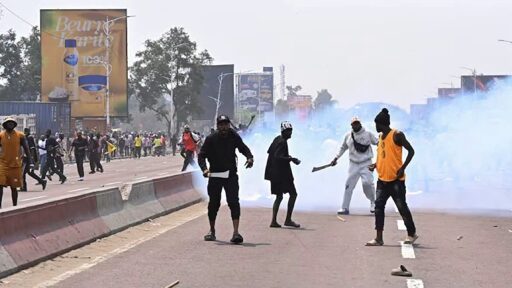

Protests rocked the Democratic Republic of Congo on Tuesday, September 15, as opposition supporters took to the streets in Kinshasa and several other cities to oppose proposed constitutional changes that they say could allow President Félix Tshisekedi to seek a third term.
The demonstrations were called by the opposition coalition C64 (Coalition Article 64), which has campaigned against changes to the Constitution and what it considers an attempt to remove the existing two-term presidential limit.
The demonstrations were also reported in several cities. In Kinshasa, hundreds of protesters gathered around the Limete area before the march was disrupted by clashes involving demonstrators and people identified as members of the Force du Progrès, a group affiliated with Tshisekedi’s ruling UDPS party. Police used tear gas and warning shots to disperse the crowd. At least 10 people were arrested in Kinshasa.
Opposition accuses authorities of an “ambush”
Martin Fayulu, leader of the Engagement for Citizenship and Development (ECiDé) and a leading C64 figure, accused authorities of deliberately allowing pro-government militants to attack the opposition march.
In a post following the confrontation, Fayulu said the C64 had agreed on its route with Kinshasa’s city authorities before the march. He alleged that protesters were then confronted in Limete by armed members of the Force du Progrès while police used tear gas against the marchers.
Fayulu wrote that the C64 had been “the victim of an ambush” and accused the authorities of using a political militia alongside security forces. He called on Kinshasa’s city authorities and the national government to explain what happened.
Read more: Lithium mining in the DRC: A new mineral rush spearheaded by the US, EU, and other major powers
The confrontation prevented the C64 march from reaching its planned destination and from delivering its memorandum to the authorities at the People’s Palace.
Opposition resistance has been building
Tuesday’s demonstrations were the latest escalation in an opposition campaign that has been building since June, when there were protests after Congo’s parliament approved legislation allowing constitutional amendments to be submitted to a referendum.
The National Assembly and Senate have both backed the referendum legislation. Critics argue that the process could eventually open the way for amendments to the presidential term-limit provisions.
Tshisekedi was first elected president in 2018 and re-elected in 2023. Under the current Constitution, the president serves a maximum of two five-year terms. His current term runs until 2028.
The proposed constitutional changes have therefore become a major point of confrontation between the government and opposition. The C64 says it is defending the existing constitutional order and has rejected any change that could enable Tshisekedi to seek another term.
The protests and the crisis is happening as the government faces other major challenges, including conflict in eastern Congo and an Ebola outbreak.
Read more: Ebola spreads to 60 health zones in eastern DRC; UN warns of funding shortfall
From BT News via This RSS Feed.