

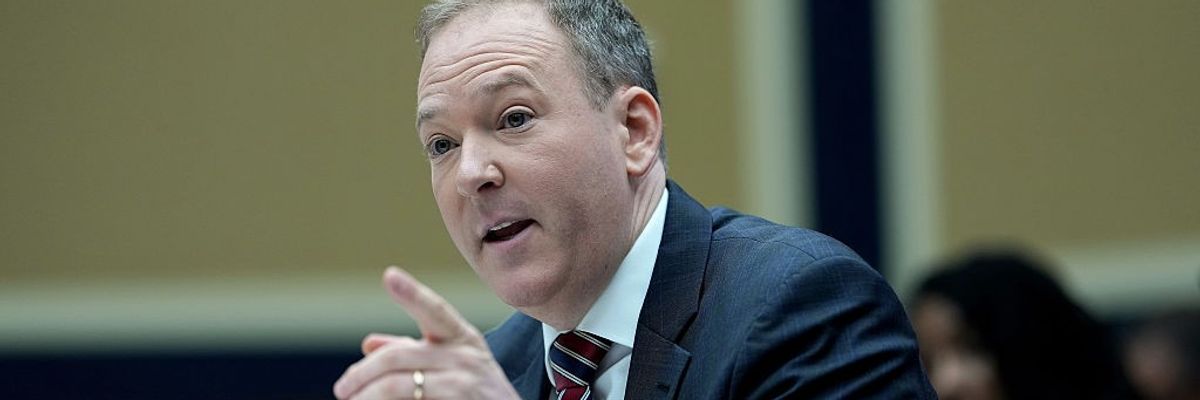
After a yearslong pressure campaign led by Students for Life, President Donald Trump’s top environmental agency is including pills used in medication abortions in a new study of drinking water pollutants—part of what one rights advocate called a ramped-up effort to weaponize “environmental protections to restrict abortion medication”—and potentially birth control, as well.
Environmental Protection Agency (EPA) Administrator Lee Zeldin announced the study last week, saying that the agency has “heard loud and clear that Americans are concerned about potential unknown pollutants lurking in their drinking water.”
But as Mother Jones pointed out, the Trump administration has shown little concern for drinking water safety as it has gutted the Clean Water Act as recently as this month, pushed for the expansion of artificial intelligence data centers despite evidence that they pollute water, and sought a reversal of rules to protect people from “forever chemicals” in drinking water.
In fact, the outlet noted, the announcement of the abortion pill study came days after Zeldin announced an elimination of pollution standards for power plants.
“The EPA’s unrelated but tandem announcements reveal an agency that has fundamentally overhauled its policies toward environmental and human health in pursuit of the Trump administration’s ‘energy dominance’ and ‘Make America Healthy Again’ agendas,” wrote Rachel Santasiero at Mother Jones.
The MAHA agenda at the EPA appears to mean a study that will test for mifepristone and misoprostol, the drugs used in medication abortions, as well as levonorgestrel, which is used in contraception, including emergency contraception pills such as Plan B.
"This is the latest tactic of trying to weaponize laws that are meant to protect our environment and protect our wastewater.”
Nathan Donley, director of environmental science at the Center for Biological Diversity, emphasized in an interview with The Cut that the EPA’s water-testing approach won’t determine how much of a chemical is in drinking water—just that it exists at all in a sample, even in trace amounts.
“That doesn’t matter much, though, in terms of the politics,” wrote Jessica Valenti, author of the blog Abortion, Every Day. “If the test finds any trace of abortion pills, conservatives will use it to legitimize their new legal front in the war on reproductive rights—one that includes weaponizing environmental protections to restrict abortion medication (and possibly contraception).”
Anna Bernstein, a federal policy adviser at the Guttmacher Institute, told The Cut that the study is part of an effort to convince Americans that medication abortions are unsafe, at a time when the number of abortions in the US has actually gone up since the Supreme Court overturned Roe v. Wade. Experts have attributed the increase to the expanded use of telehealth and the ability to mail medication abortion pill regimens to patients.
“The anti-abortion movement has become increasingly frustrated with that fact, so they really are throwing everything at the wall and seeing what sticks,” Bernstein told The Cut. “They are really ramping up disinformation campaigns about the safety of medication abortion. This is the latest tactic of trying to weaponize laws that are meant to protect our environment and protect our wastewater.”
She added that she is “concerned about the risk of added surveillance that testing for these chemicals could create in an environment where criminalization is already a factor.”
Valenti noted that Kristi Hamrick, the vice president of Students for Life, has acknowledged that attempting to crack down on medication abortion access via environmental protections is “all bullshit.”
“This is not because the environment was my first weapon of choice—it’s because it’s the one we have now,” Hamrick said last year of the group’s Clean Water campaign. "Environmental law has teeth. It already exists. And, frankly, I’m for using the devil’s own tools against them.”
The water study is part of an effort that also includes a push for legislation requiring women who have abortions and miscarriages to collect their pregnancy remains in “catch kits,” which has been proposed by state lawmakers in Wisconsin and at the federal level earlier this year.
The Food and Drug Administration already confirmed decades ago—before mifepristone was approved—that it was safe to use “without any expected adverse environmental effects."
A study by Students for Life—published in a journal run by anti-abortion doctors—was called “misleading” by experts who told Politico earlier this year that the research "should not be considered in environmental or public health decision-making.”
Donley called the notion that a one-time dose of mifepristone—a drug that’s been taken by about 1% of the US population—could be contaminating water supplies “a joke.”
“If you think of most pharmaceutical drugs, you’re not just taking one pill. You’re taking a pill on a daily or semi-regular basis,” Donley told The Cut. What that means is that those drugs used by tens of thousands—sometimes millions—of Americans every day enter our wastewater system at a much larger scale than abortion pills."
“I’ve seen no credible evidence that these drugs are causing widespread environmental harm. There’s just no data to support that whatsoever. Including mifepristone and misoprostol on this list is just stupid, but then again, we’re in a stupid administration,” he added. “It’s completely ideologically driven."
Bernstein told Abortion, Every Day that "singling out medication abortion while ignoring the agricultural and industrial pollutants that are proven threats to our health makes clear that these efforts are about restricting access to abortion, not protecting our water.”
From Common Dreams via This RSS Feed.