

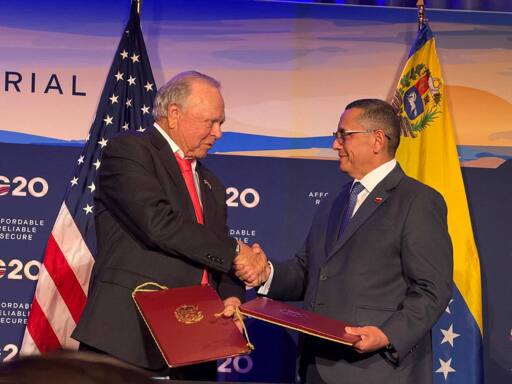
Lisbon, Portugal, September 17, 2026 (venezuelanalysis.com) – Continental Resources, a firm owned by billionaire and Trump donor Harold Hamm, struck a deal on Wednesday to exploit one of Venezuela’s largest oilfields.
Under the agreement with Venezuelan state oil company PDVSA, Continental will receive a long-term concession with “100 percent working interest” for the 500 square-kilometer Ayacucho 2 block in Venezuela’s Orinoco Oil Belt. The block contains an estimated 30 billion barrels of extra-heavy crude.
“Continental was built to recognize great resource opportunities and have the conviction to pursue them,” Hamm told Fox News, vowing that the deal would take his company to an “entirely new level.”
For her part, Venezuelan Acting President Delcy Rodríguez claimed that the agreement would “strengthen [Venezuelan] oil production” and “create opportunities for economic growth.”
Hamm and PDVSA Vice President Jovanny Martinez signed the contract in Houston on the sidelines of the G20 energy summit. Martínez and Oil Minister Paula Henao attended the conference to pitch investment opportunities in Venezuela’s oil and gas sector.
PDVSA had previously assigned the Ayacucho 2 block to Chinese private firm Anhui Guangda in 2025. However, no information on investments or output were publicly disclosed, while Venezuelan authorities have not justified rescinding the contract with Anhui.
US government-controlled corporation NABEP, which recently received long-term concessions to 17 major Venezuelan oilfields containing 65 billion barrels in reserves, will also take over projects formerly run by Chinese enterprises, including state-owned CNPC. Beijing has called for its investments and interests in Venezuela to be respected.
Hamm was one of the corporate executives present at the White House on January 9, when Trump announced that Washington would control Venezuela’s oil industry and called on Western majors to invest. Since the January 3 US attacks and kidnapping of President Nicolás Maduro, the White House has managed the South American country’s crude export revenues.
The White House has also backed Venezuelan authorities’ pro-business overhaul of the energy sector while issuing sanctions exemptions to select US-aligned corporations. Chevron, Shell, and Eni are among the companies that have signed new contracts or renegotiated existing ones in recent months.
According to Bloomberg, ExxonMobil is in advanced talks to return to the Caribbean country after a litigious past. The energy giant is negotiating rights to four major oilfields in the Orinoco Oil Belt, two of which it previously owned before they were nationalized by former President Hugo Chávez.
In the 2000s, the Texas-based corporation refused to comply with reforms implemented to assert state sovereignty over the oil industry. ExxonMobil refused compensation offers and pursued international arbitration after its assets were nationalized. The company received an arbitration award significantly below its demands.
ExxonMobil was additionally denounced repeatedly by Caracas after it spearheaded offshore drilling projects in the territorial waters of the disputed Essequibo Strip.
On Wednesday, Venezuelan authorities likewise inked a 20-year agreement with Florida-based Denarius Holding Group, controlled by Turkish energy group Çan2 Termik. Denarius is taking over the Petrokariña project in Anzoátegui state, which contains 10 oilfields producing a variety of crude types.
Heeney Capital receives gold mine concession
In parallel to its oil opening, Venezuelan authorities have also fast-tracked reforms opening the country’s mining sector to multinational corporations.
On Wednesday, New York-based Heeney Capital and commodities trader Mercuria Energy received a 30-year concession to operate the Chocó 10 mine in Bolívar State. The project holds considerable gold deposits and was run by Rusoro Mining in the 2000s before being nationalized by the Chávez government.
Heeney and Mercuria pledged US $1 billion in initial investment in the Chocó project. The two firms had struck a previous agreement with Caracas to purchase and trade Venezuelan minerals and other commodities.
One of Heeney’s co-founders, Sean Pi, signed the deal at the presidential palace in May and praised Trump’s “leadership” in defending US access to mining resources abroad. Pi has endorsed legislative initiatives deregulating and streamlining mining projects to bolster the US supply of critical minerals.
Under the trading agreement, Heeney and Mercuria are reportedly preparing to ship 15,000 metric tons of Venezuelan aluminum to the US. The corporate partners are likewise seeking to take over VENALUM, Venezuela’s biggest aluminum smelter. Glencore, an Anglo-Swiss mining and trading multinational, is also interested in VENALUM, according to reports.
Venezuelan authorities have not commented on the negotiations for the aluminum smelter. In April, Rodríguez appointed a commission to evaluate privatization of “non-strategic” state assets.
The Trump administration has identified securing access to Venezuelan mineral riches as a key national interest and is reportedly preparing an executive order to boost US corporate participation in Venezuelan mining projects.
Edited by Lucas Koerner in Philadelphia, USA.
The post Trump Allies Secure Venezuela Resource Concessions as ExxonMobil Eyes Return appeared first on Venezuelanalysis.
From Venezuelanalysis via This RSS Feed.