

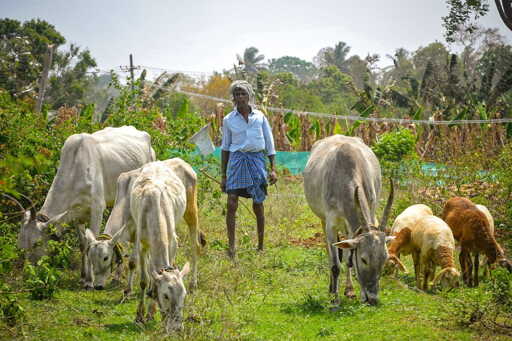
Forty-five-year-old Mahadeva Gowda was tending to his cotton farm in the village of Badagalapura in the southern Indian state of Karnataka when a tiger lunged at him from behind. He was caught unaware: He says he wasn’t aware that the forest department was trying to capture a tiger roaming through the area. Before he realized what was happening, the tiger swiped at his face, severely injuring his eyes and part of his face. After multiple reconstructive surgeries, Gowda has been left to live the rest of his life blinded, without eyes, his mouth only able to open partially, and his speech slurred. His wife, Indrani, says survival is extremely difficult for the family: Gowda was the household’s breadwinner, and now, he can’t work. He’s now become fully dependent on his wife for even his most basic needs. The incident occurred in mid-October 2025. Two weeks later, another farmer, 55-year-old Rajashekarappa, was grazing his cattle in a field when he encountered a tiger: It was fatal. Badagalapura and other villages that regularly report tiger encounters sit on the edge of the forest, placing them within what the forest department considers a “tiger landscape.” “Tigers have been present in this landscape for centuries and they constantly move here,” says S. Prabhakaran, who served as conservator of forests and oversaw operations at Karnataka’s Bandipur Tiger Reserve until earlier this year. The 1,456-square-kilometer (562-square-mile) park is home to between 154 and 175 tigers, according to a 2024 estimate by India’s National Tiger Conservation Authority…This article was originally published on Mongabay
From Conservation news via This RSS Feed.