

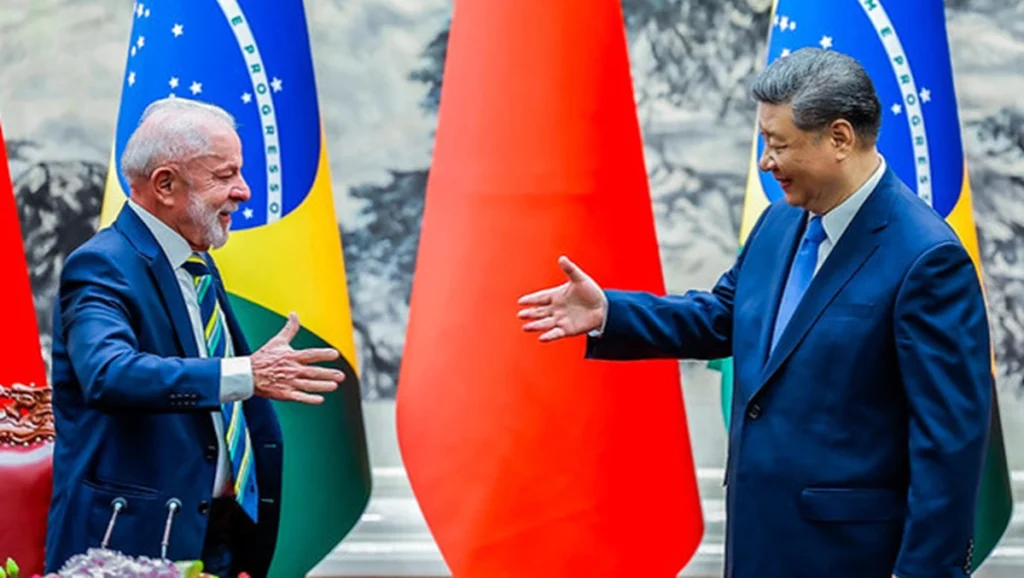
Spokesperson Guo Jiakun comments on Brazil’s elections and reaffirms the principle of non-interference.
Cooperation in artificial intelligence, computing and supercomputing, space technology, satellites, critical minerals and rare earths was among the main issues addressed by Brazilian President Luiz Inacio Lula da Silva’s special adviser, Celso Amorim, during his visit to Beijing.
In an exclusive interview with teleSUR on Thursday, Amorim highlighted the possibility of expanding technological cooperation with China, while stressing that it must preserve Brazil’s autonomy.
RELATED:
Brazilian President to Visit Rio Grande do Sul for Climate Talks and Campaign Event
On the same day, teleSUR participated in the regular press briefing of China’s Ministry of Foreign Affairs in Beijing and asked spokesperson Guo Jiakun about the letter delivered by Amorim to President Xi Jinping and about pressure from the United States on Brazil, including the context of the 2026 presidential elections.
“The main message is a positive assessment of the progress made recently in several areas, including computing and supercomputing, space and satellites, as well as the expectation of joint work on artificial intelligence, based on open-source technology and acceptable ethical standards.”
The interview took place one day after Amorim’s meeting with Chinese Foreign Minister Wang Yi in Beijing. During the meeting, Lula’s adviser delivered a letter from the Brazilian president to Xi Jinping.
According to China’s Ministry of Foreign Affairs, Wang conveyed Xi’s greetings to Lula and said that relations between the two countries had evolved from a comprehensive strategic partnership into a community with a shared future.
Wang also called for stronger strategic coordination between the two countries and highlighted the role of China-Brazil cooperation in strengthening Global South unity. The two sides also discussed international issues, including the situation in the Middle East, Latin America and Ukraine.
China Responds to Calls to Slow the AI Race: Fearmongering and Confrontation Will Serve No One
Chinese Foreign Ministry spokesperson said that artificial intelligence represents a vital technology for the well-being of all humanity, calling on all parties to work together to… pic.twitter.com/lWDFkExOIe
— China pulse
(@Eng_china5) September 14, 2026
Artificial Intelligence and Technological Autonomy
For Amorim, artificial intelligence is one of the areas with the greatest potential for cooperation between Brazil and China, particularly through open-source systems.
“We are not concerned about what the reaction of this or that country will be. What matters is that WAICO contemplates artificial intelligence based on open-source technology. This allows us to develop our own applications, without external interference, at least in principle.”
Brazil participated in the founding ceremony of the World AI Cooperation Organization (WAICO), an intergovernmental organization headquartered in Shanghai. The initiative seeks to promote international cooperation in artificial intelligence, including scientific and technological cooperation and the development of open-source ecosystems.
Amorim said this model could be particularly relevant for countries of the Global South because it could expand their ability to develop their own technological solutions.
“We know that artificial intelligence is still something we are just beginning to navigate. But, at least in principle, it facilitates a path that allows us to innovate without having to give explanations or ask anyone for permission.”
He also acknowledged that different countries have different approaches to artificial intelligence, particularly regarding open-source technology and ethical standards.
“I think it is a pity that, in reality, there are two systems, but I think that, for now, it is inevitable. They are different philosophies, especially regarding open-source technology and ethical standards.”
Amorim also highlighted the participation of the United Nations secretary-general at the WAICO founding event, saying it gave the initiative a multilateral dimension.
“For the Global South, I want to stress that having open-source artificial intelligence is the most important aspect.”
TRUMP IN PANIC: CHINA CAN SHUT DOWN U.S. STRIKES ON IRAN ANYTIME
Trump’s Iran campaign is already sputtering because Washington’s entire arsenal runs on Chinese minerals, SCMP sources warn, giving Beijing direct leverage to decide how long the bombing can actually last… pic.twitter.com/HrvGqh4Wbj
— NewRulesGeopolitics (@NewRulesGeo) March 13, 2026


Critical Minerals and Rare Earths
Another issue discussed during the meetings was cooperation in critical minerals and rare earths, an area that has gained importance in Brazil’s industrial and technological policy.
Amorim said Brazil does not want to limit its role to exporting raw materials, but rather seeks to add value to its mineral resources and use them as a basis for technological development.
“President Lula has always reiterated that we do not want simply to be exporters of minerals. I think another aspect is that we want to process them, add value and use them scientifically.”
According to Amorim, the newly created Brazilian council on critical minerals can help identify the country’s strategic needs in areas such as defense, science, space technology and supercomputing.
“In all these areas, you will need to use critical minerals. Automobiles also, obviously, and energy will require critical minerals and rare earths, and we have to be capable of processing them.”
He said Brazil can exchange experiences with China on mineral processing and technological applications. “It is not that China necessarily needs ours, nor that we will necessarily need theirs. It is more a question of exchanging experiences on how to process these materials and how to use them in favor of technological development.”
For Amorim, cooperation should go hand in hand with national autonomy. “It can be cooperative, but it has to preserve a high degree of autonomy.”
Multilateralism and Financing
Amorim also emphasized the convergence between Brazil and China around multilateralism. “China has, like Brazil — and this also applies to the first question — a natural vocation for multilateralism. I even mentioned a phrase I had read from Xi Jinping, that we need to carry the torch of multilateralism, because it is fundamental for a country that has progressed as China has, within a multilateral system based on respect, at least some respect, for international rules. Brazil likewise needs this in order to move forward.”
According to Amorim, China’s weight in the international system gives it an important role in efforts to address conflicts and strengthen multilateral mechanisms. He also pointed to the financial and monetary sphere as an area where cooperation could advance, although more gradually.
“I think this is also an area in which China can undoubtedly help, including by helping the BRICS New Development Bank become increasingly active.”
The New Development Bank, created by the BRICS countries, has expanded its role in financing infrastructure and sustainable development projects in the Global South. The issue of financing in national currencies has also gained greater prominence within the group.
China’s answer could not be clearer:
Who China trades with is none of Washington’s business.
“None of your business (关你屁事)” — that’s the boundary.You want to sanction Russia?
“None of my business (关我屁事)” — that’s the grace.Bilateral trade between China and another… pic.twitter.com/TduAyYHbWA
— 𝘊𝘰𝘳𝘳𝘪𝘯𝘦 (@OopsGuess) September 17, 2026
Middle East, External Interference and Elections
Amorim said the discussions also addressed the international situation, including the conflict involving Iran and the broader crisis in the Middle East.
“It is also very important to consider the role China can play, given its weight, in the search for peace in relation to the Middle East, but especially the war against Iran that is underway, and the Iranian reaction as well, which led to the closure of the Strait of Hormuz.”
He stressed that the effects of the conflict extend beyond the countries directly involved. “China is immediately affected by this, but others are too, including Brazil.”
Regarding foreign pressure and interference, Amorim distinguished between Brazil’s relationship with China and the broader question of external intervention. “I think we have a great deal of affinity with China regarding non-intervention in internal affairs, in any region.”
He added that Brazil must remain attentive to the risks of external intervention, regardless of where it comes from. “Brazil is a peaceful country, but the fact that it is peaceful is not a guarantee that it cannot suffer some kind of interference. We cannot accept that.”
On Thursday, teleSUR also questioned Chinese Foreign Ministry spokesperson Guo Jiakun about Lula’s letter to Xi Jinping and whether the Chinese president had responded to it.
Guo did not disclose the contents of the letter or confirm a specific written response. Instead, he emphasized the state of bilateral relations.
“In recent years, under the strategic guidance of the two presidents, China-Brazil relations have been growing by leaps and bounds, evolving from a comprehensive strategic partnership to a community with a shared future. President Xi Jinping and President Lula are in close communication through various channels, demonstrating the high level of political trust between our two countries.”
TeleSUR also asked about U.S. pressure on Brazil, including criticism of the Brazilian government’s handling of organized crime, possible sanctions against Brazilian Supreme Court justices and the approaching 2026 presidential election.
Guo responded by reaffirming China’s diplomatic principle of non-interference. “China adheres to the principle of non-interference in other countries’ internal affairs. We wish Brazil a steady and smooth election.”
Bruno Falci, teleSUR correspondent in China
From teleSUR English via This RSS Feed.