

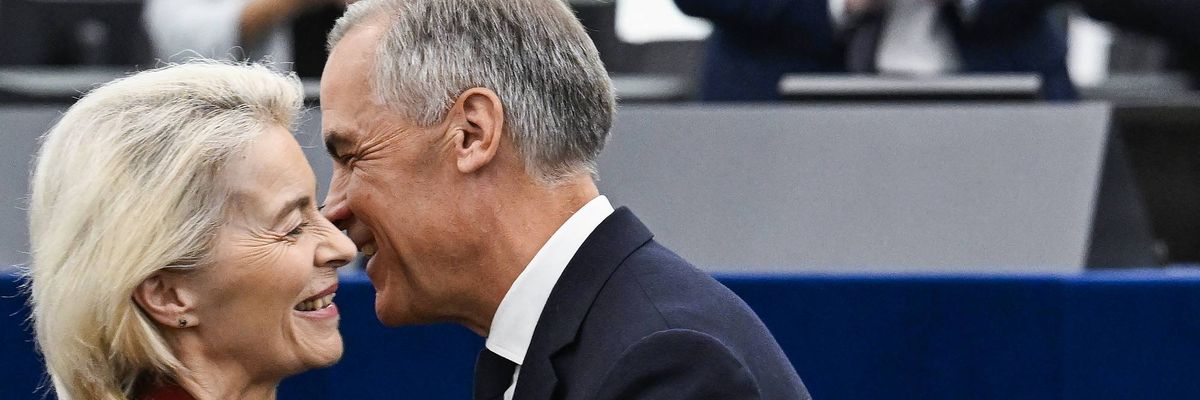
In the wake of President Donald Trump’s threats of annexation and economic warfare, Canada is distancing itself from the United States and moving toward a first-of-its-kind “associate membership” with the European Union. Trump suggested on Wednesday that this could be a “hostile act.”
European Commission President Ursula von der Leyen first introduced the idea earlier that day of Canada deepening its ties with the EU economic bloc during a meeting of the European Parliament in Strasbourg, France.
“Democracies have the freedom to choose with whom to work,” Von der Leyen said, suggesting that an “Alliance for the Future” between the EU and Canada would expand cooperation on technology, economic security, and military industry, among other critical areas.
She described such cooperation as a necessity in an “openly hostile world.”
This was, in part, a not-so-subtle dig at Trump, who has antagonized Canada during his second term by slapping 50% tariffs on roughly $20 billion of Canadian imports and repeatedly floating the idea of making it the “51st state.”
Europe, too, has been targeted by Trump’s trade war, while the president has repeatedly threatened the sovereignty of Greenland, an autonomous territory of Denmark, by suggesting the United States could take control of it—including by military force.
An “associate membership” in the EU for a non-European nation has no formal basis in EU statute. One EU diplomat told Reuters that “nobody really knows what it means.”
However, Trump described it as an unmistakable slight and issued more threats.
“I think it’s laughable, the whole thing with Canada,” he told reporters on Wednesday. “Canada’s been a terrible trade partner.”
If the two reached an agreement, Trump said he may retaliate further, heightening the tariffs that have led to sharp declines in European exports to the US and driven up costs for American consumers, especially low-income households.
“If they do that, if I think it’s at all a hostile act, I will put very serious tariffs or stop trading with Europe on many things,” Trump said. "So if they do that, if Europe does that with a bad intention, if it’s a good intention, that’s fine.”
“If it’s a bad intention, we’ll put very heavy tariffs on Europe,” he reiterated.
Speaking at the European Parliament on Thursday, Canadian Prime Minister Mark Carney—whose compatriots are now more inclined to view the US as an “enemy” than an “ally,” according to a recent poll—said of Von der Leyen’s proposal, “We welcome this ambition.”
While he did not discuss the specifics of becoming an associate member, he agreed that Canada’s relationship with the EU should move beyond the current Canada-European Union Comprehensive Economic and Trade Agreement (CETA).
“Canada and Europe should secure our strategic autonomy through deep cooperation in the full range of strategic capabilities, including critical minerals, defense industrial capacity, AI and compute, energy security, space, and payments,” he said.
Carney stressed that the act was not one of hostility toward the United States and that he did not seek to form “a third bloc in order to become a great-power rival.” But he also seemed to draw a contrast with Trump’s bellicosity.
“We do not seek power to dominate others,” he said. “On the contrary, we are pursuing resilience so that no one can control our open markets, impair our sovereignty, threaten our territorial integrity, or undermine our freedoms, our democracies, our rule of law.”
Trump has not yet specified what tariff rate he’d seek to impose against Europe or what would signify that the alliance with Canada had a “bad intention.”
But Kathleen Van Brempt, a Belgian social-democratic politician and member of the European Parliament, said that “the fact that Trump immediately resorts to new threats is further proof that stronger EU-Canada cooperation is both wise and necessary.”
“He does not find the idea ridiculous; he fears it because it would weaken his divide-and-conquer tactics and his ability to wield illegal tariffs as political and economic weapons,” she wrote on social media.
“He might not react when you lift a finger,” she added. “But he will understand when you raise a fist.”
From Common Dreams via This RSS Feed.
The Orange Pedo filling his diaper is a hostile act.