

Photo: Jeff McIntosh / The Canadian Press
A leaked document, labelled a cabinet report and outlining possible plans to overhaul Alberta’s natural gas pipeline system to spur AI data centre construction, caused an uproar last week.
It was top of mind for Alberta Premier Danielle Smith on her weekly radio show, it was the subject of an Alberta NDP news conference and it was in media outlets of every stripe. But what exactly is the leaked document at the heart of the controversy and what does it actually mean?
The document, first obtained by The Narwhal, has spread far and wide, at least according to Alberta NDP Leader Naheed Nenshi. Multiple media outlets say they’ve received a copy, but the full details have not been made public. Until now.
The document was leaked to The Narwhal by a government official whose identity is being kept confidential. The Narwhal verified they are in a position that would likely have access to such a document, and the provincial government did not deny its authenticity when it issued a statement in response to the leak.
The Narwhal is publishing a copy of the document it obtained, alongside an explanation of what it all means — and whether it is, as Smith’s government now suggests, merely one of many considerations it reviews on a regular basis.
A copy of the document can be found here. The document will contain some typos, introduced by efforts to ensure the document’s source remains confidential.
Let’s dive in.
What’s the deal with that leaked document?
The document outlines plans for the province to overhaul how natural gas pipelines operate and are regulated within the province.
According to the document, the recommended proposals for consideration include changing the regulations in Alberta to ensure all natural gas pipelines fall under provincial jurisdiction, and then also passing legislation that would allow the government to create two Crown corporations. One corporation could oversee the pipeline system and compel companies to make investments deemed a priority by the government, and the other could build and operate, or bankroll, new pipelines — and directly compete with existing private companies.
If the government doesn’t go for the recommendations, the document says there could be some combination of those interlocking options. For example, creating the Crown corporation that would oversee the system, but not the corporation that could build or bankroll new pipelines. There is also the option to continue with the status quo.
The document includes timelines for cabinet decisions, as well as implementation. It also breaks down the estimated costs of implementing the changes, including the multimillion-dollar costs of possible legal battles with companies including TC Energy.TC Energy owns and operates the largest natural gas pipeline system in the province, called the Nova Gas Transmission pipeline, or NGTL.
TC Energy and ATCO, another energy company mentioned in the document, did not respond to a detailed list of questions about the contents of the document by publication time.
In a statement released after the document was leaked, TC Energy said it is prepared to keep investing in its pipeline system to meet demand.“This will require all of us — industry, customers, regulators, governments, stakeholders and rightsholders — to come to the table and improve the conditions to get infrastructure built,” it reads.
“The key is working together to bring forward credible solutions, capital and capacity quickly enough to support Alberta’s growth and enable Canada to unlock the opportunity to meet the moment.”
Wait, why is Alberta considering this? Do we need pipelines for AI data centres?
The plans for natural gas expansion are not just about data centres, there is also reference to expanding oil and gas production, including access to natural gas for oilsands operations.
But the expansion of AI data centres are front and centre throughout the document, which notes “the Government of Alberta is actively courting hyperscale data centre capital and other investors.”So why do we need gas for that?
The Alberta government is eager to host data centres in the province, with a line-up of potential projects that dwarf any other region in the country. The province, realizing there was no way to power all those projects, capped access to the electricity grid and told producers to build their own power if they want to get up and running.
The draft rules for data centres require that electricity to be generated by natural gas, at least for now, part of a wider plan to increase production and demand for the resources.
In a recent interview with The Hub, the government argued bottlenecks in the natural gas pipeline network are an impediment to attracting and building more data centres, one of the key reasons it wants to incentivize, or force, expansions to natural gas pipelines.
TC Energy said in its statement that it has invested approximately $15 billion into expanding its Alberta network over the past ten years and plans to spend billions more.
The document says it’s not moving fast enough.
Alberta Premier Danielle Smith says this is just spitballing, is that true?
The first thing Smith addressed on her weekly radio show on Sept. 12 was whether or not the province is considering spending billions to build new pipelines for data centres.“Short answer, no,” Smith said, in response to the question from host Wayne Nelson.
She then went on to add nuance to that hard “no.”
TC Energy has a “monopoly” on the gas pipeline system, she said, and the government wants other companies to build more access.
“We would very unlikely have to create a Crown corporation to do it,” she said.
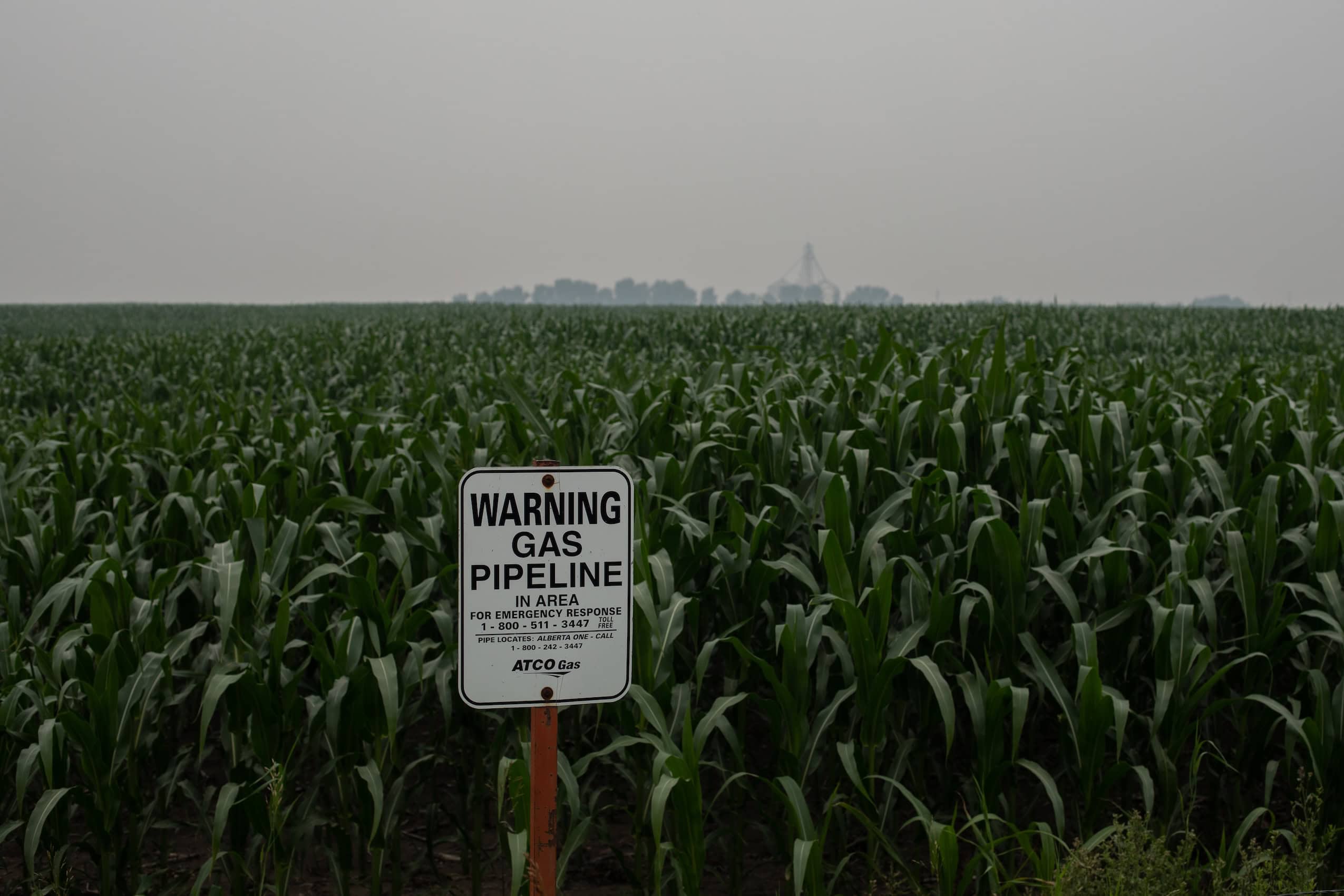
One idea floated in the leaked document is to create a new Crown corporation that could compel private companies to build more natural gas pipelines that could power AI data centres. Speaking on Saturday, Premier Danielle Smith did not disavow that idea. Photo: Amber Bracken / The Narwhal
But the premier did not rule out compelling private companies to build more natural gas pipelines the government deems to be in the province’s best interests.
One day earlier, after The Narwhal broke the news of the leaked document, the office of Alberta Energy Minister Brian Jean issued a statement.“Governments routinely examine a wide range of policy, regulatory and legislative options when considering complex issues, and internal materials do not represent government decisions,” it read.
Is this just a passing idea?
The Narwhal shared excerpts from the document with Shannon Phillips, a former environment minister in the NDP government between 2015 and 2019. Though she is not involved in the current deliberations, speaking from past experience with such documents she said she believes the document outlines a “serious plan.”
“This isn’t just the government blueskying,” she said. “They’re going to move.”
Lori Williams, a political science professor at Mount Royal University, agrees with Phillips. The Narwhal also shared excerpts of the leaked document with Williams.
“This is a fairly well-developed plan with very short timelines, and this isn’t just a discussion about something that might happen someday,” she said based on her review. (Williams is not privy to any internal details about the government’s deliberations.) “This is something that’s got timelines for this month.”
According to the document, the plan went before a high-level cabinet committee on Sept. 10 and is scheduled to be presented to the full cabinet on Sept. 22. The document says it would then move to the government’s legislative review committee to draft new laws on Oct. 15 and then new regulations on Dec. 4.
“The idea that it’s just a speculative exercise is harder to maintain when you’ve got timelines that begin this month,” Williams said.
An internal government source, whose identity is being kept confidential due to professional risk, said the cabinet report is moving forward regardless of the statements made by Smith over the weekend.
A note on trust, integrity and unnamed sources+
This story uses information from sources The Narwhal has agreed not to name. The Narwhal only agrees to keep names confidential when we believe two things. First, that the person we’re speaking with is putting themselves at genuine risk, either personal or professional, by sharing this information with us. Second, that the information they’re sharing is in the public interest. Our decision to do so is never made lightly.
There are two types of unnamed sources. A confidential source is someone whose name we know, but aren’t sharing. We make multiple attempts to verify their identity and information with other sources. If we aren’t able to get a second source, we say so.
An anonymous source is someone whose name we don’t know. It is incredibly rare for The Narwhal to publish a story with a completely anonymous source. In these instances, we don’t publish until we have verified the information shared with us with at least one other source.
And again, these stories must be in the public interest.
As Canadian governments become increasingly secretive, the courage of whistleblowers is to be admired. We value them greatly. At the same time, our promise to readers is The Narwhal will always make sure the facts are airtight.
Have something to share? Send us a story tip.
The Alberta government did not respond to questions about whether it was pursuing the plans outlined in the document by publication time.
What else is the Alberta government saying?
One item in the document raised particular concern for some, and was the focus of a news conference Nenshi hosted the same day The Narwhal published its story: cost for consumers.
The document warns the moves will likely increase costs for Albertans. One estimate in the document suggests the government’s aim is to almost double natural gas prices to support and expand production, which could see the cost to generate electricity rise by 25 per cent. That cost would then be passed down to consumers on their power bills, but the document does not predict those impacts.
On her call-in show, Smith argued the opposite was true.
“If you have constrained gas, and there’s more demand than there is supply, that’s what causes prices to go up,” she said. “And so what you need to do is you need to increase supply so prices stay low.”
That runs counter to estimates laid out in the document, the government’s own ambitions. It also runs counter to outside analysis.

Alberta citizens have expressed opposition to AI data centres in recent months. Here, residents review plans for a massive data centre in the small town of Olds. The data centre, which would have been powered by natural gas and consumed as much electricity as the city of Edmonton, was later rejected by Alberta’s utility regulator. Photo: Gavin John / The Narwhal
How could the plan in this document affect your power bills?
Data centres consume vast quantities of power. One hyperscale data centre can consume as much power as the entire city of Edmonton, or more. That also means they consume vast quantities of natural gas in their power plants.
It’s one reason why the government has explicitly linked increased natural gas demand with the data centre buildout, and argued the increased demand will help natural gas producers and the government’s own bottom line through increased royalties.
Analysis from the Pembina Institute estimates the recently announced Meta data centre near Edmonton alone could add $270 to $460 to electricity bills each year.
Beyond the cost of gas, there is also concern with the potential costs passed down to taxpayers from lawsuits, the construction and operation of pipelines or the creation of a new corporation to oversee the pipeline network.
Sonya Savage, an energy minister under premier Jason Kenney, told the Calgary Herald this week that government interventions in the market can be a big gamble.
“It makes me very nervous, because there is not a great track record,” Savage said in the wake of the document leak.
“But [if] the private sector is not prepared to invest in projects that are in the public interest — and have public merit and benefits — then I’m not opposed to the government looking and researching.”
The Narwhal’s reporters are telling environment stories you won’t read about anywhere else. Stay in the loop by signing up for our free weekly dose of independent journalism.
From The Narwhal | News on Climate Change, Environmental Issues in Canada via This RSS Feed.