

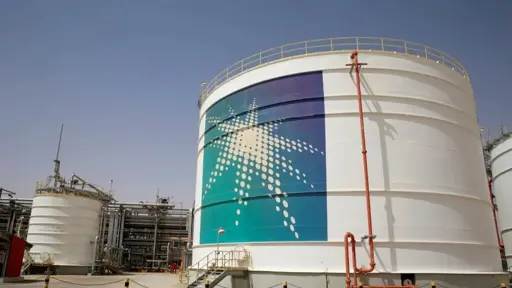
Yemen has recently struck several Saudi vessels, forced dozens more to reroute, and has heavily targeted the kingdom’s energy and military sites
Saudi oil exports have stopped, with none of the kingdom’s ships leaving the Red Sea since Yemen seized the Bab al-Mandab Strait days ago, maritime data, reports, and statements on September 15 confirmed.
The Arabian Business Gulf Insight (ABGI) reported Tuesday that “Saudi Arabia has paused Red Sea oil exports.” It cites maritime data from Vortexa.
“Saudi Arabia has not exported any oil via Red Sea ports since Saturday,” AGBI’s report added.
Vortexa’s senior market analyst Xavier Tang told AGBI that “the situation could ultimately lead to the country becoming a temporary net importer of fuel products.”
The Red Sea port of Yanbu, targeted recently by Yemeni forces, has an export target of five million barrels per day (bpd), according to recent statements by Aramco.
Aramco itself has become a prime target for the Ansarallah-led Yemeni Armed Forces (YAF). Its sites across the country have been struck multiple times in recent days and weeks.
Vortexa estimates say the kingdom currently has 22 million barrels of crude oil stored at Yanbu port, enough “for four to five days” of export at maximum capacity.
“The halt in exports could be due to shipping bottlenecks,” Kate Dourian, a non-resident fellow at the Arab Gulf States Institute, told AGBI.
Mohammad Ayyash, Minister of Transport and Labor in Yemen’s Ansarallah-led Sanaa, said on Tuesday that “Navigation in the Bab al-Mandab Strait has returned to 98 percent,” adding that “the maritime passage is safe for all ships except Saudi Arabian vessels.”
Several Saudi tankers have been hit by the YAF in recent weeks.
According to the YAF, five have been hit in the Red Sea while three others were hit in the Gulf of Oman.
Forty-eight Saudi tankers have been rerouted away from the Bab al-Mandab Strait, according to an August 19 Yemeni army statement.
An unclaimed attack recently targeted Saudi Arabia’s key East–West Pipeline, causing severe damage.
The YAF has also seized multiple Red Sea islands as well as Bab al-Mandab, while capturing much of the western coast from Saudi-backed forces.
Sanaa’s recent escalation of retaliatory operations was prompted by Saudi Arabia’s July attack on Sanaa International Airport, which has been under blockade by the kingdom for more than a decade since Riyadh launched its brutal war on Yemen in 2015 at the head of an Arab coalition.
Yemeni Forces Capture al-Ardhi Port on Bab al-Mandeb: Report
A 2023 Saudi–Yemeni peace process nearly resulted in an agreement between the two sides.
The peace talks stalled but prevented a major escalation from erupting. Yet the kingdom has continued attacks for years and maintained its illegal and deadly blockade of Yemeni ports and airports.
Sanaa has been heavily mobilizing and has vowed to fully expel the Saudi-led coalition from Yemen.
“If the Saudi enemy imagines, after three hundred raids in five days by Saudi aircraft taking off from Khamis Mushait and Taif bases, that its situation will remain secure and stable, it is delusional,” the Yemeni Foreign Ministry said this week.
The statement came after dozens of Yemeni missiles and drones targeted those Saudi bases from which attacks on Yemen have been launched.
Over 300 Saudi strikes in the past six days have failed to halt the ongoing YAF advance.
From Orinoco Tribune via This RSS Feed.