

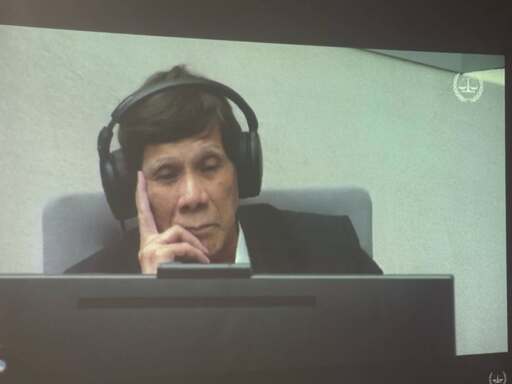
MANILA – On September 15, former president Rodrigo Duterte appeared for the first time at the International Criminal Court (ICC) Trial Chamber during the third status conference for alleged crimes against humanity.
“When I saw Duterte, I felt a sense of relief. Seeing that he was still there in The Hague, unable to leave, gave me some comfort,” Sally Ramos, a Rise Up for Life and for Rights member whose daughter was killed in 2017 by four unidentified men at the height of the anti-drug campaign, said in Filipino.
Duterte wore a black suit and white polo, with his usual hand-on-chin gesture while listening to the proceedings. Presiding Judge Joanna Korner said that he may leave during the case conference but he did not. Seeing him in his usual stature, the victims’ families said that he looked healthy enough to listen and proceed to trial.
“At first, we were surprised when we suddenly saw him. But we’re happy to see him strong and healthy so we can continue to hold him accountable for his crimes against us. Our prayers have been answered,” said Dahlia Cuartero, another member of Rise Up for Life and for Rights, in Filipino. Her son Jesus was killed during a buy-bust operation in March 2019.
The ICC Trial Chamber I ruled that Duterte will remain in detention after a second review by independent medical experts. The chamber found that the risks have increased, including the possibility that Duterte could obstruct or endanger the investigation or court proceedings. With Duterte set to face trial and potentially a lengthy prison sentence if convicted, the chamber said these risks warranted continued detention.
“In respect of the latter considerations, owing to the Prosecution’s submission of the Witness and Evidence Lists, (thereby disclosing the identities of the witnesses and the contents of their expected testimony), this increases the Accused’s ability to interfere with witnesses, either directly or through his family or supporters in the Philippines,” the ICC Trial Chamber I stated in its decision.
The chamber mainly discussed the number of witnesses and list of evidence. Korner said that such a great number is a “warning shot.”
“You may want to think about whether it is possible to reduce the number of witnesses, particularly experts,” Korner told the prosecution, saying that some experts will talk about the same topic.
“For the many reasons that I don’t have to go into, we are very anxious that this [case] concludes as swiftly as possible in the circumstances,” Korner said.
The prosecution’s list is about 15,000 items of evidence. They sought 193 hours to present their case. For the judges, it is a “very lengthy” period. The chamber has not yet decided on the matters discussed but will do so in the next case conference.
Philippine-based human rights organization Karapatan said that the number of evidence and witnesses should be scrutinized. For them, such numbers are proportional to the gravity of Duterte’s alleged crimes against humanity.
“In fact, there should be more. There is a multitude of evidence against Duterte. It may go beyond 15,000 submitted by the prosecution,” Karapatan Secretary-General Cristina Palabay said. “His daily live broadcasts, the documentary evidence submitted, and those documented by the families themselves and those they narrated in the media, the judicial affidavits: all of these are not simple things. For the poor, every step of justice entails resources.”
Independent monitoring from human rights organizations reported that there were at least 30,000 victims of extrajudicial killings during Duterte’s anti-illegal drugs campaign. Government records estimated 6,000 victims. Despite thousands of victims, there are only five prosecuted cases – some of them remain on appeal – based on the monitoring of the Philippine Truth Commission and Amnesty Philippines.
“Duterte’s appearance in court today proves that he has been feigning sick all this time. It was a delaying tactic, delaying justice and delaying healing for the victims’ families,” Fiona Magallanes, convenor of Duterte Panagutin Network – Netherlands, said in a statement.
Duterte’s trial starts on November 30. Before this, the chamber will address pending matters and adopt the procedures necessary to facilitate the fair and expeditious conduct of the proceedings through the status conferences.
“The victims of extrajudicial killings were never afforded legal processes, and justice remains elusive for them in the Philippines. While Duterte is afforded the right of a status conference and panels of experts to see if he is fit to stand trial, thousands of victims, especially poor Filipinos, were killed in cold blood and never allowed to tell their story,” Magallanes said. (AMU, DAA)
The post Duterte appears in ICC case conference appeared first on Bulatlat.
From Bulatlat via This RSS Feed.