

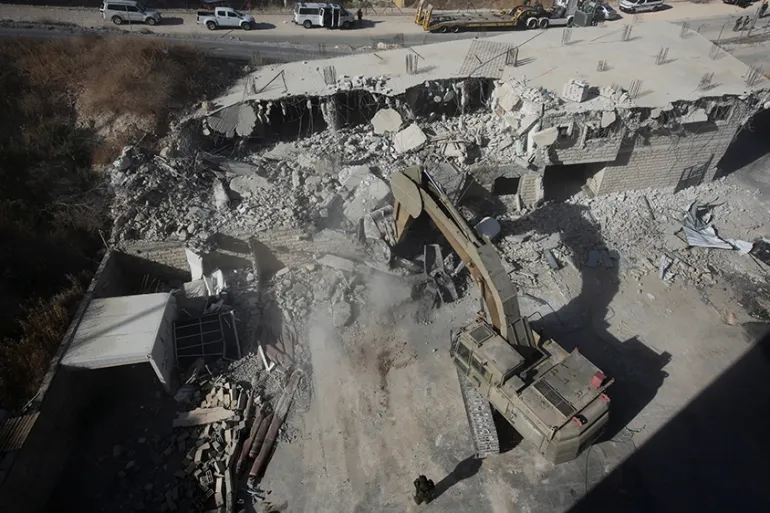
Israel is using AI-based surveillance to monitor Palestinian land and speed up enforcement operations in the occupied West Bank.
Israel is using artificial intelligence to survey Palestinian land and accelerate demolitions in the occupied West Bank, according to researchers, rights activists and Israeli media reports cited by the Turkish outlet PalDigital.
RELATED: 20 Palestinians Die in Residential Building Collapse in Gaza
At the center of the reporting is ImiSight, an AI-enabled surveillance system developed by Israeli weapons manufacturer Rafael. The technology can monitor large areas, detect changes in the landscape and identify structures deemed unauthorized, allowing authorities to move more quickly from detection to demolition.
The system was first used in the Naqab desert, where Palestinian Bedouin citizens of Israel live in villages that are not recognized by the government and where obtaining building permits is difficult. PalDigital reported that authorities used the technology to identify changes deemed unauthorized, with bulldozers moving in to demolish structures in some cases.
Israeli media reported in January 2025 that ImiSight had enabled the Israel Land Authority to survey more than 10,700 square kilometers in the Naqab, contributing to the forced eviction of more than 2,600 Palestinian Bedouin citizens of Israel.
As the world wrestles with the ethical implications of artificial intelligence, Israel has weaponised AI in the occupied West Bank to survey Palestinian land and expedite forced displacement, according to researchers and rights activists.
: https://t.co/H1NLte6wIy pic.twitter.com/A8x88PgPiL
— Al Jazeera English (@AJEnglish) September 17, 2026
The technology has since been brought to the occupied West Bank, where Palestinian homes have for years faced demolition over alleged building violations and where obtaining permits is extremely difficult, according to the reporting.
An Israel Land Authority enforcement unit was established in April 2025 specifically to operate in the West Bank. Israeli rights group Peace Now described the move as a “step of annexation” and said the authority uses advanced AI-based technologies to detect encroachments.
Amir Daoud, head of documentation and publication at the Colonisation and Wall Resistance Commission, described the development as an expansion of a surveillance and eviction model previously used in the Naqab.
“We are talking about transferring a surveillance and eviction model tested against Palestinians in the Naqab to the occupied Palestinian territory,” Daoud told Al Jazeera. “The political danger begins with establishing a district affiliated with the Israel Land Authority to operate inside the West Bank. This means introducing an Israeli civilian government apparatus directly into an occupied territory.”
Faster processing from orbit
Advances in satellite technology are also increasing the speed at which aerial imagery can be processed.
Palestinian digital media and technology expert Khaled Safi said newer satellites can process images using AI while still in orbit, reducing the delay involved in sending imagery to data centers for analysis.
Ver esta publicación en Instagram
Una publicación compartida por Al Jazeera English (@aljazeeraenglish)
“When (powerful computer chips)] and AI algorithms were adopted inside the satellite itself, it practically turned the satellite into an edge computing terminal operating in space,” Safi told Al Jazeera. “It takes the picture, analyses it, identifies changes and important objects, and then sends the result or just the important part to Earth.”
The increased automation comes amid a sharp rise in demolitions in parts of the West Bank and occupied East Jerusalem. Peace Now and Kerem Navot documented an 80 percent increase in demolitions in Area C between 2010–2022 and 2023–2025. Area C is under complete Israeli military and administrative control.
An average of 966 buildings were demolished each year from 2023 to 2025, according to the groups. In 2025, Israeli forces destroyed 1,288 Palestinian structures between January and September alone.
Daoud described AI as a tool that can expand the scale and speed of enforcement operations.
“The algorithm here is a ‘force multiplier’: It scans vast areas, prioritises targets, identifies recent changes and allows a faster transition to warning and demolition,” Daoud stated. “The government makes the decision of decisive displacement, and the algorithm lowers the cost of executing it.”
Automated enforcement network
The surveillance system also draws on information gathered through Israeli settler patrols, drones and cameras. In 2023, the Israeli government allocated 33 million shekels ($9 million) to settler patrols and 40 million shekels ($13.2 million) to equip outposts with drones and cameras.
Safi warned that such systems could reduce human involvement in decisions affecting vulnerable populations.
“The problem is transforming a fateful decision into a probability equation between zero and one, and between a number, an image, and data,” Safi stated. “This allows the criminal to disperse responsibility and escape it, making it fall either on the algorithm, the institution or another unknown entity.”
The use of automated enforcement has coincided with increased settlement activity. Between 2023 and 2025, the Israeli government advanced plans for more than 40,000 settler housing units and established 185 new outposts, according to the source material. During the same period, Israel oversaw the expulsion of 118 Palestinian shepherding communities from the West Bank.
Data from the United Nations Office for the Coordination of Humanitarian Affairs and Peace Now puts the current number of Israeli settlers in the occupied territories at roughly 750,000. Settler violence against Palestinians reached 1,836 attacks in 2025, according to the same data.
The developments also coincide with the launch of an online land registry in Area C, which Palestinian authorities, including the Colonisation and Wall Resistance Commission, have condemned as a digital mechanism intended to finalize administrative annexation.
Daoud contrasted the treatment of Palestinian construction with that of Israeli settler outposts.
“The Palestinian building is discovered early and pushed into a rapid demolition track, while the colonial outpost is funded, connected to services, and then worked on to be legalised retroactively,” Daoud noted.
Safi also pointed to the potential commercial implications for Israel’s defense industry, arguing that the occupied Palestinian territories provide a testing environment for surveillance technologies and AI systems that can subsequently be marketed internationally.
“The Palestinian territories are not just a surveillance space, but a very clear environment for the occupation to execute all these operations in the field,” Safi warned. “It trains its algorithms on the highest technologies, and makes them ready for sale and global marketing to commercial companies.”
From teleSUR English via This RSS Feed.