

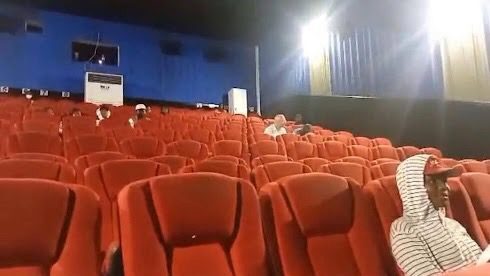

At the end of August, at the Silverbird Cinema in the Accra Mall in Ghana, two Israeli feature films were screened alongside Ghanaian student productions.
For the second year running, the seats for this Israeli film festival were empty. Ordinary Ghanaians declined the Israeli Embassy’s films, and a peaceful demonstration outside held placards for Palestine and against the continued killing of civilians in Gaza.
There is another screen Ghanaians must refuse to look away from, protestors asserted. The screens on which we have watched Gaza reduced to rubble, families displaced again and again, hospitals and schools destroyed, and children carried from the wreckage of a war that, despite the ceasefire announced in October 2025, has not stopped killing them.
However, something else walked through the doors of the film festival: schoolchildren. In uniform. On a Sunday.
Students from Achimota School and Accra Girls Senior High School, two of Ghana’s most prominent public secondary schools, were brought into an embassy-sponsored event at the center of a serious political controversy. Those of us who were there saw them. We have photographs and videos. The question Ghana must now answer is not about cinema. It is about who sent our children, and why.
The 2025 Israeli Film Festival
Last year, the Embassy staged a week-long Israeli Film Festival at the same venue and called it an exercise in “dialogue and mutual understanding.” Nearly 400 Ghanaian organizations, student movements, trade unions, faith communities, civil-society groups, signed one statement calling for a boycott. Protesters gathered outside. Sponsors pulled out. The Embassy still declared the event a success.
The veteran editor Kwesi Pratt Jnr., who joined the picket, recalled what that “success” looked like a year ago for the “Alhaji and Alhaji” program:
“This is the first time in my life that I’ve seen 400 organizations come together to sign one statement calling for a boycott of the film festival. I joined the picket at the Silverbird Cinema, and a few, very, very few, prominent Ghanaians, including Afenyo-Markin, attended in spite of the protest. But it was a fiasco. The room was empty. Ghanaians rejected the film festival completely.”
So the Embassy returned smaller: two Israeli films on a single Sunday, free entry, free popcorn, raffle prizes, and an invitation aimed squarely at young people. When adults again refused to fill the room, uniformed students appeared. If Ghanaian adults will not lend legitimacy to this event, should Ghanaian children be made to supply it?
The timing makes it harder to dismiss as a routine outing.
President John Dramani Mahama has publicly described what is happening in Gaza as genocide. The Israeli Ambassador to Ghana has publicly rejected that position and defended his government’s conduct. He is entitled to make his case, but he is a guest of a sovereign state, not the author of its policy.
Against that backdrop, the presence of uniformed students inside an embassy program, days after this very public disagreement, demands an accounting. Pratt put the question bluntly:
“At the time that the ambassador was attacking our president, some authorities in our secondary schools decided to side with [the embassy]. What judgment was exercised by the school authorities when they agreed to bus their students to this film festival? What were they expecting? What checks did they do on the quality of the films?”

Ghanaian activists picket the Israeli Film Festival. Photo via PATV
Those are the right questions, and they are not rhetorical. They have not yet been answered and there has been no investigation.
What the students deserve
None of this is an accusation against the children. They may have had little understanding of the political purpose around the event. The responsibility belongs to the adults who placed them there.
Ghana rejected the Israeli film festival not because cinema or cultural exchange is evil. Not because Israeli artists have no right to make films. The rejection is not an attack on Jewish people. Antisemitism is hatred and must also be rejected.
The problem is that this festival is not an example of artists meeting freely across borders. It is an Israeli Embassy-backed initiative staged while the Palestinian people continue to pay with their lives. Amid the killing of civilians and the destruction of Palestinian life, the use of state diplomacy to manufacture an appearance of normality while those questions remain unresolved is nothing less than political soft power.
Ghanaian children are not diplomatic props, and Ghanaian schools must never become extensions of a foreign embassy. Teach them, yes. Teach them the Holocaust, the Nakba, occupation and international law, and give them the evidence to think critically. That is education. Busing uniformed children into a controversial embassy function, and letting their presence become evidence of Ghanaian acceptance, is the opposite.
That is why the demand is simple, and now directed at the Ministry of Education and the Ghana Education Service: did you know? If yes, explain. If not, investigate. And if any official bypassed procedure or abused authority to place schoolchildren inside a foreign government’s public-relations exercise, hold them accountable.
Ghana’s revolutionary legacy
There is a longer tradition at stake. Ghana is the country from which Kwame Nkrumah declared that our independence was meaningless unless linked with the total liberation of Africa. Africa understands what cultural normalization is for: domination has rarely arrived only with rifles. It seeks respectability, the reception, the festival, the partnership, until oppression becomes a disagreement to be discussed politely while business continues.
Palestine poses that old question to the African conscience once more. And a small part of the answer is being written by who walks into a cinema in Accra Mall, and who is made to walk in.
For the second year, the empty seats have spoken. Now Ghana’s own institutions must speak. Our children deserve education, not enlistment. And a sovereign state deserves to decide, in the light of its own conscience, what its schools lend themselves to.
Stay away. Let the empty seats speak, for the Palestinian child who will never again enter a classroom, and for the proposition that human life is worth more than diplomatic image-building.
From BT News via This RSS Feed.
You must log in or # to comment.