

The Boston Globe (9/13/26) reports that there is “significantly less tension and fear over speech controversies” at Harvard—which is not the same thing as more free speech.
The Boston Globe (9/13/26) ran an article contrasting two Boston-area universities’ approaches to campus free speech. Penned by higher education reporter Mike Damiano, the piece reads like an installment of Highlights for Children‘s didactic “Goofus and Gallant” feature, with one school clearly doing it right while the other is letting down the cause of free speech.
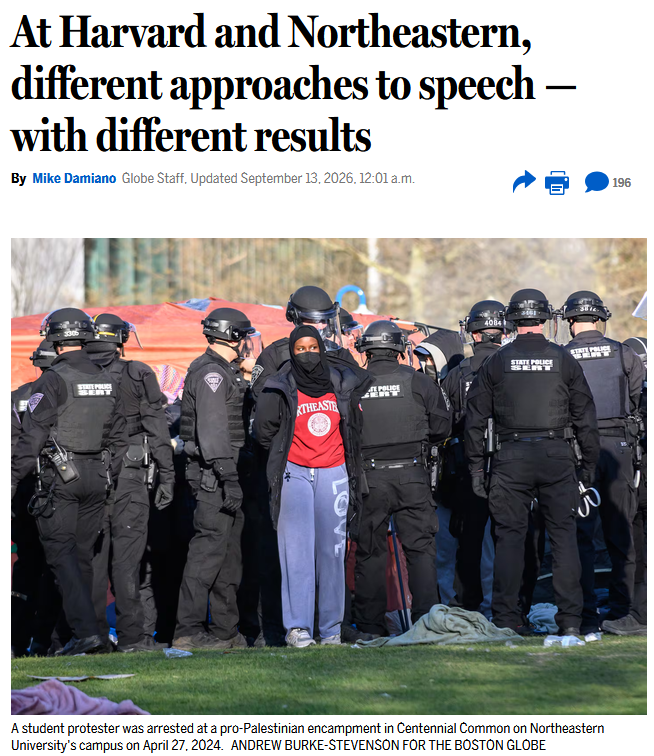
Northeastern University plays the role of the loathsome Goofus, with critics remarking that the “school’s leaders have taken a hands-off approach to speech issues since cracking down on a pro-Palestinian protest encampment more than two years ago.”
Meanwhile Harvard, in Gallant fashion,
undertook a multi-year experiment in remaking campus speech norms with top-down reforms, resulting in what students and professors describe as a kind of thaw on a campus where tensions over politics, ideology and speech had thrust it into an acrimonious national debate.
That certainly makes it sound better than Northeastern’s “hands-off approach.” But you have to ask: What did Harvard’s leadership actually do for speech when they put their hands on it?
Well, for one thing, “they have nudged teaching fellows and professors to keep their personal politics out of the classroom.” Huh—telling faculty not to talk about their politics does not actually sound like promoting free speech.
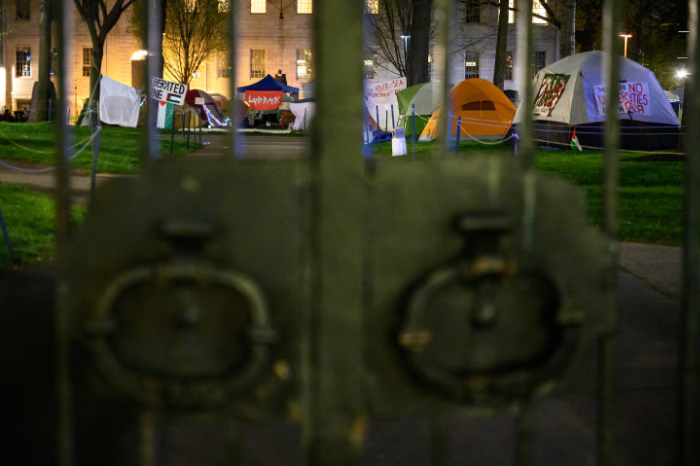
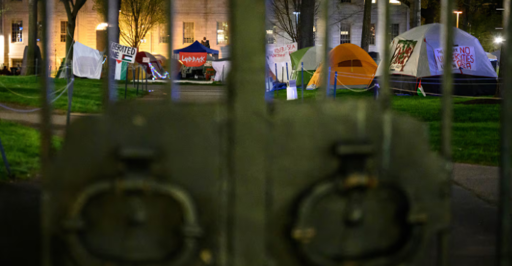
During the Gaza encampment, Harvard locked the gates of Harvard Yard for six weeks—and it locks them again whenever the danger of political speech rears its ugly head. (Boston Globe photo by Andrew Burke-Stevenson.)
Also, “they have pushed for rules for campus events and classrooms requiring participants to promise not to disclose after the fact who said what.” Likewise, muzzling students who want to discuss each other’s speech is not a free speech policy.
Another rule that’s praised is “Harvard’s policy of institutional neutrality, which discourages university leaders from taking public positions on contentious issues.” In this case, it’s a mandate for self-censorship that’s presented as protection of free speech.
The university, the Globe reports approvingly, “is now recruiting professors representing viewpoints that are scarce at Harvard.” As this is all under the shadow of “the second Trump administration’s bitter fights against schools it deems intolerant to all but leftist ideology*,*” you can rest assured that those “scarce” viewpoints are on the right—the kind that will demonstrate “tolerance” to the White House.
Needless to say, hiring staff based on their acceptability to your country’s ruling party—which necessarily means not hiring other people because their politics are not so acceptable—is not a project for free expression.
How can it be that this series of speech restrictions is hailed by the Globe as “efforts to improve the climate for speech”? It has to do with the way the problem is framed: “How to get students and professors to speak freely when they have reason to fear the consequences?” It’s clear from context that the kind of consequences the Globe is talking about involve not being invited to parties or to join clubs, and the like.
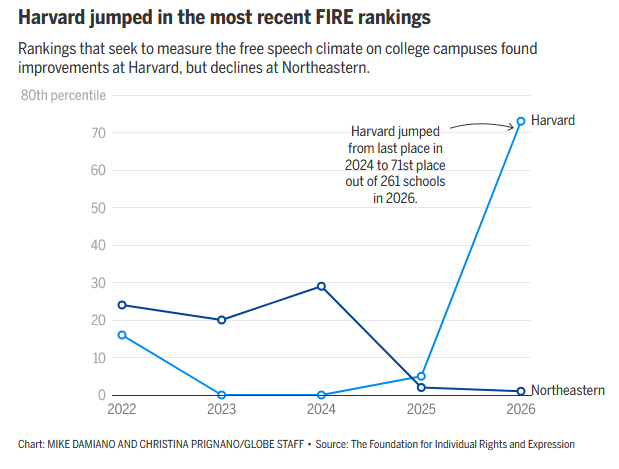
The Boston Globe (9/13/26) noted that in the latest rankings from the Foundation for Individual Rights and Freedom, “Harvard leapt into a respectable 71st out of 261 schools.” The paper didn’t note that this resulted from FIRE changing Harvard’s rating from an F to a D.
If you view as the big danger to free speech the fact that speech may have such social consequences, it follows that protecting people from those consequences is imperative. Social consequences often take the form of speech; the article cites concerns about being “shamed on social media,” or being called “weird” or “conservative.” Thus is born the impulse to suppress free speech in order to save it (FAIR.org, 3/4/25, 10/3/25).
The thing is, speech is supposed to have social consequences. If you say, “Adolf Hitler is my hero,” that should change the way people talk about you, right? Many people believe that if you say you support a nation that is currently engaged in genocide, or a president who is actively trying to dismantle democracy, that should affect the conversation about you as well.
Efforts to police the speech-based consequences of speech in the name of free speech are a fool’s errand. There are other, more serious kinds of consequences for speech, though—like when Harvard suspended five students and put more than 20 others on probation over their participation in an encampment against the genocide in Gaza; 12 seniors weren’t allowed to get their diplomas with their class (Harvard Crimson, 5/17/24).
Harvard has a non-discrimination policy that incorporates the International Holocaust Remembrance Alliance (IHRA) definition of antisemitism, which means that Harvard students can be sanctioned for saying that the formation of Israel was a racist project, or comparing Israeli genocide to the tactics of the Third Reich.
These are consequences for speech that Harvard could do something about directly—by not imposing them. But the Globe notes that the university’s rules governing student protests, which “some consider affronts to speech rights,” remain in force. That this doesn’t keep the paper from treating Harvard as the school doing the right thing on free expression just shows how low the media’s bar on campus free speech has gotten.
From FAIR via This RSS Feed.