

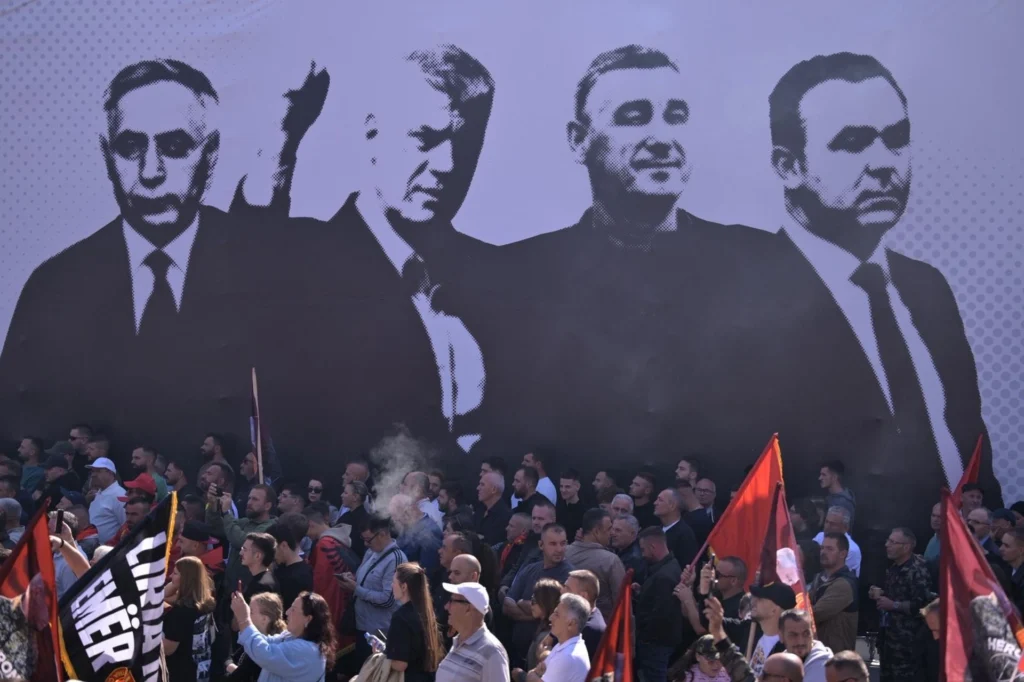
The Special Tribunal for Kosovo (STK), based in The Hague, has sentenced this Wednesday former Kosovo President Hashim Thaçi to 25 years in prison for his involvement in war crimes committed between 1998 and 1999.
The Court found Thaçi guilty of participating in a “joint criminal enterprise” within the Kosovo Liberation Army (KLA), which targeted political opponents and individuals perceived as collaborators with the Serbian government. The tribunal held Thaçi responsible for the arbitrary detention of at least 385 people, cruel treatment of 49, torture of 303, and the murder of 96 individuals.
RELATED: Kosovo President Denies that the Kosovo Liberation Army Committed War Crimes
The verdict, delivered by a panel of judges led by Charles Smith, also implicated three other former KLA leaders: Kadri Veseli, Rexhep Selimi, and Jakup Krasniqi. Veseli, the former head of KLA intelligence, was convicted for his role in identifying and selecting targets based on unverified accusations.
Selimi, the former inspector general, was found guilty of tolerating severe violations of international humanitarian law. Krasniqi, the former spokesman and deputy commander, was held accountable for issuing communications that promoted the persecution of opponents.
This is the moment the international tribunal in The Hague read the verdict to former Kosovo Liberation Army commander and later Kosovo President Hashim Thaci. He was found guilty of war crimes and sentenced to 25 years in prison.
The 58-year-old Thaci and three other former… pic.twitter.com/E7C5zb36n9
— Radio Free Europe/Radio Liberty (@RFERL) September 16, 2026
Charges Absolved
The tribunal absolved Thaçi and the other defendants of six charges related to crimes against humanity, stating that there was no evidence of a systematic attack on the civilian population.
Judge Smith emphasized that the trial did not question the legitimacy of Kosovo’s independence movement or the KLA’s cause but rather focused on the criminal methods and systematic violence used against defenseless individuals.
The reading of the verdict sparked immediate protests in both The Hague and Pristina, Kosovo’s capital. Hundreds of supporters gathered outside the courthouse and in the streets, holding banners and proclaiming the innocence of the defendants. They described the KLA’s actions as a liberation struggle. Political figures and parties in Kosovo, including the Democratic Party of Kosovo (PDK), condemned the ruling as unjust and influenced by hostile narratives.
Cheers in Prishtina as The Hague drops two main charges: war crimes and crimes against humanity against Thaçi and others. pic.twitter.com/zIZMUl6i3b
— Xhemajl Rexha (@xhemajl_rexha) September 16, 2026
Independence and Legal Aftermath
The political and territorial dispute between Serbia and Kosovo dates back to the dissolution of Yugoslavia. In 1999, NATO bombed Serbia, forcing Belgrade to withdraw its forces from Kosovo. The region then came under the provisional administration of the United Nations. In 2008, Kosovo unilaterally declared its independence, though parts of the international community do not recognize it as an independent state, viewing it as part of Serbia.
The conviction of Thaçi and the other former KLA leaders marks a significant moment in the ongoing conflict and its legal aftermath. Thaçi’s defense team announced plans to appeal the verdict.
The trial has brought to light the atrocities committed during the Kosovo War and has sparked renewed debate about the legitimacy of the KLA’s actions and the future of Kosovo’s independence.
From teleSUR English via This RSS Feed.