

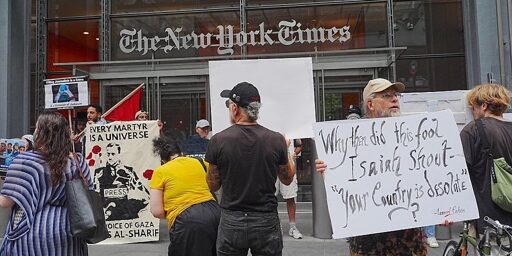
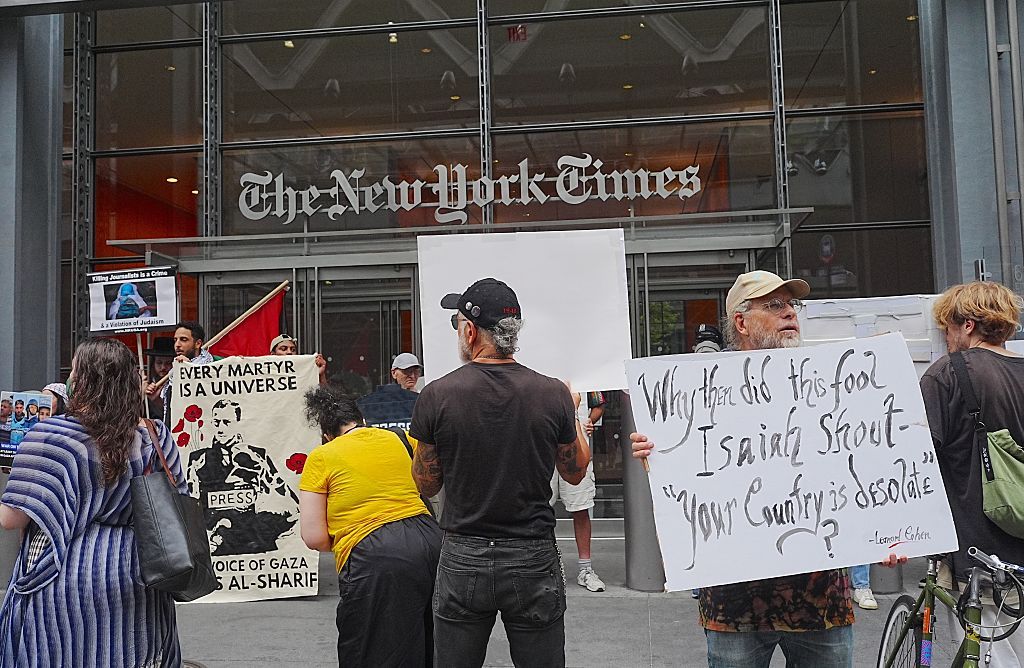
Protesters picket the New York Times to demand justice for Palestinian journalist Anas Al-Sharif and other journalists killed in Gaza by Israel, on Aug. 10, 2026, in New York City. Photo: Selcuk Acar/Anadolu via Getty Images
The New York Times recently published a sweeping accounting of President Donald Trump’s campaign against the American press: FBI agents arriving at reporters’ homes, subpoenas for journalists’ records, Pentagon access restrictions, regulatory pressure on television networks, numerous lawsuits against news organizations, and an increasingly politicized Federal Communications Commission.
“Almost 20 months into Mr. Trump’s second term, his long-running media clashes have grown into a sweeping campaign to control speech in America that stands out for applying so many levers, so fast, all at once,” Times reporters Maggie Haberman and Jim Rutenberg wrote. “Each time the president assails what has long been considered protected speech … he is eroding norms and undercutting the role of an independent press.”
All told, it is a damning inventory.
It is also difficult to read without noticing who occupies almost every frame: Us.
Reporters. Editors. Television hosts. Networks. Publishers. Their lawyers. And the access our industry has become so reliant upon.
[
Related
Amy Goodman on the Media’s “Access of Evil”](https://theintercept.com/2026/04/14/amy-goodman-democracy-now-independent-media/)
The Times is right about the threat. Trump has indeed weaponized government agencies and private litigation against news organizations in ways that seriously threaten the First Amendment, although judges have repeatedly rebuked parts of the administration’s legal strategy. But Trump’s attacks on free speech have extended well beyond the journalism, from ICE protesters in Los Angeles to faculty in solidarity with Palestine on college campuses. But somewhere along the way, the American press began conflating two things: press freedom, with the conditions under which the press had become accustomed.
Those are not the same thing.
Free speech was never free.
It was wrested loose. Sharpened and stretched, stifled and reborn, often on the backs of those who put the pain and personal safety of others ahead of their own.
Somewhere along the way, the American press began conflating two things: press freedom, with the conditions under which the press had become accustomed.
In 1892, a little more than two decades after the nation wrenched itself back together from war, Ida B. Wells challenged the lies white Memphis terrorists used to justify lynching Black men in her newspaper, the Memphis Free Speech and Headlight. In retribution, a mob ransacked her office and destroyed the paper’s printing equipment. Wells happened to be away. Threatened with death if she returned, she continued her investigation from the North. There was no White House Correspondents’ Dinner, no presidential press core podium to be invited to, no shining press awards. As a Black woman, she couldn’t even vote; in her isolation, her best job security was to carry a pistol.
“It is with no pleasure I have dipped my hands in the corruption here exposed. Somebody must show that the Afro-American race is more sinned against than sinning, and it seems to have fallen upon me to do so,” she wrote in her book on the excruciating personal trade-off she made to pursue her work: perspective. Her fear, exhaustion, and isolation existed beside something larger: actual bodies, tangible violence, and lived injustice.
I will be candid: Melancholy abounds. I write this as a journalist who has grown depressed while slinking through the yearly industry conferences, newsrooms, and brown bag luncheons. There is a palpable dread to most discussions, with an acknowledgment that the world is less fair, less stable, and overwhelmingly more difficult.
We talk about everything. Except the necessity to win, and most importantly, for who.
Israeli airstrikes and other attacks are still killing and displacing Palestinians in Gaza, where the United Nations reported last month that medical shortages and restrictions on critical supplies continue to undermine an already devastated health system. In the West Bank, settler violence, backstopped by the Israeli military, is a daily and growing threat. Israel’s war on Gaza has now killed nearly 300 journalists — more news gatherers than in both world wars, Vietnam, Yugoslavia, and Afghanistan combined.
[
Related
The New York Times Repeated Israeli Claims of Hamas Stealing Aid Without Evidence](https://theintercept.com/2025/07/30/new-york-times-hamas-aid-israel-gaza-famine/)
The Times in particular has done more than almost any other media outlet to launder the justification for this ongoing death and destruction, and to police the language we’re allowed to use when discussing it, which didn’t warrant any mention in its attacks-on-free-speech roundup.
In the U.S., ICE arrests reached nearly 51,000 in August alone as the Trump administration dramatically expanded immigration enforcement. Many of those being detained had no criminal record, while courts continue battling out the administration’s detention practices. A Department of Homeland Security watchdog reported on Monday that immigrants at Florida’s now-defunct “Alligator Alcatraz” prison were confined for more than an hour at a time in outdoor metal cages known as “calming areas” that were barely larger than a phone booth.
Government coercion and obfuscation is difficult; it doesn’t hold a candle to death, subjugation, and the powerlessness of victimization.
[
Read our complete coverage
Chilling Dissent ----------------](https://theintercept.com/collections/chilling-dissent/)
As Wells put it, I’ve had the displeasure of covering a national violence, I’ve also had the displeasure of living it.
There is nothing in my day job that can match the pain, or permanence, of a loved one ripped from your household, the lifelong inequity of being racially outcast, or the haunting mental anguish those events leave behind as an inheritance.
As a result, there is a vibrating dis-ease — something close to nausea — in listening to tales of journalists ground under the boot of power, only to hear complaints of our own injury grow so loud that it begins to obscure the suffering beyond us. Maybe that is part of the point of these attacks in the first place: Hurt us until our wounds become the horizon. Hurt us into forgetting those hurt more.
We need to fight even harder for truth, not because journalists are the principal victims of its erosion, but because the people paying a far higher price outside the newsroom’s walls are the reason we do this work at all.
Those starved in Gaza at the United States’ discretion. Those suffering and dying around the world after our medical aid is withdrawn. The millions of Americans living a crisis away from ruin because they were stripped of their healthcare.
We need to fight even harder for truth, not because journalists are the principal victims of its erosion, but because the people paying a far higher price outside the newsroom’s walls are the reason we do this work at all.
That discrepancy may also help explain why Americans increasingly roll their eyes when journalists describe threats to journalism as threats to democracy.
[
Related
Scott Pelley Shows How Legacy Media Got It Wrong — Before Bari Weiss Made It Worse](https://theintercept.com/2026/06/11/bari-weiss-scott-pelley-60-minutes-cbs-news/)
In 2025, Gallup found that only 28 percent of Americans trusted newspapers, television, and radio to report the news fully, accurately, and fairly — the lowest level ever measured. When Gallup began asking the question in the 1970s, the figure ranged between 68 and 72 percent.
There are many reasons for that collapse, from deepening partisanship and a fragmented information ecosystem to the hollowing out of local news.
But I understand some of the suspicion.
I understand why nobody wants to invest in a product from an industry that refuses to admit it wants to win.
And by “win,” I mean something journalists have become strangely embarrassed to admit it we want: to make it harder to abuse human beings without anybody knowing.
There is nothing neutral about that mission.
And there never was.
Perhaps the mistake comes from imagining freedom, and by proxy freedom of press, as a possession rather than a practice.
Perhaps the mistake comes from imagining freedom, and by proxy freedom of press, as a possession rather than a practice — a right handed down and intact, rather than a capacity that must be worked, tested, and fought for when the cost of exercising it rises.
In his 1951 book “The True Believer: Thoughts on the Nature of Mass Movements,” writer Eric Hoffer captured the appeal of fascism in five unsettling words, uttered by an ardent young Nazi: “to be free from freedom.” He used the quote to examine an uncomfortable possibility — that freedom may not be innate to the human mind, but something closer to muscle — strengthened under strain, grown through resistance, and, if left unused, atrophied.
Press freedom lives under the same rule. Its value is not measured by how easily journalists can exercise it, but by what survives when power becomes hostile.
Our charge is to comfort the afflicted and afflict the comfortable. Journalists’ own comfort was never part of the equation.
The post The New York Times Conveniently Forgets the Real Stakes of Attacks on Free Speech appeared first on The Intercept.
From The Intercept via This RSS Feed.