

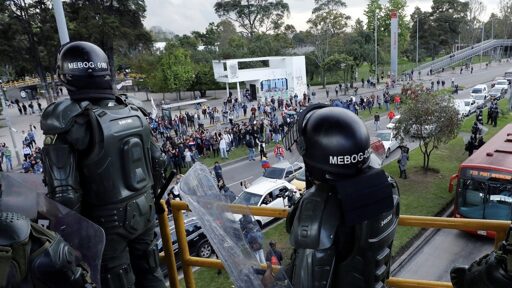

A little over a month into his term, far-right President Abelardo de la Espriella continues to advance a security agenda that often conflicts with certain rights historically won by Colombians.
This time, De la Espriella has signed a decree allowing police access to university campuses. In several Latin American countries, the prohibition of police access to universities has been established through student struggle to prevent abuses by authorities against student movements.
Thus, universities have historically become places where students seek refuge from repression, arrest, and regroup during times of intense social mobilization.
This was evident during the 2021 protests, known as the “National Strike,” in which students, workers, left-wing political parties, young people, and others took to the streets to protest against the right-wing government of Iván Duque. The mobilization, which lasted several months, was considered a true “social upheaval,” and many experts have seen in it the consolidation of a democratic alternative (the government of Gustavo Petro) to decades and decades of right-wing rule.
During these protests, universities became hubs of popular mobilization, driven primarily by the youngest members of society. On university campuses, protesters were able to regroup, defend themselves against police repression, and coordinate new demonstrations – among other things – always protected by the fact that police are barred from entering university grounds.
De la Espriella calls popular protests “terrorism”
Clearly, De la Espriella seeks to nip this possibility in the bud – that is, to prevent universities from once again becoming coordination centers for the protests. Many have speculated that the president is signing this decree precisely because he knows that his radical neoliberal agenda could spark major protests, and in this way, he hopes to proactively undermine the protest movement.
Read more: One month of De la Espriella’s administration in Colombia
Whether or not this is De la Espriella’s primary intention, only time will tell. What is certain is that the president views university autonomy as an obstacle to the implementation of his security agenda, which also includes curtailing the ability of informal opposition political groups to participate in public life.
“Under no circumstances will I allow public universities to continue to be sanctuaries of violence. I respect and guarantee peaceful protest, but I will not allow universities to continue to be used as sanctuaries of vandalism and crime,” said De la Espriella on X.
Furthermore, true to his combative rhetoric, he compared social protests to terrorism – a common trope in the historical discourse of the Colombian right: “University autonomy is not a blank check for impunity: I have issued precise instructions for a national protocol of action that allows us to distinguish between the legitimate exercise of protest and acts of violence, flagrant offenses, danger, or extraordinary disturbances of public order that require intervention by the authorities. The university is for knowledge and ideas, not to serve as a refuge for violence and terrorism.”
A violation of the Constitution
However, the opposition has viewed this decision as a serious attack on university autonomy. Ana Erazo, a member of the House of Representatives from Valle del Cauca, wrote: “It is an ATTACK ON UNIVERSITY AUTONOMY and a direct threat to the young people at the country’s public universities. With this, Mr. Abelardo de la Espriella is beginning to reveal what could become a BRUTAL RETALIATION against the student movement, against its ability to organize and mobilize, and against thousands of young people who historically have not supported his political agenda.”
Some universities have joined in this criticism. One of them is the National Pedagogical University, whose academic council stated that in the past, “the serious consequences of resolving conflicts within public universities through militarization have been demonstrated on repeated occasions.” Furthermore, the council stated that university autonomy is one of the pillars of Colombian democracy, along with freedom of thought and research, among other things. Losing autonomy means jeopardizing these values of the republic, it stated.
For his part, former presidential candidate Iván Cepeda said that De la Espriella’s measure contradicts Article 69 of the Constitution, which guarantees university autonomy. Regarding the announcement, Cepeda also said: “Such an announcement is not only an affront to university autonomy. It also demonstrates, once again, the authoritarian and despotic nature of De la Espriella, who seeks to stigmatize, persecute, and violate the rights of Colombian youth and the university community. Colombia has not forgotten the victims of police abuse during the National Strike, nor the history of security forces intervening on university campuses, resulting in student deaths. Young people cannot once again be persecuted or treated as an internal enemy and an enemy of the state.”
From BT News via This RSS Feed.