

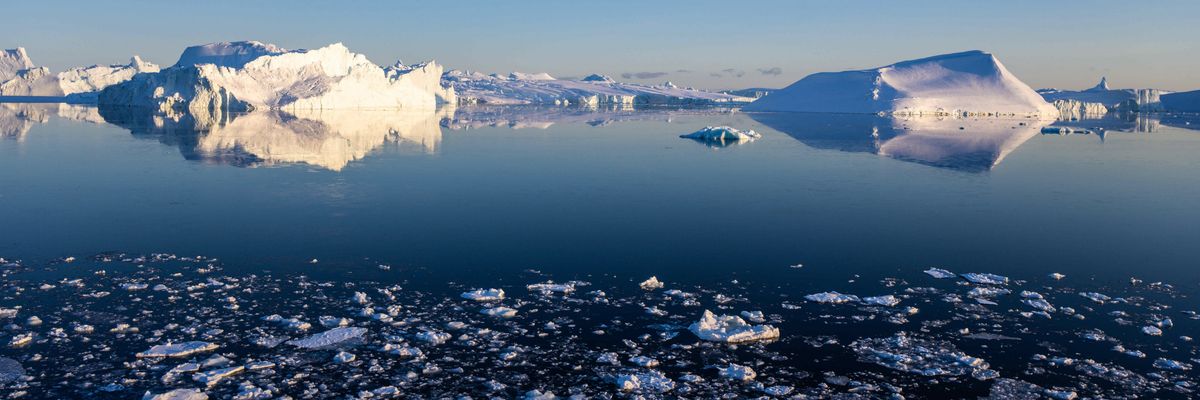
Following fresh warnings from scientists about governments not doing nearly enough to cut fossil fuel pollution and what that could mean for the warming planet, an international team of experts on Wednesday published “the most complete picture of ice loss from Greenland and Antarctica to date.”
The polar scientists compared and combined 42 independent estimates derived from satellite observations for Earth’s two main ice sheets to determine their gains and losses from 1972 in Greenland and 1979 in Antarctica until 2023—then released their findings in the journal Scientific Data.
The Ice Sheet Mass Balance Inter-comparison Exercise (IMBIE) team found a collective loss of about 11.3 trillion metric tons, or 12.5 trillion US tons.
Inès Otosaka, the professor from England’s Northumbria University who led the study, told Reuters that “to put this very large number into context, 11.3 trillion tons of ice is enough ice to fill in a cube that would be 23 kilometers (14.3 miles) in height.”
The Associated Press pointed out that it is also “enough frozen water to stack ice 5 feet (1.5 meters) deep across the continental United States.”
The ice loss led to around 3.1 centimeters, or 1.2 inches, of global sea-level rise. Study co-author, IMBIE founder, and Northumbria professor Andrew Shepherd said in a statement that the figure “may sound small, but that puts another 6 to 9 million people at risk of coastal flooding and erosion.”
The study stresses that “since the 1990s, the pace of ice loss from the Antarctic and Greenland ice sheets has accelerated, contributing to the increase in global mean sea-level rise, with the ice sheets now representing almost a quarter of global sea-level rise.”
“Our dataset shows that Antarctic mass loss continues to be dominated by ice discharge from West Antarctica,” the scientists explained, “rising in every decade of our record,” from 29 billion metric tons per year in the 1980s to 163 billion in the 2010s. Across the ice sheet, that rate rose from 48 metric tons in the 1980s to 202 billion in the 2010s. The team estimated that during the study period, Antarctica lost a total of 4.78 trillion metric tons.
“Greenland was close to a state of balance in the 1970s but started to lose mass in the following decades,” they explained. While the ice sheet lost about 60 billion metric tons annually in the 1980s and 57 billion in the 1990s, “losses then accelerated, reaching a rate three times higher in the 2000s,” at 192 billion metric tons, and climbing to 264 billion in the 2010s. Overall, Greenland lost 6,215 trillion metric tons of ice from 1972 to 2023.
TK said that “by reaching back to the 1970s, we can now see how the ice sheets have changed across half a century. More than four-fifths of the ice lost was discharged into the ocean by faster-flowing glaciers, rather than melted at the surface—which tells us the long-term trend is being driven by the dynamic response of the ice sheets to a warming ocean.”
International scientists have previously found that the ocean stores an estimated 91% of the heat from excess greenhouse gases, and the rate of ocean warming has more than quadrupled over the past four decades, as humanity has largely ignored experts’ warnings to urgently phase out fossil fuels.
The new study was released less than two months ahead of the next United Nations Climate Change Conference (COP31) in Türkiye—where recent deadly fires have reignited demands for a swift global transition away from fossil fuels and stronger efforts to prepare vulnerable communities around the world for what UN scientists now warn is an inevitable, but potentially temporary, overshoot of the Paris Agreement’s 1.5°C target for temperature rise this century.
Otosaka told Reuters that “when ice sheets melt, they contribute to rising global sea levels. And with every additional centimeter of sea-level rise, about 2 to 3 million people are put at risk of annual coastal flooding.”
“These findings have implications for coastal planning,” she added, “showing that we urgently need to develop plans for protecting coastal communities around the world from the impact of ice sheet melting.”
From Common Dreams via This RSS Feed.