

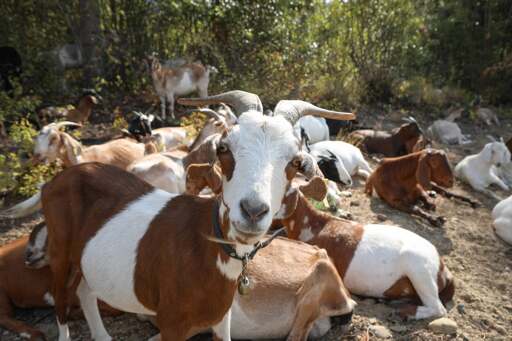

Wildfire fighting goats are pictured in Kanaka Bar, B.C., on Sept. 1, 2026. Photo by Aaron Hemens
This article has been co-published with the Narwhal as part of their 2026 Indigenous journalism fellowship
On a grassy slope in Kanaka Bar, a herd of goats frolic and play. But this isn’t a farm or a petting zoo — it’s an innovative wildfire mitigation effort from the First Nation.
Some of the goats loudly bleat as they chow down on invasive species and overgrown brush.

A wildfire fighting goat eats vegetation in Kanaka Bar, B.C., on Sept. 1, 2026. Photo by Aaron Hemens
“In the last five years, Kanaka community has been experiencing devastation with fire,” Pauline Michell said.
That includes two evacuations due to wildfires, as well as floods and mudslides that have closed roads and cut off her community from the world. And in Kanaka Bar, there is no fire truck or fire hall.
“Kanaka has solely been on its own in regards to fire,” said Michell.
Located in Nlaka’pamux territory, twenty kilometers south of Lytton, Kanaka Bar Indian Band also goes by T’eqt’ aqtn’mux, “the crossing place people.”

A helper greets one of the wildfire fighting goats in Kanaka Bar, B.C., on Sept. 1, 2026. Aaron Hemens/The Narwhal
In 2021, the Lytton Creek wildfire devastated the area, evacuating numerous First Nations for years at a time, while burning structures and homes to the ground.
Later that year, an atmospheric river raged through the Fraser and Thompson Rivers, washing out roads and cutting people off from leaving Kanaka Bar.
According to a new report from the office of the B.C. Human Rights Commissioner, between 2000 and 2024, First Nation reserves accounted for 36 of 37 communities where at least half of the total land area was burned by wildfire, with the only non-reserve community being Lytton.

Vegetation that had been previously grazed by wildfire fighting goats, near the entrance to Kanaka Bar, B.C., on Sept. 1, 2026. Photo by Aaron Hemens
Further, First Nation reserves in “B.C.” are four times more likely to be impacted by wildfire than non-reserve communities.
This prompted Michell, an elected councillor in her community, to take a proactive approach to the wildfire season.
For eight weeks starting in late July, a herd of goats ate their way through the Kanaka Bar Indian Band, targeting areas with built up fuel and brush that would burn up in a fire.

A wildfire fighting goat eats vegetation in Kanaka Bar, B.C., on Sept. 1, 2026. Photo by Aaron Hemens
About 80 goats have been clocking in this summer, while a few goats — like Dandelion and Cuddley — are part of a rebel club in their own separate enclosure.
“This is a trial for Kanaka, to look at fuel management in this way,” said Michell.
“Hearing about these goats being able to do this sounded really intriguing and interesting, they’ve been here for about a month now.”

Wildfire fighting goats are pictured in Kanaka Bar, B.C., on Sept. 1, 2026. Photo by Aaron Hemens
The idea came by accident, after an area grazed by sheep acted as a fire stop during a wildfire three years prior.
“Back in 2023, the Kookipi Creek fire came through … we had been grazing the sheep that we had out in this back area, and when that fire came through, it actually came pretty much all the way down to community, and then it stopped where the sheep had been grazing,” Emma Bryce said.
She recalled thinking, “This is really cool, we just kind of made our own fire break without really intending to.”

Emma Bryce, the lead for a project of goats fighting wildfires, is pictured with the goats in Kanaka Bar, B.C., on Sept. 1, 2026. Photo by Aaron Hemens
Bryce has been the nation’s food self-sufficiency lead since 2022, and after the sheep experience, started researching different animals to graze in the community.
“In conversations with chief and council, I brought it up and was like, ‘What if we used goats to do wildfire risk reduction?’ They were like, ‘okay, let’s do it,'” she said.
“This goat grazing project has been a passion project of mine for the last couple of years,” Bryce added, after she took the green light from Kanaka and ran with it. That’s when she met Bruce Bradley, who does contract work across “B.C.” with his herd of goats.

Bruce Bradley of BC Timber Goats holds one of his baby goats in Kanaka Bar, B.C., on Sept. 1, 2026. Photo by Aaron Hemens
Based on “Vancouver Island,” it took three trips by ferry to bring his herd to the mainland and then to Kanaka Bar this summer. But the Ainslie Creek and Brunswick Creek wildfires impacted initial operations back in July.
As of Sept. 11, those wildfires remained burning 31 kilometers down the road from Kanaka Bar, though they are now contained. Once it was safe, the goats got to work.
Goat grazing benefits for biodiversity and wildfire
The goats have grazed about 12 hectares of ground since arriving in the community earlier this summer, covering about a quarter-hectare per day.
“We’re trying to get in all the nooks and crannies, especially around the houses and around the roads, the important spaces to make them more defensible and resilient to fire,” Bradley said.

A wildfire fighting goat eats vegetation in Kanaka Bar, B.C., on Sept. 1, 2026. Photo by Aaron Hemens
On top of reducing wildfire risk, “the ecological benefits are huge because the goats are trampling, they’re fertilizing … and they’re especially effective for invasive weeds.”
“We’ve tackled this year quite a bit of Canadian thistle, Himalayan blackberry and Scotch broom.”
Bradley’s been deploying his fire-mitigating goats since 2018, through his company BC Timber Goats.
“It’s a very unique tool, and I think a powerful tool to get wildfire risk reduction benefits and silviculture benefits on the same site, at the same time,” he said.
According to the provincial government, silviculture is “the thoughtful, deliberate and balanced management of forests and surrounding local ecosystems” that encourages tree diversity to increase resilience against threats like pests, climate change and disturbances.
The idea to start a goat grazing business came from Bradley’s experience in farming.

A baby goat pictured in Kanaka Bar, B.C., on Sept. 1, 2026. Photo by Aaron Hemens
“I grew up on a farm that had lots of weed control issues. I’d always spray and mow, and we’d break the mowers. I’d get sick with the spray and so I thought, there’s got to be a better way,” he said.
Bradley said that in areas of the farm sprayed with pesticides, “everything would just turn brown, and half the time it would burn in wildfire in the summer.”
Goat grazing achieves similar outcomes as pesticide use but is much healthier for the environment.
According to the University of Calgary, which piloted a goat-grazing project at their main campus last year, “targeted grazing is a proven land-management technique that uses livestock to naturally control vegetation growth. Unlike herbicides, which can have a lasting environmental impact, goats provide a natural way to reduce unwanted plant growth while encouraging native vegetation to thrive.”

Burnt forestry as a result of wildfire in the mountains above Kanaka Bar, B.C., on Sept. 1, 2026. Photo by Aaron Hemens
Animals grazing through southern Interior communities has become less common with wildlife populations declining.
“Using goats actually mimics what you would have typically seen if you had large herds of elk moving through … Goats mimic a natural system that this landscape would have evolved with already,” Bryce said.
An addition to the FireSmart toolbox
Over the summer, the goats have been working alongside Kanaka Bar’s fuel management crew.
As the FireSmart team gathers fuel and brush into a pile, the goats eat until it’s gone. It’s a win-win situation: feeding the goats and disposing of the community’s built-up fuel.

A baby goat pictured in Kanaka Bar, B.C., on Sept. 1, 2026. Photo by Aaron Hemens
“I don’t think there’s ever going to be a scenario where we don’t need people out on the ground, going out and doing the bigger fuel management,” Bryce said, adding goat grazing complements other fuel management strategies.
“They can go in and defoliate, which is great to have more visibility when you’re out there working in really dense brush,” she said.
“The goats are going in and doing a really efficient job at something that is really challenging to do with just human crews alone.”
When the project was first brought forward to the community, residents were interested in learning more about it, but not exactly excited about goats. That quickly changed.

Wildfire fighting goats are pictured in Kanaka Bar, B.C., on Sept. 1, 2026. Photo by Aaron Hemens
“Now it’s to the point where members want a couple of goats to tackle the brushes in their yard as well, so that’s really good,” said Michell.
“When wildfire comes to Kanaka, we’ll be more prepared.”
The post Call in the goats: Kanaka Bar calls on herd for help with wildfire risk appeared first on Indiginews.
From Indiginews via This RSS Feed.