

By Susana Bejarano – Sep 13, 2026
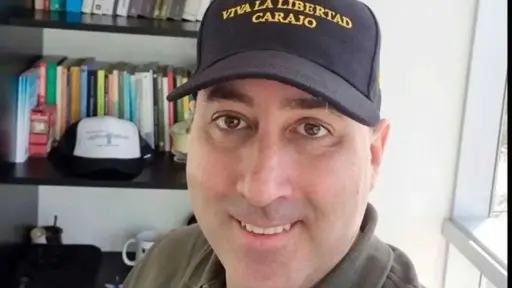
Fernando Cerimedo ended up where he did not want to be: in the maximum-security prison of Chonchocoro. To avoid his transfer to this prison, he claimed he was ill, that his life was in danger, and that Bolivian Vice President Edman Lara, his enemy, persuaded the judge to issue the order. None of this helped him, and the transfer occurred anyway, but with privileges: he used the presidential hangar, and the cell designated for Cerimedo is quite well equipped and isolated from other prisoners. The Minister of Government, Marco Antonio Oviedo, justified the situation, in line with the Argentinian, stating that Cerimedo’s life was in danger (without explaining what danger).
Cerimedo made a statement before entering the prison: he apologized to Rodrigo Paz “for not having listened to him and getting involved with that crazy woman.”
‘We build the narrative’
The “crazy woman” is Nadia Beller, the woman who received three gunshot wounds on August 17, for which Cerimedo is being investigated as the intellectual author of an attempted femicide.
Previously, Cerimedo said that Beller had not been his partner but an “adventure;” later, she was the “scorned woman,” the “obsessed one.” Now she is “the crazy woman.” Cerimedo says he regrets it, but not what is being investigated, rather having gotten involved with her. An ode to patriarchy.
Hours later, Bolivian President Rodrigo Paz entered into a dialogue with the “almost advisor” and responded publicly: “It pains me that, having placed trust in that gentleman, that trust was not reciprocated in the correct sense or was not understood.”
This strange exchange between two hurt men revolves around a woman who received three bullet wounds. Cerimedo functioned as the president’s political advisor, and now it turns out that Paz functioned as Cerimedo’s sentimental advisor: “don’t mess with that crazy woman.”
However, in recent days, something more disturbing than this exchange has occurred. A series of audio recordings appeared that, beyond the information they contain (which is very serious), reveal a possible method of operation.
One part of the recordings has a known source: Beller, who claims to have handed over her information to the Prosecutor’s Office. Others were presented by Vice President Edmand Lara, and another group by different media outlets. Unofficial sources claim that several of the recordings came from Cerimedo’s cell phone.
This information is alarming. In Argentina, Fernando Cerimedo was implicated in the leak of compromising recordings related to Karina Milei, the sister of President Javier Milei. This precedent raises doubts about the origin and use of the recordings now appearing in Bolivia.
Did Cerimedo record his conversations? We do not know, although everything seems to indicate that he did, and that this was his method of political action: to record, save, and accumulate—to accumulate information, bargaining power, and influence.
‘Zamora and Aramayo; the four of us are fighting to keep this from falling apart’
His defense lawyer appeared before the media and greatly complicated the explanation about the recordings. He did not deny them, he did not say they were false, he said nothing about a possible AI fabrication or anything like that. What he said was that Iran had tapped the phones to destabilize the Bolivian government: an explanation so outlandish that it was hilarious.
Among all the recordings, there is one that is particularly revealing: a voice attributed to the first lady of Bolivia, María Elena “Bibi” Urquidi, converses with Cerimedo about the very heart of the Bolivian admin istration. They speak about the then-Police Commander Mirko Sokol and Minister “Tuco” Oviedo and discuss who should stay and who should be removed. “With Tuco Oviedo and Sokol, I’m afraid they can turn Rodrigo against us,” says the voice attributed to Urquidi.
Cerimedo responds: “Tuco has to go.” About Sokol, he is even more explicit: “If he doesn’t remove Sokol, we cannot advance” (Sokol ended up leaving when this scandal had already broken out. The Bolivian government attributed it to a “resignation”).
The relevance of this exchange is that it discusses the positions of authorities and the possibility of the Bolivian government advancing or collapsing depending on who occupies certain positions.
Who are the “we” that the Argentinian refers to in this recording?
Cerimedo himself answers later: “Zamora (minister for public works) and Aramayo (minister for the presidency); the four of us are fighting to keep this from falling apart.”
The phrase shows that Cerimedo is part of a group acting to “sustain” the Bolivian government; he is more than just a campaign political consultant. There is an even more important phrase: Cerimedo announces that he will go to see the president after the cabinet meeting because Paz asked him to tell him “how the operation is going; what we are doing.”
The conversation not only places Cerimedo very close to the president. It positions him as someone who directly reports on ongoing operations (who knows what these might be) and who participates in the highest decisions of power.
The first lady says that Óscar Mario Justiniano (minister for sustainable development), Mauricio Zamora, and Ernesto Justiniano (minister for defense) would share her concerns, but “no one dares to tell” Paz. She talks to Cerimedo; Cerimedo talks to Paz. So the chain of command ends up being the following: those who do not dare to speak directly with the president resort to the first lady; the first lady talks with Cerimedo, and Cerimedo announces that he will raise the matter with Paz.
An independent analysis concluded that the audio recording was authentic, although the judicial expert opinion is still pending.
‘We must cut electricity and internet to the population’
One does not have to be a genius to deduce that for an individual whose power depended on access and information, it was useful to build an archive of recordings that would at some point serve as a reserve of power.
Let us think a little about what happened in Argentina: the hypothesis for Cerimedo’s motivation to leak the audios was to free his ex-wife Natalia Basil from suspicion and direct public attention towards Karina Milei. Others speak of settling scores within La Libertad Avanza [Milei’s political party].
We can deduce, then, that building a reserve of recordings could be Cerimedo’s way of bolstering his own position within governments: knowing what was said, who asked for what, who wanted to fire whom, and who needed a certain conversation to remain secret. It is a very powerful weapon.
Another audio recording revealed during the week was an alleged conversation between Cerimedo and “Tuco” Oviedo about the road blockade in the Santa Cruz town of San Julián, within the framework of the “53-day conflict” that occurred in Bolivia in May and June.
The recording contain discussions about detaining people: “there must necessarily be detainees,” says one of the voices. “We must cut electricity and internet to the population,” says the voice attributed to Cerimedo. If the expert opinion confirms its authenticity, there would be grounds to sue for state terrorism. Collectively punishing a population, isolating and incomunicating it, is an inadmissible extreme in a democracy and must be penalized. From Chapare, Evo Morales’ territorial stronghold, similar procedures were reported on the same dates in these two territories, both known for their support of Evo Morales and his policies.
Meanwhile, Paz continues to modify his own version of Cerimedo’s claims. First, he did not represent the Bolivian government; at that time, Cerimedo was only a distant communications advisor, claims Paz; now, after the publication of dozens of photographs of Paz with the supposed “absent advisor,” the president acknowledges that Cerimedo helped put Bolivia on the map.
This statement was outrageous for many. Paz invented a story without any real basis: “Bolivia was isolated, and thanks to Cerimedo, the Bolivian president met with other presidents.” It is an offensive view of the country he leads. Bolivia was never isolated. In fact, from Evo Morales’ administration, beyond likes or dislikes for this political figure, a very important expansion of bilateral relations occurred.
It is well known that Evo and even his successor Luis Arce maintained not only cordial but also coordinated working relationships with their neighbors and with several counterparts from all continents.
What Cerimedo did bring to Bolivia was a transnational scandal that has placed the Bolivian government in the cesspool of vulgarity and lies and in the mire of corruption.
Then, Viacha exploded
The tragedy in this municipality near the city of La Paz momentarily displaced Cerimedo from the center of public conversation. Nine people died and dozens were injured by the explosion of a military depot where gunpowder was stored.
Even before knowing the causes, the president introduced a political hypothesis: he asked to investigate whether it was an “attack.” Afterwards, his minister of government had to clarify that there was no evidence pointing to any intent of this sort.
It is at this point that the two stories meet again.
In another recording pending expert assessment, a voice attributed to Rodrigo Paz converses with Cerimedo about how to politically manage the 53-day conflict: “We build the narrative,” he says. We must “imaginatively design the novel” and “use this to divide.”
If the audio recording is authentic, it exposes the Bolivian president’s conception of power: it is not enough to manage facts; one must “fabricate” a narrative that will give political meaning to everything that happens. This would not be dramatic; that is how power works. The drama is the idea that this narrative must “serve to divide.” Social conflict, then, is not a crisis that must be resolved but an event that can be organized, narrated, and used to divide. It makes one shudder at the indolence regarding the care of the social fabric, the unity of a nation so wounded by its political differences.
In the case of Viacha, incorporating the narrative of the attack aims to change the axis of political discussion. Let’s stop talking about Cerimedo and start debating who could have attacked an innocent population. It also hides the responsibilities of the military, the lack of expertise in the administrative management of the Army that did not comply with basic protocols for handling explosives.
It is shameful to have to say it, but Viacha deserved mourning, investigation, and a response, not to become the new “drama.”
Translation: Orinoco Tribune
OT/JRE/SL
From Orinoco Tribune via This RSS Feed.