

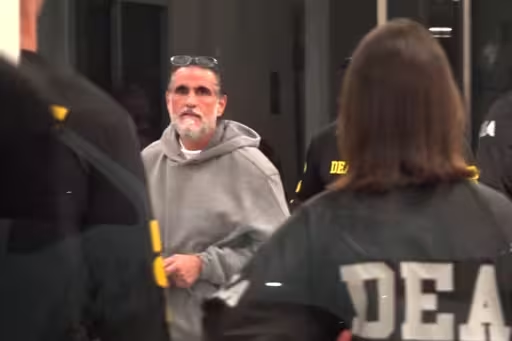
Alex Saab, Colombian businessman and former minister of Industries and National Production of Venezuela, changed his initial plea of not guilty on Tuesday, September 15, and pled guilty to a money laundering charge before a US federal court in Miami. The case originated from contracts for the importation of food to Venezuela, and in accordance with the agreement reached with the US Attorney General’s Office, he would cooperate with ongoing US investigations against him.
According to the plea deal, Saab also agreed to hand over $195 million to the United States authorities.
This figure corresponds to a US fiscal accusation about an alleged bribery scheme associated with food import contracts. It claims that the operation resorted to companies and documentation that allowed the movement of resources through the United States financial system, violating unilateral US sanctions against Venezuela. These accusations are part of the case being handled by the US Attorney General’s Office and do not necessarily match what Saab acknowledged when changing his statement.
The admitted crime carries a maximum sentence of 20 years in prison. The prosecution committed to recommending a sentence at the lower end of the applicable range and reserved the possibility of requesting an additional reduction if Saab’s cooperation proves useful for its investigations.
The court, which must set the final sentence, declared that the stage in which Saab maintained that he was not guilty has closed. Now a new phase has opened, focused on his compliance with the terms set by the agreement with the Attorney General’s Office.
This agreement comes after a judicial history that spans more than half a decade. Authorities of the African country of Cape Verde arrested Saab in June 2020 while he was on a diplomatic mission to Iran on behalf of the Venezuelan government. Cape Verde extradited him to the United States in October 2021, in a procedure that Venezuela denounced as a violation of the official’s diplomatic immunity.
Saab remained imprisoned in the US until December 2023, when he was released following negotiations between the governments of Venezuela and the United States. Less than a year later, in October 2024, President Nicolás Maduro appointed him as minister of Industries and National Production of Venezuela.
The ministerial position coexisted with another judicial front. The Prosecutor’s Office of Rome closed a case investigating Saab and his wife, Camila Fabri, in January 2026, and reaffirmed their innocence in a money laundering case also investigated by Switzerland, Ecuador, Brazil, and Colombia.
Thereafter, on May 16, 2026, the Venezuelan government, led by Acting President Delcy Rodríguez, itself deported Saab to the United States. The official statement from the Administrative Service of Identification, Migration, and Foreign Affairs (SAIME) of Venezuela justified the measure under the country’s immigration legislation and indicated that Saab was involved in crimes being investigated in the United States.
On May 18, Saab appeared before a US federal court in Miami, where he was notified of the charges against him for alleged conspiracy to launder money and conceal the origin and control of funds linked to Venezuela.
Exchange diplomacy with Washington
Three days after the deportation, the president of the National Assembly of Venezuela, Jorge Rodríguez, at the plenary session of the parliament, responded to a question from Deputy Luis Florido about the case. He confirmed Saab’s Colombian nationality and stated that “Venezuela cannot obstruct or prevent any deportation process.” He added that the type of relationship Saab had with US agencies will be disclosed.
Rodríguez considered the case as part of the exchange diplomacy that Caracas has with Washington. In this regard, he said that on December 20, 2023, he traveled to a Caribbean island to negotiate the prisoner exchange that led to Saab’s release, a mechanism that also helped recover the child Maykelis Espinoza Bernal in May 2025 and 252 Venezuelan migrants who were detained at the Terrorism Confinement Center (CECOT) in El Salvador, in July of that same year. He added that these efforts were part of the foreign policy of the Venezuelan government to repatriate compatriots detained outside the country.
With Saab back in the US, the case now enters the sentencing phase. In parallel, the US authorities will be able to advance in the cooperation agreed with Saab, although the extent of that collaboration and the information he will provide are not publicly known at the moment.
The court has not yet set the date for the sentencing hearing. Until then, Saab’s compliance with the agreed terms will determine the course of the case.
Can the Saab case affect the lawfare against President Maduro?
Alex Saab’s guilty plea comes at a time when President Maduro and First Lady Cilia Flores are also facing lawfare proceedings in the United States, raising questions about whether there might be any connection between the two cases.
The process against Saab includes other people who hold or held high positions in Venezuela, according to the statement of facts that is part of the process signed by Saab himself.
The text explicitly mentions José Gregorio Vielma Mora, a deputy from the ruling United Socialist Party of Venezuela (PSUV), who was superintendent of the Tax Service, governor of the state of Táchira, and minister of Foreign Trade.
There is no explicit mention of Maduro or Flores.
However, among those investigated in the case, there are four other accused individuals who have not been identified, and among whom there should be, at least, another high-ranking public official, as the accusation mentions several, but so far the only one explicitly named is Vielma Mora.
According to the same document, Saab and his business partner Álvaro Pulido Mora, along with “high-level Venezuelan officials,” set up a scheme to obtain lucrative contracts for importing food and medicines related to the CLAP social assistance program through bribery.
The document adds that there were “other conspirators” who did not fully comply with the contracts and, instead, used fictitious companies, false invoices, and fraudulent shipping records to launder hundreds of millions of dollars.
(Telesur) with Orinoco Tribune content
Translation: Orinoco Tribune
OT/SC/CD
From Orinoco Tribune via This RSS Feed.