

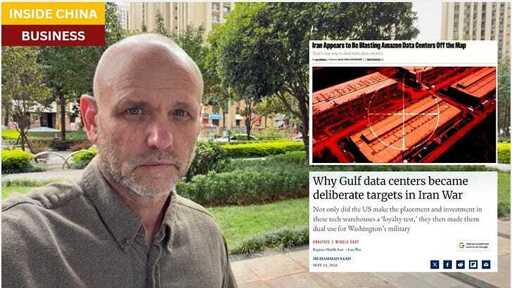
Bullets:
“Compute Diplomacy” was a US strategy to dislodge Chinese companies in the Middle East, and compel cooperation with Silicon Valley AI developers.
Bahrain and the UAE hosted large Amazon Web Services data centers, and planned a $30 billion, 5-GW Stargate project.
But Iran targeted AWS facilities in the earliest days of the war, knocking them offline for months.
Cloud Services is Amazon’s primary profit driver, and is a “dual-use” company that serves a wide range of military and commercial clients.
The Stargate project in the UAE is now under review, as the managers wrestle with how to protect the facilities from attack by drones and missiles.
China’s “Token Outbound” economy is ramping up, and is ironically in the best position of all to benefit from Iran’s attacks on data centers in the Gulf.
Inside China / Business is a reader-supported publication. To receive new posts and support my work, consider becoming a free or paid subscriber.
Report:
Good morning.
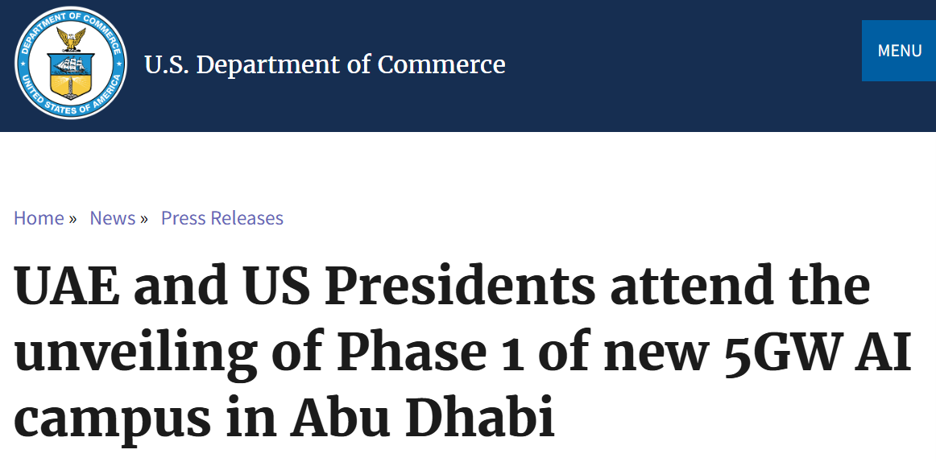
In May of last year, 2025, the United States and the United Arab Emirates announced plans for the construction of biggest AI campus in the world, outside the US. The presidents of both countries attended, and the Commerce Department and the American Embassy in the Emirates put out big press releases for the complex, which will be “home to US hyperscalers and large enterprises that can leverage the capacity for regional compute with the ability to serve the Global South.”
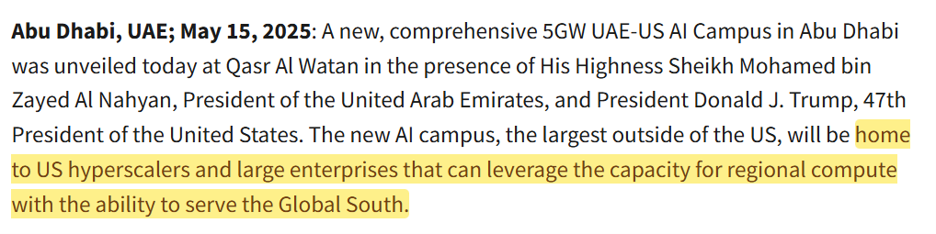
That term tripped us up a bit, because we’ve never seen “Global South” in an official document issued by the US government, ever. We got Googling, and found the only other instance of it here:
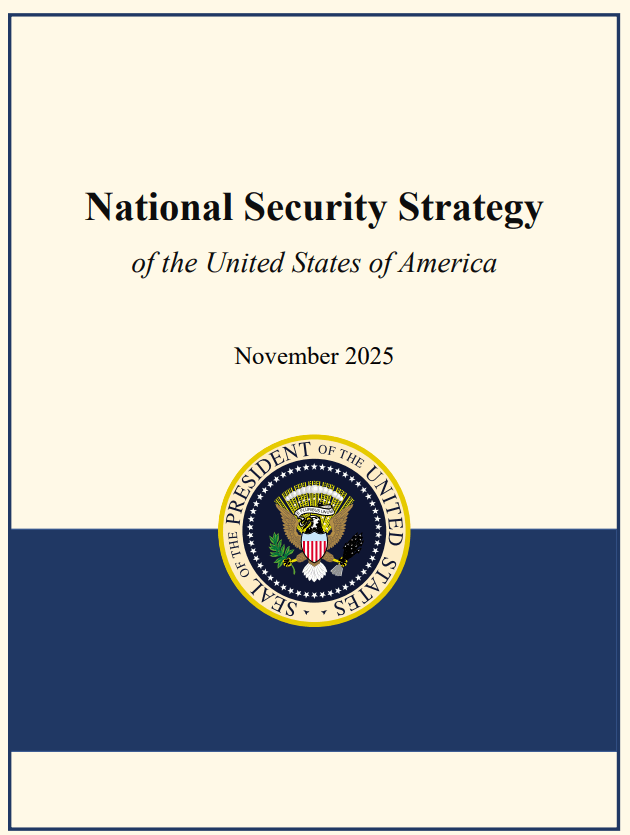
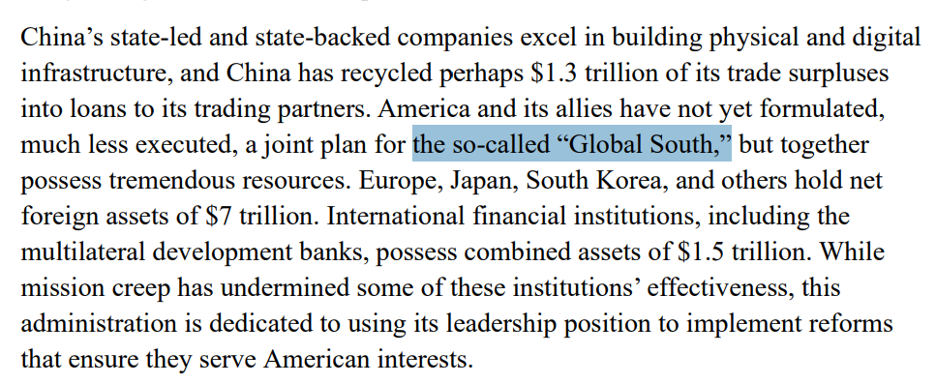
The National Security Strategy of the United States, issued in December, referenced the “”so-called “Global South””, which isn’t quite the same.
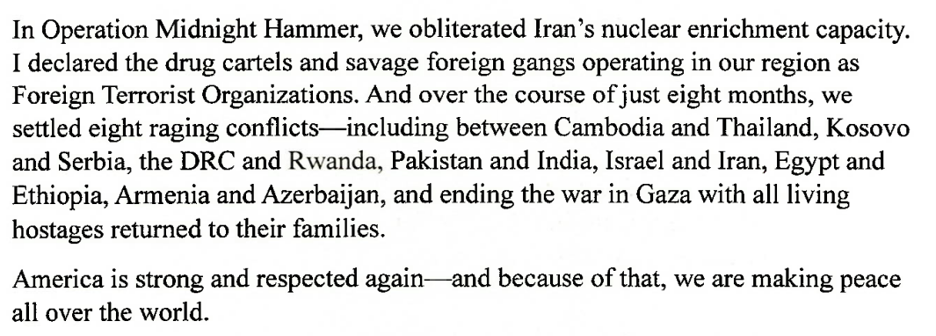
And on page one of that document, we learn that “In Operation Midnight Hammer” we obliterated Iran’s nuclear enrichment capacity. Over the course of just eight months, the war in Gaza ended, America is strong and respected again, “we are making peace all over the world.”
Everyone was full of hope and optimism, then. Iran had been defeated, peace in the Middle East had been achieved, so it was full-speed ahead on building a regional platform for trillion-dollar Silicon Valley companies to offer low-latency services to half the population of the world, from right there in the desert in Abu Dhabi.
American companies will operate the data centers and build American-managed cloud services, in a “major milestone in achieving” the president’s “vision for US AI dominance.”
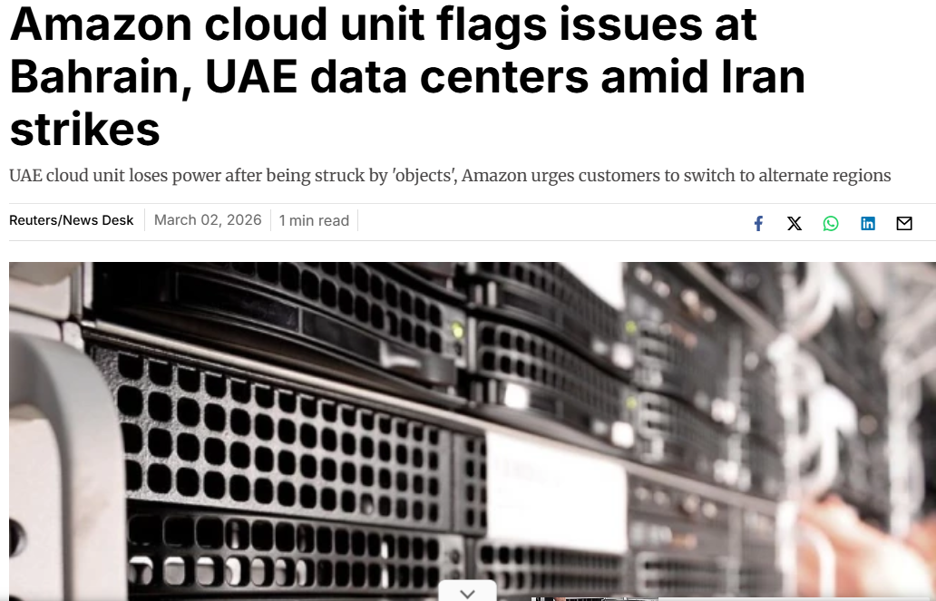
But in 2026 everything ran off the rails. In the very early days of this year’s War on Iran, Amazon’s data centers in Bahrain and the Emirates were attacked by Iranian missiles and drones, along with key infrastructure there. Power was knocked out, and Amazon told their customers to try other servers until they could fix the ones that were taken down. Later in March, AWS systems were again disrupted by drone activity, and again had to move customers to other servers.
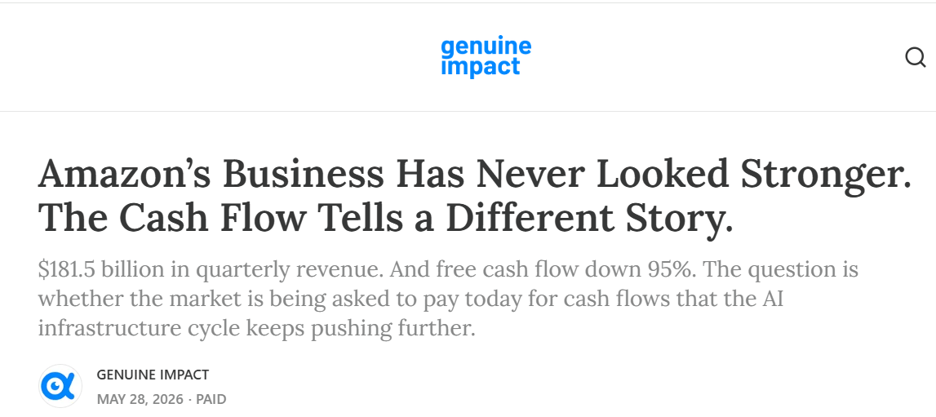
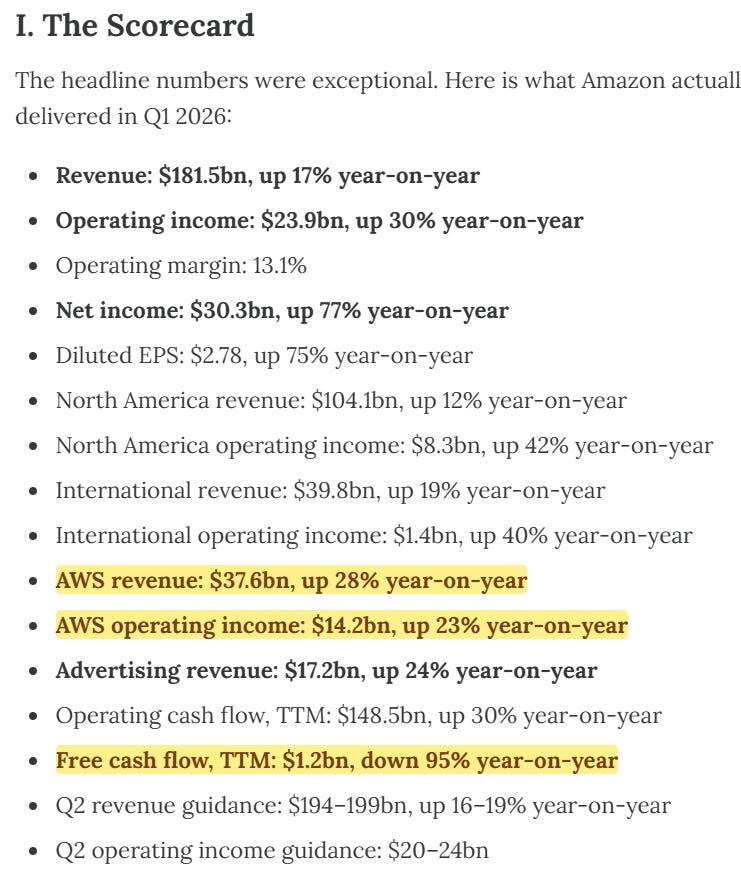
Amazon makes most of its profits from their cloud services division. The hundreds of warehouses across the world, with hundreds of thousands of people moving products and delivering them, the massive revenues from advertising and search, billions more from credit card processing—it’s actually Amazon Web Services where most of the company’s profits come from. It’s by far the most important division of the company today, and without that double-digit growth in Amazon Web Services’ income, free cash flow at the company would be negative. AWS makes more money for Amazon than North America and International, combined:
Amazon’s most important clients for AWS are money-no-object government and large corporate customers. Artificial Intelligence data centers cost a lot to build, but generate long-term revenue streams, and so Gulf States were happy to partner up with Silicon Valley and the Pentagon, to make sure they could get a piece of that business. And in the happy days of 2025, that looked like a sure bet.
But this year isn’t going anything like anyone thought it would. American navy and army bases were blown up and probably won’t be rebuilt, Saudi pipelines and refineries are being bombed almost daily by Houthi forces, and the big plans for the Emirates to build AI for the “so-called Global South” are falling apart. Last year’s commercial asset is now a battlefield target and diplomatic liability.
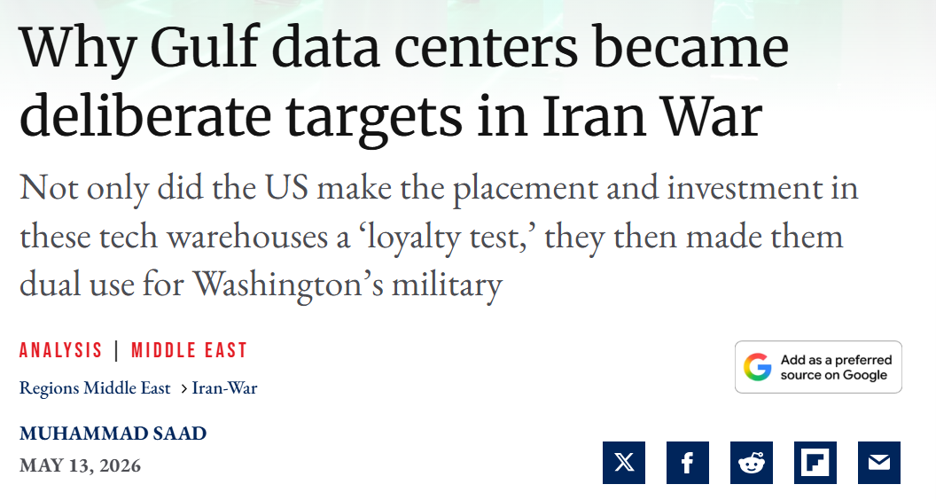
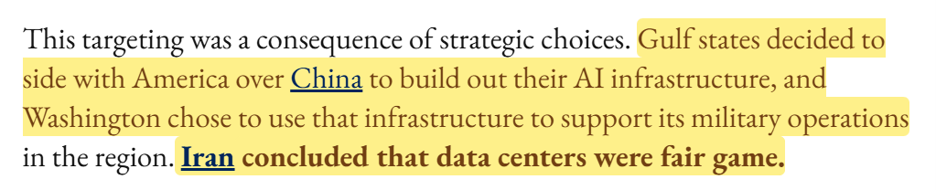
Persian Gulf countries sided with the United States, instead of China, to build infrastructure, and Washington uses those facilities to support military operations. At the time, Iran wasn’t a consideration; the strategy was to contain China, and use friendly countries in the Middle East to help the hyperscalers expand. So $15 billion from Microsoft, another $5.3 from Amazon were promised, along with chips from Nvidia, if Saudi and the UAE agree to phase Huawei out of their telecom systems, and divest from Chinese technology. “Compute Diplomacy” was a loyalty test.
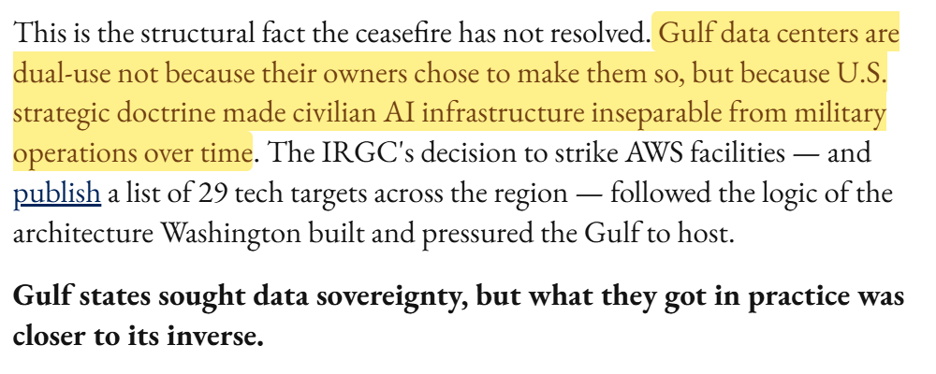
But today, Iran is very much back in the conversation. Claude runs on Amazon, and was used to identify targets in Iran, and Amazon Web Services hosts banking systems for the Gulf states. AWS is therefore by definition a “dual-use” company—serving commercial and civilian users, and military ones. Teheran figures that make them valid military targets, and published a target list that included dual-use facilities.
Summing up: Gulf States believed they were hedging their risk, by partnering with the United States and the hyperscalers by building data centers for them.
But what happened instead was that those same centers went to the very top of Iran’s target priority list, on the first day. Then as soon as the drones landed, the money got scared. Pure DC paused their plans to expand in the Middle East. Projects cost a lot more now. Insurance costs are going vertical, for companies who can buy insurance at all. There is now high “focus on security, physical protection, and backup systems”. Data flow is slowing.
Persian Gulf governments thought the Iran War was over, and that all the money promised by Wall Street and Silicon Valley was inevitably coming, so they poured in tens of billions of dollars themselves. Then came this year’s war, Iran overhauled the satellite navigation systems in their drones and missiles, and now are taking down billions of dollars’ worth of high-profile targets with low-cost munitions.
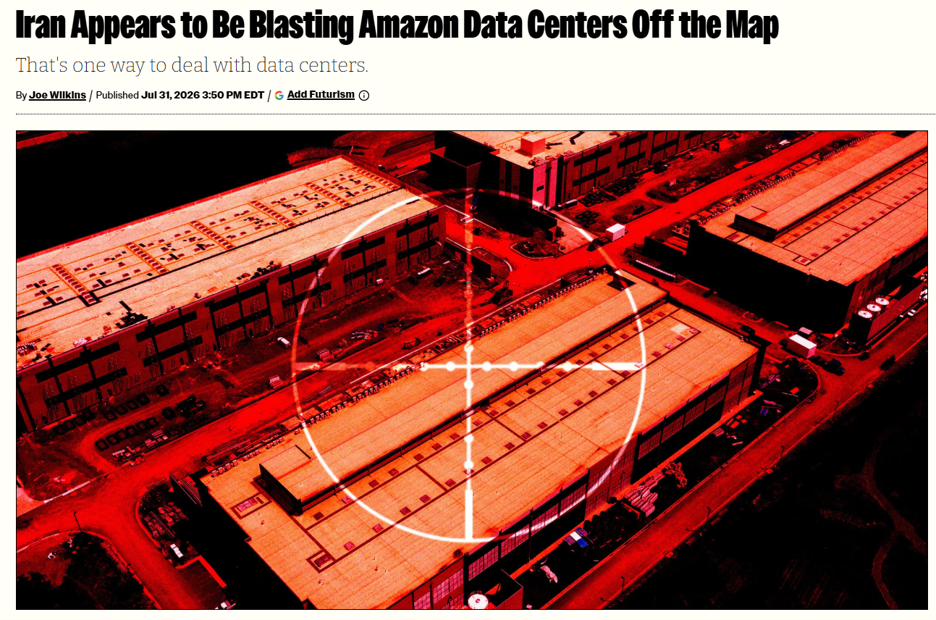
Later, in July, AWS facilities in Zallaq and Askar were heavily damaged; Iran says they were taken out because of Amazon’s support for the war. Amazon declined to comment. Bahrain’s National Communication Centre is not communicating. The Pentagon and the Central Command have the most loquacious public relations people in the world, and they also don’t know what to say. AWS warned of prolonged disruptions in March, in April, Amazon’s data center cluster in Bahrain was “unavailable” and customers should download their data to floppy disks or something. And that was the last time Amazon said anything about how things are going in their Persian Gulf investments.
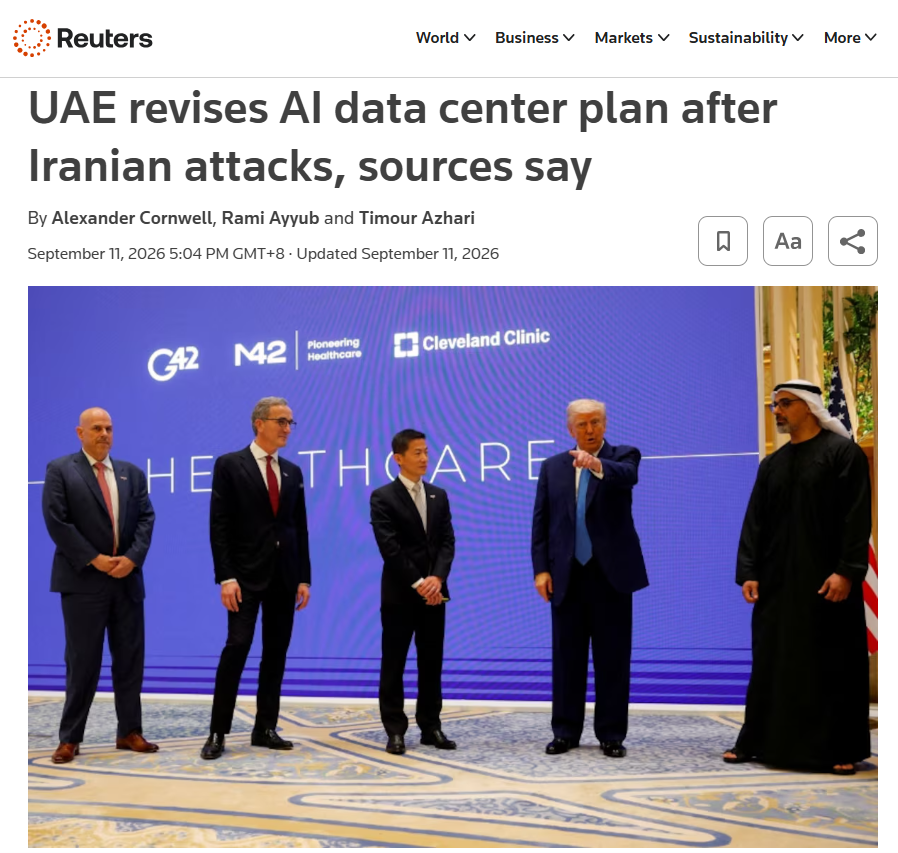
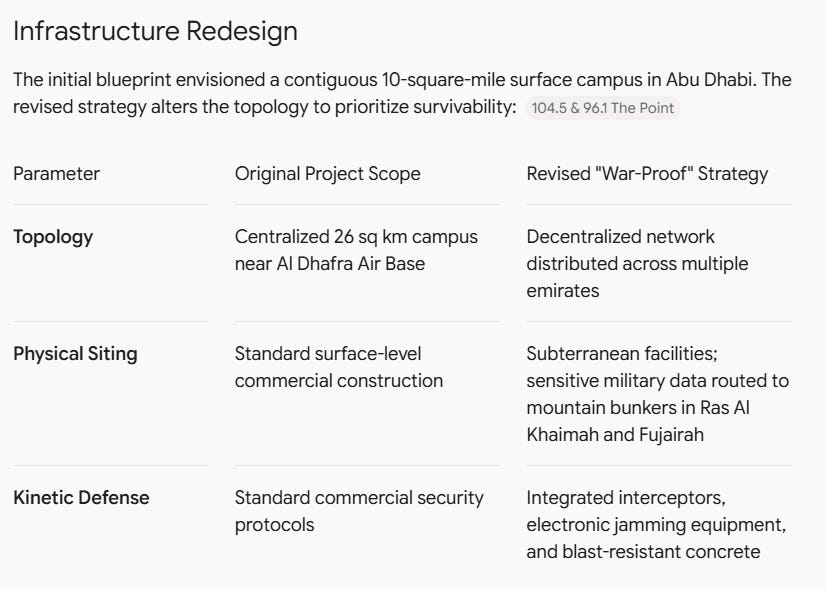
This all leads to one place. The “Iran War has prompted a rethink” of whether it’s a bright idea to build a 10-square mile AI data center complex just down the street from the ones that Amazon can’t use anymore. The idea now is for a network, spread across the country, while can hopefully be protected against drone and missile attacks by being placed underground.
They’re in a tough spot—the Emirates already cut ties with Chinese companies, and are all-in with Open AI, Oracle, Softbank, and Nvidia. Construction began last year, but now everything is being reviewed. Iran published a video that shows where the Stargate project is, which was not publicly known at the time. So the Emirates and the hyperscalers probably see little point in spending tens of billions of dollars to get them built, stuffing them with billions of dollars more of Nvidia chips, then watching a few Iranian drones that cost $50,000 blow it all up on the first day.
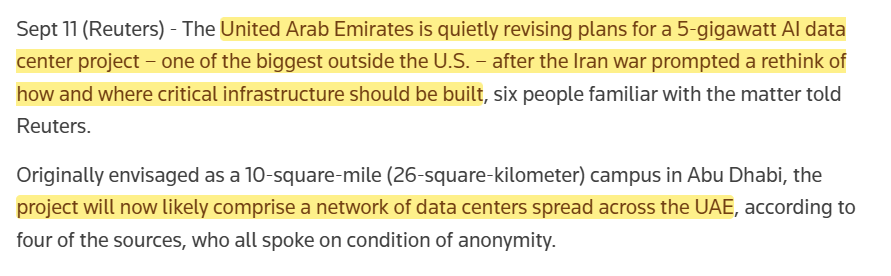
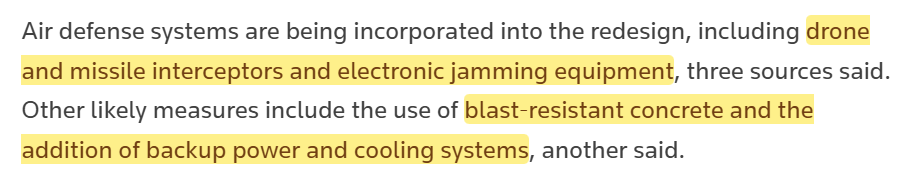
Nobody believes anymore that the Persian Gulf is a “safe haven”, and everyone is trying to cope. Some suggest that the most sensitive data operations be put inside mountains, and that drone and missile interceptors be set up to protect them. They would be surrounded by blast-resistant concrete, with backup power systems so they don’t go completely off like Amazon did.
The new priority is survivability, and that means a high price tag. The cost per megawatt will jump to two to five times what they budgeted for, with enormous upfront costs to harden the facilities:
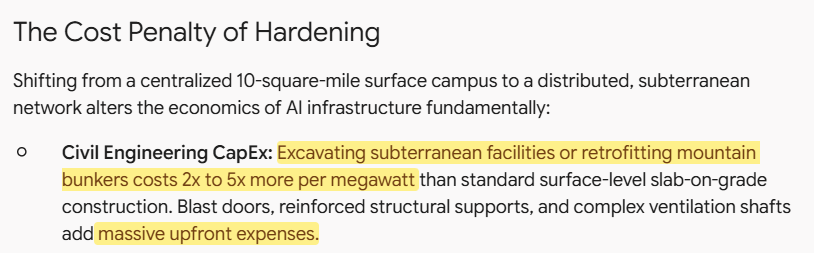
The costs then, to construct and protect these facilities, are going parabolic. And we’re looking here at another example of the wildly asymmetric realities of war today. That data center was forecast at $30 billion.
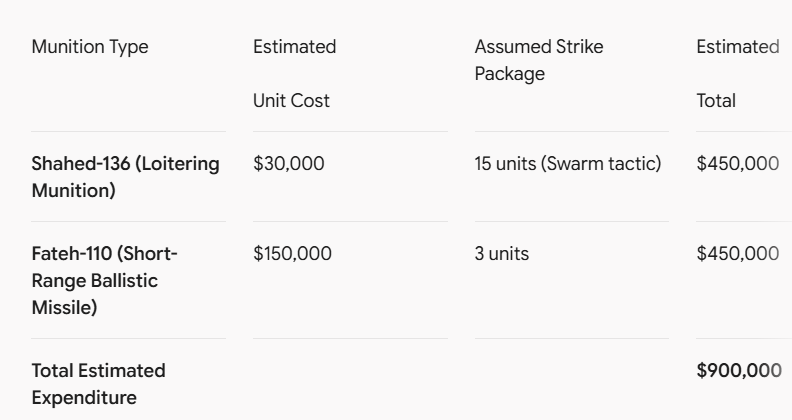
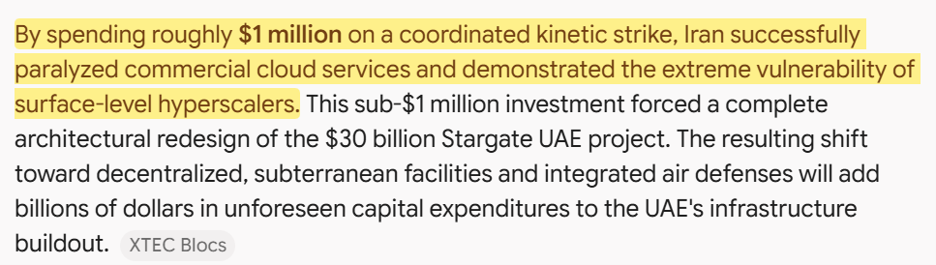
If we assume a strike package of Shahed-136 drones and -110 missiles, it likely cost Iran under $1 million to take down Amazon Web Services across the Middle East, and wreck the finances for that $30 billion project, which, if built, will now cost $60 to $150 billion, and take a lot longer.
Remember that the original motivation for that project was to sideline China in the AI race and lock Huawei out of the Persian Gulf. But ironically, it’s China who is benefiting right now. China’s token outbound is a huge new industry, and it’s already set up, and already serving customers in Asia.
And it will always be a compelling draw for corporate users in the Global South, who probably didn’t realize until this year that the data center they use would be blown up if it’s also running cloud services for the Pentagon.
Be Good.
Resources and links:
UAE and US Presidents attend the unveiling of Phase 1 of new 5GW AI campus in Abu Dhabi
https://www.commerce.gov/news/press-releases/2025/05/uae-and-us-presidents-attend-unveiling-phase-1-new-5gw-ai-campus-abu
UAE and US Presidents attend the unveiling of Phase 1 of new 5GW AI campus in Abu Dhabi
https://ae.usembassy.gov/uae-and-us-presidents-attend-the-unveiling-of-phase-1-of-new-5gw-ai-campus-in-abu-dhabi/
National Security Strategy of the United States of America
https://www.whitehouse.gov/wp-content/uploads/2025/12/2025-National-Security-Strategy.pdf
Reuters Exclusive: Amazon says AWS’ Bahrain region ‘disrupted’ following drone activity
https://insidetelecom.com/reuters-exclusive-amazon-says-aws-bahrain-region-disrupted
Amazon’s Business Has Never Looked Stronger. The Cash Flow Tells a Different Story.
[ Genuine Impact - Because your money deserves better
Amazon’s Business Has Never Looked Stronger. The Cash Flow Tells a Different Story.
Amazon reported what, on the surface, looks like one of the strongest quarters in the company’s history. Revenue rose 17% year-on-year to $181.5 billion. Operating income increased 30% to $23.9 billion. Net income reached $30.3 billion, up from $17.1 billion a year earlier. AWS grew 28%, its fastest growth rate in 15 quarters. Advertising revenue increased 24%. North America operating income rose 42%. The company guided Q2 revenue to $194–199 billion, implying another 16–19% year-on-year increase…
Read more
4 months ago · 12 likes · Genuine Impact](https://genuineimpact.substack.com/p/amazons-business-has-never-looked?embedding_publication_id=3320368)
Amazon cloud unit flags issues at Bahrain, UAE data centers amid Iran strikes
https://tribune.com.pk/story/2595367/amazon-cloud-unit-flags-issues-at-bahrain-uae-data-centers-amid-iran-strikes
Amazon Data Centers Hit in Iran Strikes, Satellite Images Show
https://www.bloomberg.com/news/articles/2026-07-28/amazon-data-centers-hit-in-iran-strikes-satellite-images-show
Iran Appears to Be Blasting Amazon Data Centers Off the Map
https://futurism.com/science-energy/iran-blasting-amazon-data-centers-war-usa
Why Gulf data centers became deliberate targets in Iran War
https://responsiblestatecraft.org/saudi-data-center-iran-war
UAE revises AI data center plan after Iranian attacks, sources say
https://www.reuters.com/world/middle-east/uae-revises-ai-data-center-plan-after-iranian-attacks-sources-say-2026-09-11/
UAE revises 5 GW AI project following Iranian strikes
https://beninwebtv.com/en/uae-revises-5-gw-ai-project-following-iranian-strikes/
Is the UAE’s AI Hub Becoming a Target? Semalt’s take: Resilience over scale
https://blocs.xtec.cat/pfabreg3/tacremat-taller-de-creacio-de-materials/taller-de-creacio-de-materials-2018-stop-motion
China’s “eyes” and Iran’s “fist”: Iran dumped GPS, switched to Beidou, and won the war
We were wrong about DeepSeek. Now Chinese AI companies export trillions of AI tokens.
youtube.com/HV0gr3knrTA
Tokens are China’s next goldmine
https://global.chinadaily.com.cn/a/202606/01/WS6a1cc2c4a310d6866eb4baae.html
Inside China / Business is a reader-supported publication. To receive new posts and support my work, consider becoming a free or paid subscriber.
From Inside China / Business via This RSS Feed.