

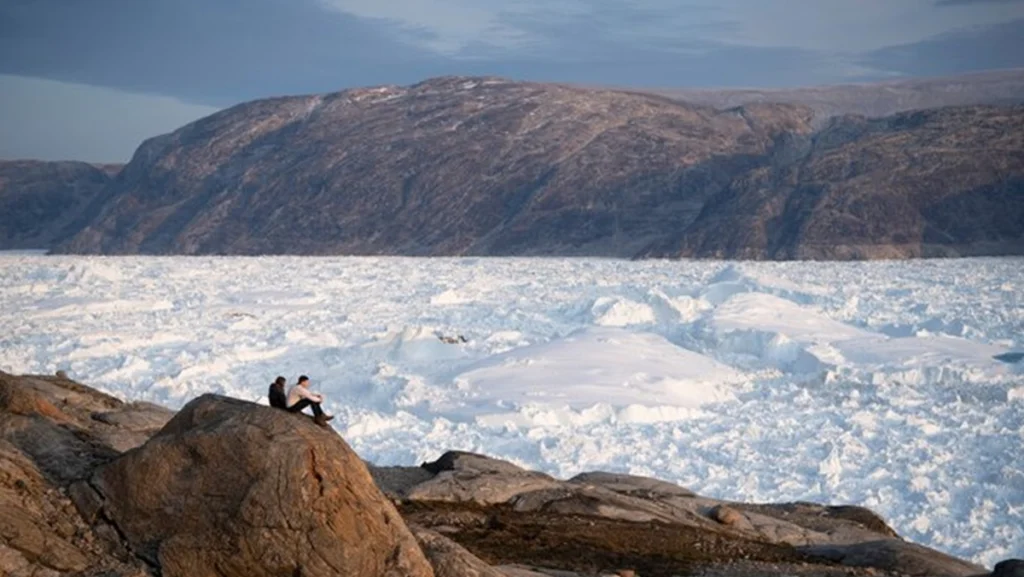
The two ice sheets lost 11.3 trillion tons of ice between 1979 and 2023, contributing more than 3 cm to global sea-level rise.
On Wednesday, the European Space Agency (ESA) and the U.S. National Aeronautics and Space Administration (NASA) published a study showing that ice melt in Greenland and Antarctica is responsible for one-quarter of sea-level rise.
RELATED:
Melting Glaciers in the Alps Redraw Border Between Switzerland and Italy
“Greenland and Antarctica’s ice sheets are key factors in the rise of average global sea levels and are expected to remain so in the future,” the study published in Scientific Data states, highlighting the role of glaciers’ discharge of ice into the oceans.
Up to 84% of ice loss in the aforementioned areas of the Earth occurred as a result of glaciers and how they discharge ice into the ocean as they flow faster. The remaining 16% of ice loss was caused by surface melting, according to the study.
“The new findings also highlight that this is not simply about surface melting. The glaciers draining these vast ice sheets are also flowing faster, pouring enormous amounts of ice directly into the ocean,” the ESA reported.
The study is the result of what the ESA described in a statement as “the most extensive record” of satellite data on the planet’s frozen surfaces.
Half a century of satellite data shows 11 trillion tonnes of ice loss
The longest satellite data record of ice-sheet change ever assembled reveals that Greenland and Antarctica have lost a staggering 11 trillion tonnes of ice since the 1970s, driving global sea level up by… pic.twitter.com/HL40xYyVZu
— ESA’s CryoSat mission (@esa_cryosat) September 16, 2026
11.3 Trillion Tons of Ice Melted
Between 1979 and 2023, Greenland and Antarctica lost 11.3 trillion tons of ice, causing sea levels to rise by more than 3 centimeters.
The research was conducted using data obtained from different satellites, which were cross-referenced to provide a picture of the situation in the frozen regions of the Earth.
Ice melt in Greenland alone is responsible for a 1.81-centimeter rise in sea levels, while the melting process in Antarctica has caused a 1.33-centimeter increase.
The researchers behind the study accompanied their research with animated graphics showing how Greenland began to lose ice at an accelerated rate starting in the 1990s.
The Arctic island, which is part of the Kingdom of Denmark, went from losing 60 billion tons of ice during periods of melting in the 1980s to seeing 264 billion tons of ice melt in the past decade.
In Antarctica, ice loss stood at 48 billion tons in the 1980s, but in the past decade, melting affected 202 billion tons of ice.
“Unlike Greenland, Antarctica’s net ice loss was exclusively due to ocean-driven melting and the acceleration of its outlet glaciers,” the ESA noted.
Coming soon to where you live as global warming spirals out of control, largely ignored by media, politicians and commentators.
Every degree C of temperate rise means 7% more moisture is absorbed into the atmosphere and what goes up must come down. https://t.co/XCQ8TsvrtQ
— Matthew Todd
(@MrMatthewTodd) September 14, 2026

Net Ice Losers
Between 2020 and 2023, data collected by scientists showed a slowdown in ice loss in both Antarctica and Greenland. “In Antarctica, unusually heavy snowfall across East Antarctica provided enough ice to offset part of the losses from glaciers in other areas of the continent,” the ESA said.
In Greenland, a string of relatively mild summers has substantially reduced surface melting. That streak reduced by approximately half the amount of ice lost through this process in the Arctic territory during that period.
That slowdown does not represent a change in the trend, given that the planet’s frozen ice sheets continue to be net ice losers each year. According to Diego Fernandez, an ESA researcher, “these results demonstrate the fundamental importance of international scientific collaboration in addressing the major environmental changes of our time.”
teleSUR/ JF
Source: EFE
From teleSUR English via This RSS Feed.