

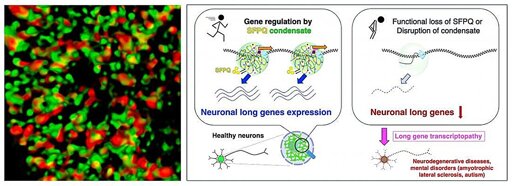
Neurons in humans and other mammals express many exceptionally long genes, ranging from more than 100 kbp to more than 2 Mbp, that are important for forming synapses and neural circuits. In general, genetic information is read from DNA into RNA. This process is called transcription. The longer a gene is, the more time it takes to read from beginning to end. In addition, gene expression must be regulated at several steps. Neurons are therefore thought to require special mechanisms to read long genes accurately and stably, but the details of these mechanisms have remained unclear.
From Biology News - Evolution, Cell theory, Gene theory, Microbiology, Biotechnology via This RSS Feed.
You must log in or # to comment.