

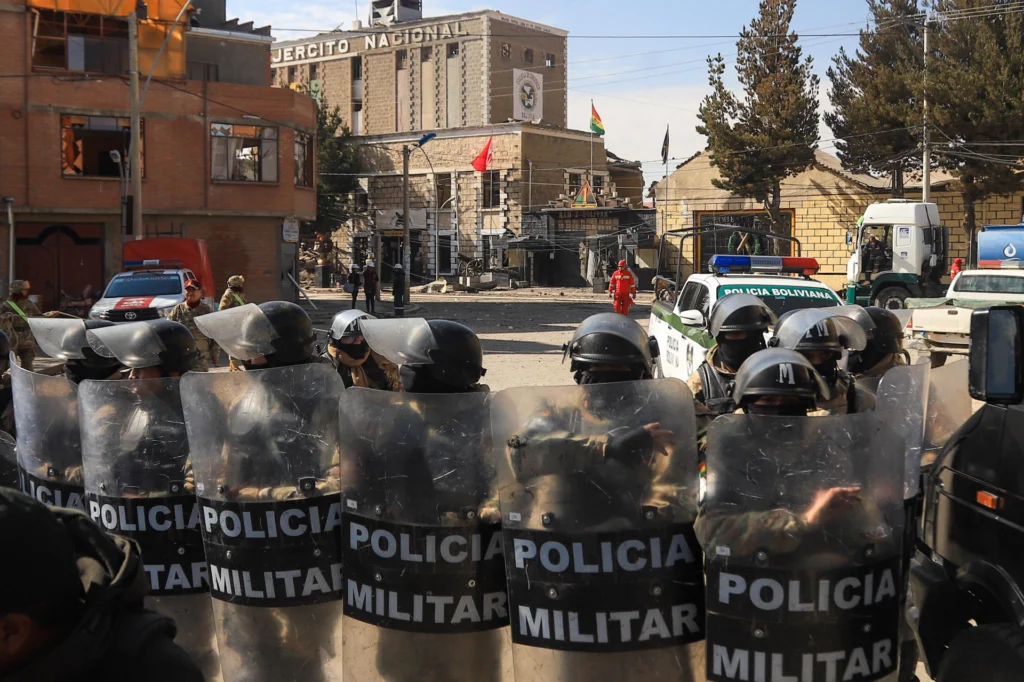
The government of Bolivia, led by President Rodrigo Paz, has approved a decree to extend the state of exception for 90 days, a move widely criticized as an attempt to criminalize protests against neoliberal policies.
The decree signed by the President Rodrigo Paz, justified by the national government as necessary due to persistent “risk factors” and threats of mobilizations, was sent to the Plurinational Legislative Assembly.
The Plurinational Legislative Assembly must decide within 72 hours, by an absolute majority, whether to approve or reject the continuation of this exceptional measure, which was initially set to end on September 18 after three months of implementation.
RELATED: Bolivia Agrees Harsh IMF Adjustment Package in Exchange for $1.9 Billion
Defending the need to extend the decree, Defense Minister Ernesto Justiniano argued that it is essential to maintain control amid growing public discontent. Meanwhile, the Constitutional and Plural Justice Commission of the Chamber of Deputies accelerated a resolution project, citing the need to preserve the country’s supposed economic reactivation.
However, trade unions and popular organizations argue that the underlying motive of this legislation is to suppress the widespread discontent against the executive’s policies. They claim that the state of exception aims to criminalize social protests, mobilizations, and territorial vigils that have erupted across the nation.
NO SÓLO MÁS ESTADO DE EXCEPCIÓN SINO TAMBIÉN ESTADO DE SITIO: vocero presidencial José Luis Galvez, advirtió que el gobierno está decidido a dictar Estado de Sitio y militarizar el país, si retornan protestas sociales como ocurrió en mayo y junio pasados: @teleSURtv pic.twitter.com/P7VdBWSGac
— Freddy Morales (@FreddyteleSUR) September 15, 2026
Text reads: “Not only more state of emergency but also state of siege: presidential spokesman José Luis Galvez, warned that the government is determined to impose a state of siege and militarize the country if social protests return as occurred in May and June.”
The primary triggers for this citizen outrage include the sharp increase in diesel prices, the drastic loss of income affecting Bolivian families, and a climate of harassment marked by political persecution against trade union leaders and opposition social leaders.
The latent conflict has recent intense antecedents, marked by massive protests in May and June led by the Bolivian Workers’ Union (COB, in Spanish) and the Peasant Federation of La Paz. These protests included road blockades that resulted in 16 deaths, severe supply shortages, and economic losses exceeding $3 billion.
El Gobierno usó el Estado de Excepción para contener la protesta social frente a la corrupción, el narcotráfico, el incremento de precios en la canasta familiar y la escasez de combustibles.
¿Acaso su ampliación resolverá la crisis económica? ¿Bajará los precios del alimento,… pic.twitter.com/mY1r2Rw7LB
— Evo Morales Ayma (@evoespueblo) September 15, 2026
Text reads: “The government used the state of emergency to contain social protest against corruption, drug trafficking, rising prices in the household basket and fuel shortages.…”
Amid this tense situation, the political opposition has also expressed concerns. Senator Milton Quispe of the Unity Alliance is analyzing legislative deadlines, while former President Jorge Tuto Quiroga warned that the measure could delay constitutional reforms aimed at attracting foreign investment.
While the ruling party insists on the existence of a supposed “citizen consensus” to support the extension, social bases affirm that they will maintain their resistance in the streets and regions against an economic model they consider harmful. They also oppose a regime that responds to popular demands by restricting constitutional guarantees.
From teleSUR English via This RSS Feed.