

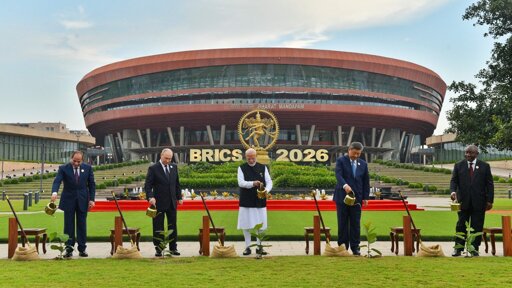
The political and economic bloc held its annual summit in New Delhi to outline common positions on international conflicts, trade, and energy
The BRICS group of nations adopted a joint declaration on 12 September, expressing “deep concern” over the ongoing conflict between the US and Iran and urging “maximum restraint” as part of a “multilateral approach” that respects national viewpoints.
The declaration was adopted on the first day of the BRICS leaders’ annual summit in New Delhi.
“We express deep concern over the continued escalation of tensions in Middle East/West Asia and, recalling our respective national positions, call for exercising maximum restraint, as well as avoiding actions that could further aggravate the situation,” the declaration said.
BRICS leaders gathered at the summit to develop the bloc’s common positions on international conflicts, sanctions and trade, reform of global institutions, finance, energy, technology, health and development.
BRICS leaders failed to reach a consensus condemning the US aggression against Iran, as the bloc includes both Iran and the UAE, which are on opposing sides of the conflict.
The BRICS group of nations unanimously adopted a joint declaration expressing ‘deep concern’ over the war in the Middle East and urged maximum restraint. READ: https://t.co/nXJgNWjwVH pic.twitter.com/o40AozQil9
— Reuters (@Reuters) September 12, 2026
The UAE joined the war against the Islamic Republic on the side of its allies, the US and Israel.
Summit host India is also a close ally of Israel and one of its main weapons suppliers.
Other BRICS members include Brazil, Russia, China, South Africa, Egypt, Ethiopia, and Indonesia.
In response to the unprovoked US-Israeli attack in February, Iran effectively closed the Strait of Hormuz, through which Gulf energy exports to Asia flow.
The closure caused a surge in energy prices that has harmed the economies of BRICS nations, in particular in Asia.
The declaration affirmed the commitment of BRICS member states to a peaceful resolution of international disputes “through dialogue, consultation, and diplomacy.”
It also expressed concern over “unilateral tariff and non-tariff measures” that distort trade, disrupt supply chains, and harm global economic development.
Since returning to office, US President Trump has used the threat of tariffs against China and India and imposed additional economic sanctions on Iran and Russia.
Trump has also issued secondary sanctions against nations and entities trading with Iran.
The joint statement expressed “serious concern” about deliberate attacks on civilian infrastructure and peaceful nuclear facilities under full International Atomic Energy Agency (IAEA) safeguards, saying such attacks violate international law and relevant IAEA resolutions.
🇮🇷🇦🇪 Iran and UAE
Iranian President Masoud Pezeshkian met and held talks with Sheikh Khaled bin Mohamed Al Nahyan, Crown Prince of Abu Dhabi, on the sidelines of the BRICS Summit in New Delhi. pic.twitter.com/XLesT6guo4
— Megatron (@Megatron_ron) September 12, 2026
Though the US and Israel have carried out attacks on Iran’s nuclear facilities and civilian infrastructure, the statement did not name either country specifically regarding such attacks.
Regarding Israeli actions in Gaza, the statement calls for maintaining the ceasefire and facilitating unhindered humanitarian assistance; opposes the forced displacement of Palestinians and territorial/demographic changes to Gaza; and supports Palestinian self-determination and the creation of a Palestinian state on the 1967 borders with East Jerusalem as its capital.
Regarding Lebanon, the statement calls on Israel to withdraw its forces from Lebanese territory and adhere to the Lebanon ceasefire and UNSC Resolution 1701.
BRICS Meeting: Araghchi Says US Empire in Decline, Iran Will Never Bow to Pressure
On Syria, it calls for respect for Syria’s sovereignty and an inclusive Syrian-led political process, warns of the risk posed by “foreign terrorist fighters” to Syria’s and regional stability and security, and calls for the withdrawal of foreign occupying forces, an apparent reference to Israel.
It also encourages continued work on interoperable cross-border payment systems and greater use of BRICS members’ local currencies rather than US dollars for trade and investment settlements.
The BRICS statement also stresses the importance of reliable energy supplies and stable markets and explicitly says fossil fuels will continue to play an important role, especially for emerging and developing economies.
It simultaneously backs a “just, orderly, equitable and inclusive” transition to renewable energy and emissions reductions according to countries’ different circumstances, as outlined in the UN’s Sustainable Development Goal 7 (SDG 7) framework.
From Orinoco Tribune via This RSS Feed.