


This column was originally published on Substack.
Mark TrahantSubstack
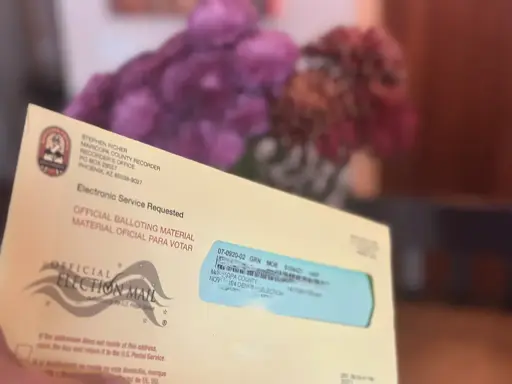
The Supreme Court put the brakes on the Trump administration’s wacky idea of using the U.S. Post Office as an election referee.
The breaking news from The Associated Press:
“The decision allows states to continue sending out mail ballots under the same processes they’ve used for years and have accounted for nearly a third of votes cast.
“It represented a stark defeat for Trump on an issue he consistently has emphasized as vital to ensuring election integrity even though there is virtually no evidence of fraud with mail ballots.
“The Supreme Court majority wrote that the administration’s push to implement the restrictions this year is likely to lose in court, though the brief emergency order didn’t detail its reasoning. Two justices, Samuel Alito and Clarence Thomas, publicly dissented.”
The court action limits the damage the Post Office can do to wreck the midterms. The legal cases will continue in a variety of forms, but it’s now too late for the Trump administration to enforce its “state citizenship” idea using a variety of federal data bases.
Two key points: Ballots have already been mailed out in a couple of states (and nearly all over the next three weeks) and nationally about a third of all voters cast ballots by mail.
Colorado, Oregon, Washington, Hawaii, and Utah mail all of their ballots (but voters do not return them all by mail.) This is important because Trump’s executive order was little more than a back-of-the-envelope musing about how the post office could vet voters for citizenship.
Markwayne Mullin’s Department of Homeland Security is supposed to coordinate with the Social Security Administration and create a voting age list of American citizens with confirmed residences. (In July Mullin threatened local and state officials with prison if they did not comply with his agency’s made up law.)
The Brennan Center for Justice details how this nonsense is supposed to work:
“The federal government does not currently maintain a list of all U.S. citizens, let alone lists of citizens in each state, and there is no federal law that authorizes it to do so. Various federal privacy and information security laws have prevented the creation of such lists.
“Per the order, the new “state citizenship lists” would not be compiled using existing state voter registration lists or any other state data but rather a variety of federal databases that have been created for other purposes. However, the federal government’s information on citizenship is incomplete and sometimes inaccurate, meaning American citizens could be left off DHS’s lists. If those lists are used to determine voter eligibility, anyone excluded could potentially be disenfranchised.
“For example, one source the executive order claims should be used for citizenship verification is the Systematic Alien Verification for Entitlements, or “SAVE,” program. But this program was created to determine immigrants’ eligibility for various government benefits, not as a comprehensive list of U.S. citizens. Even with those additions, recent attempts by DHS to use this data to identify noncitizens on states’ voter rolls demonstrate that the SAVE program frequently mistakenly flags Americans as potential noncitizens, with a very high error rate. Moreover, none of the datasets that the order lists are designed to determine whether a person “maintains a residence” in a given state.”
Relying on a system that doesn’t work? It’s always interesting reading the dissent.
SCOTUS blog’s Amy Howe reports:
“In dissent, Alito contended that the Trump administration “has made the showings necessary for a stay.” First, he reasoned, the civic groups challenging the rule had relied on “cryptic filings” to assert their right to sue. But they must “make specific allegations establishing that at least one identified member had suffered or would suffer harm,” Alito stated, and provide that member’s name.
“As for the states, Alito continued, the dispute boils down to “whether the Postal Service has statutory authority to promulgate the rule.” In this case, Alito asserted, the challengers must meet a high bar, but they cannot do so, because the USPS “has broad authority to regulate the mail.”
“Alito agreed with the Trump administration that it would suffer permanent harm if Talwani’s order is not put on hold while the litigation continues, because it would not be able to implement the rule in time for the November elections even if her injunction is ultimately reversed. “[T]he Government,” Alito emphasized, “has a strong interest in enforcing the rule.”
“By contrast, although Alito made clear that he took “th[e] problem” of “the practical effects of implementing the rule close to the midterm elections” “very seriously,” he concluded that “it is not enough to convince me to deny the application.” Some states, he noted, support the rule and say that they can comply with it during the November elections. Moreover, he suggested, the challengers and the courts “bear a substantial share of the blame” for the delay in the implementation of the rule.”
What now?
This is a big win for the election process that’s constitutional, states manage elections not the White House. But this won’t be the end. Politics is always about moves and counter moves — and expect that to continue between now and November.
Remember the goal is chaos.
The main thing between now and Election Day is to have an election plan. Today is National Voter Registration Day. Tell alll your friends: Check their voter status. Make sure everything is up to date, deadlines are fast approaching.
If you do use mail, make sure to track your ballot. There are a number of tools that let you check where that ballot is all through the process, until it’s counted.
I think the most important trend in this election is First Day Voting. That’s voting on the first day that you can, whether by mail or in person. That gives you plenty of time to make any corrections (such as forgetting to sign an envelope) before Election Day.
Details.
We already know the Post Office actions are problematic in this election season. On Sept. 9, ProPublica published an accounting of some of the problems.
“The identified failures increase “the risk that Election and Political Mail is not handled, documented, monitored, and reported in accordance with Postal Service policy,” the audit said, though it noted that “most facilities we visited generally adhered to Postal Service’s election-related policies and procedures” and that nearly 99% of ballots reached election officials in a timely manner.
“While instances of non-compliance were low relative to overall volume, the presence of similar procedural gaps across multiple facilities indicates a need for improved understanding and increased enforcement of Postal Service policies among its employees,” it said.”
And…
“Top Postal Service employees, along with a whistleblower who filed a disclosure with U.S. Sen. Richard Blumenthal, D-Conn., have expressed concern that the new system stands to disenfranchise large swaths of eligible voters, both by its design and lack of testing, ProPublica reported last week.
“Election experts told ProPublica the new audit findings should be considered by the Supreme Court, as they make even clearer what election officials already know.
“David Becker, executive director of the Center for Election Innovation and Research and a former Justice Department civil rights lawyer, said the audit confirms that USPS has “a long way to go to meet its core obligations of delivering election mail in a timely manner.”
Today’s Newsrime
Kennedy Center says it might go broke
there’s not enough cash to pay its folk
Crisis began when board added Trump’s name
They’ll add him again as they have no shame
The post Go ahead and mail that ballot (trust, but verify) appeared first on ICT.
From ICT via This RSS Feed.