

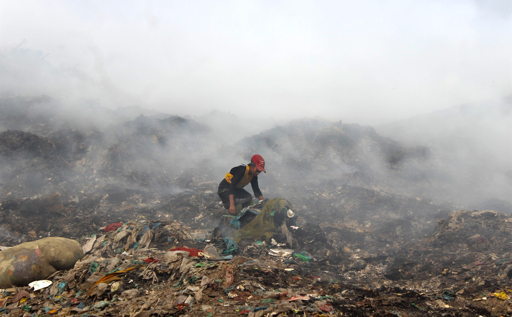
At years old, Yeasmin Begum has lived near the Amin Bazar landfill on the outskirts of Dhaka her whole life. She says the stench often triggers allergies, including colds and coughing. “Sometimes it is quite difficult for us to breathe when waste collectors burn the waste under the open sky. Smoke and ashes envelop our home and surroundings,” she says. That’s a problem that could get worse under a plan by municipal authorities to burn trash on a much larger scale. A so-called waste-to-energy project would incinerate up to 3,0000 metric tons of trash daily to heat a boiler, which would then produce steam to drive a turbine, thereby generating electricity. This would be the first-ever waste-to-energy project in Bangladesh, part of an effort to tackle the increasing volume of municipal waste. But the 42.5-megawatt North Dhaka project has raised concerns among nearby communities that have long suffered from exposure to polluted air, water, and soil. Dhaka North City Corporation is the municipal authority overseeing the project, which is owned by the China Machinery Engineering Corporation. Some of the total $467 million in total funding has been pledged by multilateral lenders including the Asian Infrastructure Investment Bank and the New Development Bank, both headquartered in China. The project is due to be completed by December 2028, four years later than initially planned. For nearby residents like Yeasmin, the prospect of thousands of tons of municipal waste every being burned every day, potentially releasing toxic substances like heavy metals and dioxins,…This article was originally published on Mongabay
From Conservation news via This RSS Feed.