

Democrats in the US Senate may be on the verge of helping Republicans pass a cryptocurrency bill that could enable President Donald Trump’s self-enrichment.
On Tuesday, the Senate will hold a key vote on whether to advance the Digital Asset Market Clarity Act, a bill drafted hand-in-glove by the crypto industry that fulfills many of its key objectives, amid a $190 million lobbying blitz.
The bill, commonly called the Clarity Act, establishes what would be considered the first federal regulatory framework for cryptocurrency, which is much looser than the rules that govern stocks and other securities, with fewer disclosure requirements and investor protections.
In May, Sen. Elizabeth Warren (D-Mass.), the top Democrat on the Senate Banking Committee, warned that this bill would help to “turbocharge” President Donald Trump’s “crypto corruption.”
“In just one year in office, the president and his family have raked in at least $1.4 billion in gains from crypto deals alone, and yet this bill stunningly includes zero provisions to prevent that,” Warren said.
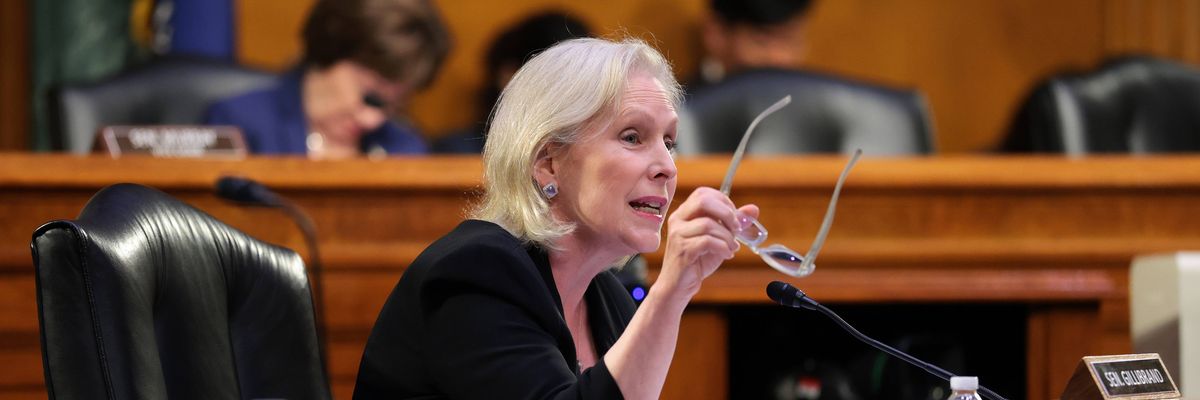
As Politico reported Monday, Sen. Kirsten Gillibrand (D-NY), one of Congress’ biggest crypto supporters, is privately urging others in her party to back the legislation and break the filibuster.
According to the Government Transparency Project, Gillibrand is Congress’ top recipient of campaign donations from employees in the crypto sector. And as Andrew Perez noted on Tuesday for Zeteo, Gillibrand’s 22-year-old son “recently received startup backing from a crypto billionaire.”
Politico said there were about a dozen Democrats in the chamber who had “signaled openness” to voting for the legislation, though it did not specify who they were.
Two potentially worth watching are Sens. Ruben Gallego (D-Ariz.) and Angela Alsobrooks (D-Md.), the only two Democrats who voted to advance the initial, even less restrictive version of the bill out of the Senate Banking Committee.
Trump reported roughly $1.4 billion in crypto-related income in 2025, including hundreds of millions from his family’s crypto exchange World Liberty Financial (WLF), which is funded by the United Arab Emirates’ national security adviser, Tahnoun bin Zayed Al Nahyan, and from sales of his $TRUMP meme coin, a kind of digital collectible that Trump’s own Securities and Exchange Commission has acknowledged typically has “no use."
Last month, WLF received preliminary approval from a Trump-appointed regulator to become a federally regulated bank, leading to warnings from anti-corruption watchdog groups that the institution could create a new vehicle for Trump to accept bribes from business interests and foreign governments seeking his favor.
The Trump family reportedly owns about a 38% stake in the holding company for the bank, while Al Nahyan, who is also the brother of the UAE’s president, owns about 49% of the venture.
The Clarity Act will require 60 votes to advance in the Senate, meaning that seven Democrats will have to get on board, assuming all Republicans vote yes. Some have demanded that the bill address some of its shortcomings, including provisions that would allow Trump to continue profiting.
On Sunday, with the vote less than 48 hours away, Senate Republicans and the White House unveiled a new version of the bill that purports to do just that, which they described as a “final offer” to Democrats.
But Mark Hays, the associate director of crypto and fintech policy at Americans for Financial Reform, said these changes were mostly “window dressing.”
Under the new version, he wrote on Monday, crypto would still have fewer guardrails than other investments, much of its activity would still escape oversight, regulators would still have too few tools to crack down on abuse, and crypto would still become much more intertwined with national banks, meaning that a crypto crash could wreak havoc across the economy.
Hays said the bill’s new ethics language also “still fails to address President Trump’s unprecedented profiteering from corrupt and conflicted crypto ventures while in office,” a predictable outcome since his own White House approved the language.
The bill prohibits state attorneys general from bringing ethics enforcement against public officials unless Trump administration officials approve. It also leaves the US attorney general, Todd Blanche—who has portrayed himself as Trump’s personal lawyer—and an in-house ethics council as the sole arbiters of whether the president violated new rules.
And while the Clarity Act could eventually require Trump to put some of his assets in a blind trust, Hays noted that the provisions “exclude the lion’s share of the Trump family’s existing crypto enterprises, exclude his sons who operate these firms, and allow carve-outs that enable Trump’s branded crypto ventures to continue to generate profits.”
Hays called the bill an attempt to “trick senators into voting for a giveaway to the crypto industry and crypto billionaires,” adding that “no one should be fooled” by the last-minute changes.
“It still fails to stop Trump’s crypto corruption; it still allows traffickers, rogue actors, and sanctions evaders to launder money with crypto; it still allows crypto platforms to unfairly gouge customers; and it still allows platforms to pay interest on stablecoins that will drain deposits from community banks,” he said.
Sen. Mark Warner (D-Va.), who also sits on the Senate Banking Committee, has participated heavily in negotiations around the Clarity Act and has said he’s not ruled out allowing it to advance. But on Monday, he told Semafor’s Burgess Everett that while “there has been some movement,” he didn’t “think the ethics provision is near enough.”
Warren made the case on the Senate floor Monday for her colleagues to vote against the bill, describing the new provisions as a “weak fig leaf that will do nothing to stop him from making his next $1.4 billion in crypto profits” and that would enable his effort to create a bank.
She called on Congress to instead pass her Ending Presidential Corruption in Banking Act, which would bar senior government officials from owning and controlling a bank while in office.
From Common Dreams via This RSS Feed.
Almost certainly.
Worthless.