


Editor’s note: This is one in an occasional series on “forgotten” ancestors who may not have been fully recognized for their achievements.
Raymond Wilson
Special to ICT
Ella Cara Deloria, a Yankton Dakota anthropologist, ethnologist, linguist, author, teacher and member of the well-known Deloria family, recorded and provided valuable information about Native people and languages.
She was born in the White Swan District, Yankton Sioux Reservation in South Dakota, on Jan. 31, 1889. Her Native name was Aŋpétu Wašté Wiŋ, meaning Beautiful Day Woman. Her father, Philip Joseph Deloria, was an Episcopal priest, and her mother was Mary Sully Bordeaux Deloria. Her nephew is the noted writer Vine Deloria Jr.

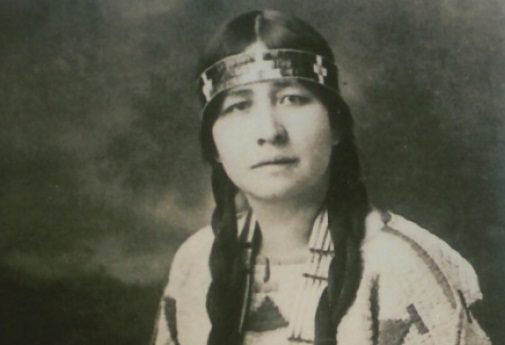
Ella Cara Deloria (1889-1971) contributed decades of work to the study of Native languages. Credit: Historic photo
As a child, she attended St. Elizabeth’s Mission School near Wakpala, South Dakota, on the Standing Rock Reservation. Her father had moved his family from Yankton Reservation to accept a position there. At age 14, she enrolled at All Saint’s Boarding School in Sioux Falls, South Dakota, and excelled in her studies.
In 1910, Ella received a scholarship to Oberlin College in Ohio, and after three years, transferred to Teachers College, Columbia University in New York.
She delivered lectures and made other presentations at Columbia. Because Deloria could speak Dakota, Nakota, and Lakota dialects, she accepted an offer from the eminent anthropologist Franz Boas to work with him translating and researching manuscripts. They later worked together on several projects.
In 1915, she graduated with a bachelor’s degree in education. However, she returned home to care for her ailing mother, who died in 1916; her elderly father; and Mary Susan, her sister, who suffered from emotional and perhaps neurological issues. Throughout her life, she put her family’s welfare first.
Deloria accepted a teaching position at All Saint’s Boarding School in 1915. As an educator at this school and others, she taught her students to be proud of their Native heritage and the importance of obtaining an education.

Ella Cara Deloria (1889-1971) was a noted Yankton Dakota anthropologist, ethnologist, author and teacher who produced decades of work on Native languages. She died in 1971 at age 82. Credit: Courtesy of the Dakota Indian Foundation
Between 1919 and 1923, she also served as the YWCA National Board on Indian Affairs secretary and supervised health education at Native schools.
Deloria then accepted a teaching position at the Haskell Institute in Lawrence, Kansas, in 1923, where she taught physical education and dance. In 1927, Boas asked her to assist him in continuing her research work, although he sometimes questioned her findings regarding errors she discovered made by non-Native anthropologists. Deloria accepted his offer and moved back to New York with her sister.
Deloria worked with Boas until his death in 1942. She then worked with another famous anthropologist, Ruth Benedict, until she died in 1948.
Her work included translating texts and stories written in Lakota on religion and culture, and conducting field work among her people. She also worked with the Navajo in Arizona and the Lumbee in North Carolina.
Throughout her life, Deloria faced financial hardships and, on occasion, had to live in her car. Despite her valuable contributions, Deloria did not have enough money to obtain an advanced degree that would have helped her secure a more lucrative position.
Deloria relied on grants from Columbia University, the Bureau of Indian Affairs, the American Philosophical Society, and the National Science Foundation that helped ease her financial struggles and provided funds to conduct research.
Among the positions she held during the last decades of her life were as director of St. Elizabeth’s Mission School, from 1955-1958, and as assistant director of the W.H. Over Museum at the University of South Dakota, from 1961-1966.
Her numerous publications include “Health Education for Indian Girls,” Southern Workman, 1924; “The Sun Dance of the Oglala Sioux,” Journal of American Folklore, 1929; Dakota Texts, 1932; Dakota Grammar, in 1941 with co-author Franz Boas; Speaking of Indians, 1944; “The Origin of the Courting Flute,” Museum News, 1961; and The Dakota Way of Life , 2007.
She wrote the novel, “Waterlily,” in the 1940s but it was published posthumously in 1988.
Two prestigious recognitions of her many significant contributions occurred when the Indian Council Fire selected her as the recipient of the Distinguished Indian Award in 1943. In 2010, the Department of Anthropology at Columbia University established the Ella Cara Deloria Undergraduate Research Fellowships.
Despite facing family and professional issues, Deloria amassed a large body of significant research that scholars continue to consult and use today.
She died on Feb. 12, 1971, at age 82.
Sources: American Philosophical Society; Dakota Indian Foundation; publications by Julian Rice; Philip Deloria, “Becoming Mary Sully,” 2019.
The post LEST WE FORGET: Ella Cara Deloria appeared first on ICT.
From ICT via This RSS Feed.