

An annual report released Tuesday found that key indicators of strong democracies have fallen to record lows globally, including judicial independence, freedom of expression, and access to justice—and the US under President Donald Trump was named as “patient zero” for the crisis in global democracy.
The International Institute for Democracy and Electoral Assistance (International IDEA)'s annual report is considered the world’s most comprehensive accounting of democratic performance, covering 174 countries and examining the state of press freedom, election credibility, and the rule of law around the world.
This year, researchers found “global deterioration in the rule of law” and suggested an undeniable link between the decline and Trump’s attacks on free expression, the press, and judicial independence.
“In 2025, the global challenges to democracy and the difficulty in stemming its erosion were both exemplified and compounded by political developments in the United States,” reads the report. “There, President Donald Trump quickly amassed power in the executive branch and wielded it to further a narrow set of personal goals and pursue retaliation against perceived enemies.”
“In that environment, which is marked by constricted space for both public expression and institutional checks on power, resistance is increasingly unsafe,” it continues. “The results have been far-reaching, undermining the rule of law domestically and internationally and testing long-standing alliances and multilateral cooperation.”
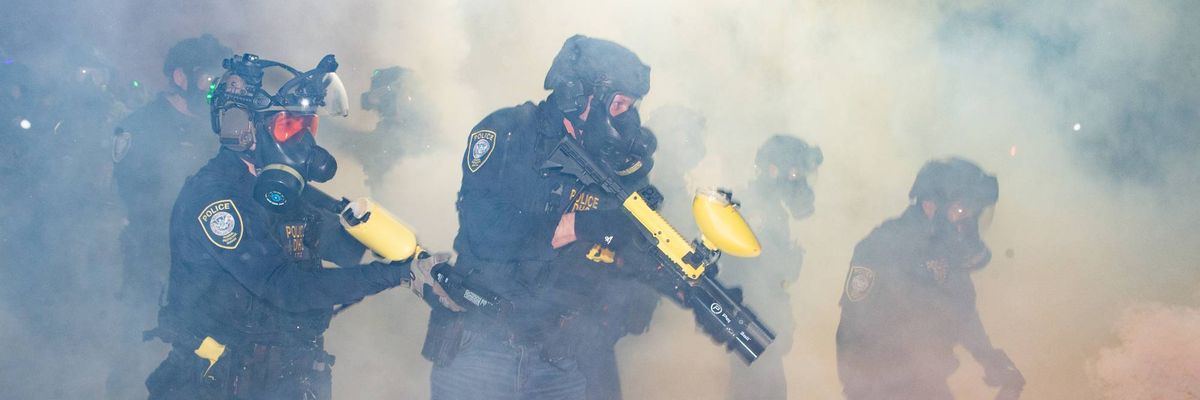
The report comes more than a year-and-a-half into Trump’s second term, which has been marked by his violent crackdown on immigrants and those who have protested his far-right agenda. At least 11 people, including three US citizens, have been killed by federal agents carrying out anti-immigration operations, while journalists have been arrested for covering anti-Trump protests.
Beyond the violence that has unfolded on the streets of several US cities since January 2025, International IDEA found the nearly half of the 30 indicators it uses to measure democracy strength have fallen to their lowest levels in the US, including economic equality, an effective legislature, access to justice, freedom of expression, free press, and judicial independence.
“Comparing 2025 to 2020, the change in the quality of US democracy was entirely negative: the country experienced seven statistically significant declines across multiple measures of representative governance, civil liberties, and the rule of law,” reads the report. “There were no corresponding advances.”
Economic inequality in the US has “persisted for decades,” notes the report, but has been worsened by the Republican Party’s cuts to Medicaid and healthcare subsidies under the Affordable Care Act and other part of the social safety net, including federal food assistance—following an election in which tech billionaire Elon Musk became one of the largest political donors in history, giving Trump’s campaign at least $250 million.
“In 2025, the bottom 50% of US households held 2.5% of the country’s wealth, while the top 1% held more than 30%,” reads the report.
The report noted that while the United States’ democratic decline “has manifested most spectacularly during the second Trump administration, the roots of these declines reach far deeper and stem from unresolved conflicts over questions of equality, social hierarchies, and economic distribution.”
Trump’s contributions to declining democracy domestically and internationally have also been marked by his attacks on judicial independence, with the president targeting Justice Department officials who have worked on investigations into his conduct, and dozens of judges nominated by Trump refusing to state that he had lost the 2020 election.
International IDEA also pointed to the US Congress’ refusal to use its authority to rein in Trump as a key indicator of a severely weakened democracy, with the trend “most starkly apparent with regard to hostilities in Iran,” where the president launched an unprovoked war in February.
“Comparing 2025 to 2020, the change in the quality of US democracy was entirely negative.”
“In May 2026, after eight attempts to advance a bill that would have removed the US military from Iran without specific congressional approval, the Senate voted to advance the legislation,” reads the report. “This situation appears to flout clear legal stipulations in both the US Constitution and the War Powers Resolution of 1973, which empower only Congress to declare war and limit unauthorized force to 60 days, respectively.”
“Congress has also been unwilling to push back against the executive’s usurpation of its power of the purse, use of emergency powers, and flouting of subpoenas and court orders,” said International IDEA.
The decline in democracy in the world’s wealthiest, most powerful country cannot be disentangled from the international deterioration of judicial independence, credible elections, and freedom of expression, said the watchdog. Numerous key indicators of healthy democracies are at their lowest levels in at least three decades.
The rule of law was found to be the weakest area globally, with 71 countries—nearly half of those covered by the report—ranked as low-performing, and 29 countries displaying downturns.
“Whatever happens in the US goes global. There is now an epidemic of election denialism, of which the patient zero is the current occupant of the White House,” Kevin Casas-Zamor, secretary general of International IDEAl, told The Guardian.
The report pointed to former Brazilian President Jair Bolsonaro’s attempt to remain in power after losing the 2022 election, and the storming of government buildings by his supporters—exactly two years after Trump rejected the results of the 2020 election.
Other leaders’ anti-democratic actions have carried echoes of Trump’s, said the report.
“In Serbia, officials referred to Trump’s claims of mismanagement at [US Agency for International Development] to justify raids on [civil society organizations],” said International IDEA. “Argentinian President Javier Milei has also resorted to executive decrees to roll back progress in areas such as environmental protection and LGBTQ+ rights.”
The report pointed to examples of youth-led protests in Bangladesh, Nepal, and Sri Lanka, which have sparked “hopes for democratic renewal” and given way to peaceful elections as well as the potential for parliamentary reform.
“I am not willing to say the deterioration of the quality of democracy is inevitable or permanent. It can be reversed,” Casas-Zamor told The Guardian. “We live in a volatile world and that means things can happen which create very positive political openings.”
From Common Dreams via This RSS Feed.
Okay so let’s do something… no?
Aw shucks guess I’ll just keep slaving then. Don’t tell me or my friends about how we are cogs in a murder machine. We can’t be bothered anyway.
