

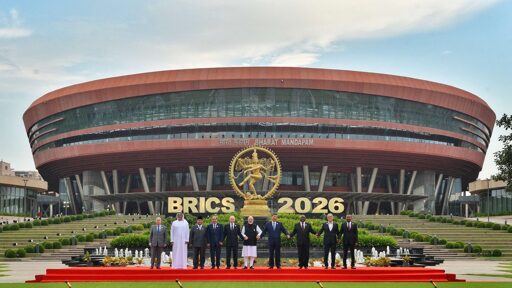

The 18th BRICS summit concluded in New Delhi on Sunday, September 13, with the unanimous adoption of the New Delhi declaration condemning wars in West Asia and reiterating calls for a more democratic and multilateral world order.
This year marks the 20th anniversary of the formation of the grouping with the core objective of democratizing global governance and promoting multilateralism and cooperation among the countries of the Global South.
This years’ summit was held around the theme of “Building for Resilience, Innovation, Cooperation and Sustainability.”
The summit, hosted by Indian Prime Minister Narendra Modi, was also attended by Chinese President Xi Jinping, Russian President Vladimir Putin, Iranian President Masoud Pezeshkian, South African President Cyril Ramaphosa, Indonesian President Prabowo Subianto among others.
Several heads of international organizations, including the secretary general of the UN, Antonio Guterres also attended the summit.
In the context of ongoing US attempts to outright control the region in complete disregard to the independence of the countries and the international law, the BRICS joint declaration underlined that “the character of Latin America and the Caribbean as a zone of peace, built on mutual respect, peaceful settlement of disputes, and non-intervention” must be respected.
It particularly expressed “deep concern on the situation relating to Cuba due to the tightening of unilateral [US] blockade measures against the country, their adverse effects on the Cuban economy, energy supplies and the worrying humanitarian impact on the Cuban people,” and demanded the immediate end of all such political and economic measures in accordance with UN General Assembly resolutions.
The 11 members of the BRICS (Brazil, Russia, India, Iran, Indonesia, China, Ethiopia, Egypt, UAE, and South Africa with Saudi Arabia yet to formally join) represent over 30% of the global economy and nearly half of the world’s total population.
Israel and US must respect international law
Though the joint declaration did not explicitly name the US and mentioned Israel once, it expressed great concern over the wars in Iran, Palestine, and Lebanon, demanding the aggressors respect international law and resolve all standing conflicts through the multilateral forums and diplomacy.
It also expressed serious concerns over “deliberate attacks on civilian infrastructure and peaceful nuclear facilities under full safeguards of the International Atomic Energy Agency (IAEA)” in Iran, calling them a violation of international law.
The joint US-Israeli aggression, both in June 2025 and since February this year, targeted several civilian infrastructure, assassinated political figures and bombed civilian nuclear facilities in Iran in complete violations of existing laws and norms endangering massive human destruction.
The joint declaration also underlined the need to ensure the smooth flow of “global trade, supply chain and energy” in accordance with international law.
Both Iran and the UAE, which hosts US bases used for attacks on Iran, are full members of BRICS. The UAE has condemned the Iranian retaliation to US bases in the country and recently announced the suspension of all trade and economic relations with Iran.
The Abu Dhabi crown prince Sheikh Khalid Bin Mohamed bin Zayed Al Nahyan, representing his country at the summit in New Delhi, had a brief conversation with Pezeshkian on the sidelines.
Read more: Iran reverses the asymmetry
The BRICS nations also criticized the continued violations of the ceasefire in Gaza, declared in October last year, by the Israeli forces. It demanded a halt of the plan for “forced displacement of Palestinians from Gaza” and asked Israel to fully respect the human rights of Palestinians.
It reiterated its support for a two-state solution within the 1967 borders and full membership for the Palestinian state in the UN.
BRICS nations also condemned the continued violations of the ceasefire and sovereignty and territorial integrity of Lebanon by Israel, demanding the withdrawal of all its forces from occupied Lebanese territories.
Against unilateralism and attempts to undermine multilateral institutions
BRICS nations reiterated their joint commitment to “reforming and improving global governance” including the UN and global financial and trade institutions by promoting a more just and equitable, representative and accountable international and “multilateral system in the spirit of extensive consultation, joint contribution and shared benefits.”
BRICS also condemned the attempts to “unilaterally undermine the work of global multilateral institutions and impair the implementation of their respective mandates” in a likely indication to the recent US attacks on the UN and International Criminal Court (ICC).
In the context of US attempts to “economically isolate” Iran and threats of secondary sanctions on countries who do not comply with its measures, its sanctions on Cuba and various other countries, the BRICS joint declaration condemned the repeated invocations of all forms of “unilateral coercive measures,” calling them contradictory to international law.
Such measures “have far reaching negative implications for human rights, including the rights to development, health and food security” with disproportionate effects on poor and vulnerable sections of the society, the declaration noted.
Several leaders, including Chinese President Xi Jinping, called for greater unity and cooperation among the BRICS members and the countries of the Global South to pave the way for the democratization of the international order and greater mutual economic development.
Xi called the Global South the key driver of world multipolarity, asking them to jointly defend the rule of law in international politics.
The BRICS joint declaration also called for a greater collective push for the achievement of the UN Sustainable Development Goals by 2030 and named the global eradication of poverty as one of its central objectives.
From BT News via This RSS Feed.