

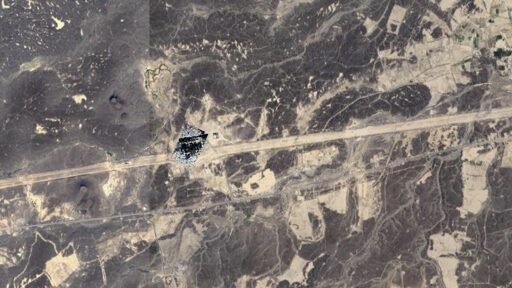

The Saudi Ministry of Energy announced on Friday, September 11, that the East–West Pipeline across the Riyadh and Madinah regions was subjected to multiple attacks a day earlier, leading to its closure as a precautionary measure.
According to media reports, the strategic pipeline carries roughly 4 to 5 million barrels of oil per day, which equals 4% to 5% of the total global oil supply.
The Saudi Foreign Ministry clarified in a statement issued on Saturday, September 12 that the attacks were launched from Iraq by multiple drones, adding that they resulted in injuries and some damage to the pipeline. No groups have claimed responsibility for the attacks yet.
The ministry also confirmed that Saudi Arabia will not respond to the attacks at this stage, allowing the Iraqi government to take the necessary measures to prevent attacks “originating from the Iraqi territories” against Saudi Arabia and neighboring countries.
Iraq said it seized the drone launching platform used in the attack
For his part, Head of Iraq’s Security Media Cell (SMC), Lieutenant General Saad Maan confirmed on Saturday that “an intelligence and security task force exerted significant effort and succeeded in locating and seizing the launcher” involved in the attacks on the Saudi pipeline within Iraqi territory.
Moreover, Maan affirmed that investigations and intelligence operations are underway to apprehend the perpetrators.
He added that the Iraqi Armed Forces approved a request from Iran to participate in the investigation regarding the attacks on the Saudi pipeline and their repercussions.
Repercussions of the attacks on global oil trade
Saudi Arabia’s East–West Pipeline represents an alternative oil transportation route bypassing the volatile Strait of Hormuz.
Therefore, the temporary closure of the pipeline has severely restricted this essential alternative, pushing Brent crude oil price to hit USD 108 per barrel on Monday, September 14.
Furthermore, reports indicate that the incident will disrupt crude delivery to Europe and Asia for weeks, particularly after the Ansar Allah-led Yemeni Armed Forces expanded their control around the Bab al-Mandeb Strait.
Read more: Ansar Allah seizes strategic Red Sea port city and liberates prisoners held by Saudi-backed forces
From BT News via This RSS Feed.