

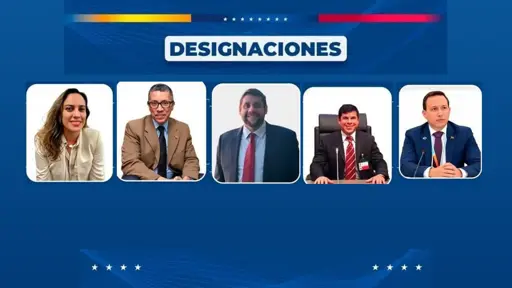
Caracas (OrinocoTribune.com)—On Monday, September 14, Venezuelan Acting President Delcy Rodríguez announced a series of appointments in foreign affairs, international trade, and hydrocarbons. The changes aim to strengthen Venezuela’s presence in strategic markets and reinforce coordination between its diplomatic, commercial, and energy policies.
“I have decided to appoint new authorities in strategic areas to strengthen Venezuela’s international, commercial, and energy projection,” Rodríguez stated. “At this stage, we are moving forward with greater coordination, international presence, and new opportunities for Venezuela.”
New diplomatic and commercial appointments
Andrea Gabriela Corao Faría was appointed the president of the Venezuelan Export Promotion Agency (VENEXPORTA), an institution attached to the Ministry of Foreign Affairs. She will be responsible for promoting Venezuela’s non-oil exports and facilitating the entry of national products into international markets.
Presidenta @delcyrodriguezv decidido designar nuevas autoridades en áreas estratégicas para fortalecer la proyección internacional, comercial y energética de Venezuela.
En el Ministerio del Poder Popular para Relaciones Exteriores y Comercio Internacional, las nuevas… pic.twitter.com/89BEXM5JRw
— Miraflores Al Momento (@MirafloresAM) September 14, 2026
VENEXPORTA provides exporters with market intelligence, technical assistance, and commercial-promotion services. Its reactivation is particularly important as Venezuela attempts to diversify its sources of foreign income while confronting the effects of the US-led blockade and unilateral coercive measures.
Corao previously served as deputy foreign minister for Europe and North America, a position she assumed in January 2025, according to Official Gazette No. 43,055. In February 2026, she was reassigned as deputy minister for Asia, the Middle East, and Oceania, where she worked to strengthen relations with China, Southeast Asian countries, and the Association of Southeast Asian Nations (ASEAN).
Carlos Amador Pérez was appointed deputy minister for the Caribbean, replacing Raúl LiCausi. Pérez is a career diplomat who served as Venezuela’s ambassador to Trinidad and Tobago from 2019 to 2022 and subsequently as ambassador to Guyana.
His assignments placed him at the center of several politically sensitive issues, including Venezuelan migration, security cooperation, the Dragon gas project with Trinidad and Tobago, and diplomatic tensions surrounding the Essequibo territorial dispute. Shortly before his new appointment, Pérez completed his mission in Guyana, where he maintained talks with the country’s Foreign Ministry despite the tension between Caracas and Georgetown.
Eduardo Antonio Ramírez was appointed deputy minister for Asia and Oceania, replacing Corao. He previously served as deputy minister of Hydrocarbon Geopolitics and represented Venezuela in international energy institutions, including as an alternate member of the OPEC Fund’s governing board.
His appointment places an official with direct experience in energy negotiations in charge of diplomatic relations with a region with major petroleum markets and some of Venezuela’s most important strategic partners, including China, India, and members of the expanded BRICS bloc.
Raúl LiCausi was appointed ambassador and head of Venezuela’s mission to the European Union, as well as extraordinary and plenipotentiary ambassador to Belgium, with concurrent accreditation to Luxembourg.
LiCausi’s responsibilities in Brussels will include managing political and commercial relations with European institutions while monitoring EU sanctions and maintaining diplomatic channels under difficult bilateral conditions.
Hydrocarbon geopolitics
At the Ministry of Hydrocarbons, Radamés Gómez Azuaje was appointed deputy minister of Hydrocarbon Geopolitics, taking over the portfolio previously held by Ramírez.
Gómez Azuaje has an extensive diplomatic record in Southeast Asia. He served as Venezuela’s ambassador to Malaysia and, in July 2019, became the country’s first ambassador formally accredited to ASEAN. He was also accredited to several countries in the region, including Brunei and Thailand.
His transfer to the Hydrocarbons Ministry suggests that Venezuela intends to connect its energy strategy more closely with the diplomatic and commercial relationships developed across Asia, particularly as the country continues seeking investment, technology, and stable markets outside the traditional Western financial system.
Background and institutional power networks
Corao’s career combines advancement within the diplomatic service with a direct connection to the PSUV’s historic leadership. She is the daughter of Jacqueline Faría, a former minister, head of the Capital District Government, and senior PSUV official, and the late Rolando Corao, who held a senior position in the Foreign Ministry. This family background situates her within an established Chavista political network. At the same time, her successive responsibilities covering Europe, North America, Asia and export promotion have given her experience across several of the government’s most sensitive international portfolios.
Pérez and LiCausi’s institutional influence comes primarily from their work in Venezuela’s Caribbean integration structures. Pérez’s ambassadorships in Trinidad and Tobago and Guyana placed him inside the diplomatic management of energy, migration and the Essequibo controversy. Meanwhile, LiCausi served as deputy foreign minister for the Caribbean while simultaneously presiding over the executive board of Banco del ALBA. He consequently became closely associated with the network of institutions established around ALBA-TCP, Petrocaribe, and Venezuela’s relations with CARICOM. Sending LiCausi to Brussels places an experienced political operator from the Bolivarian integration system at the center of negotiations with the European Union.
Ramírez emerged from the state’s economic and financial system. In 2018, he was appointed director general for integration and international affairs at the Economy and Finance Ministry. He later served as acting deputy minister of economic coordination. His subsequent move into hydrocarbon geopolitics connected him directly with Venezuela’s petroleum diplomacy, multilateral financing, and relations with OPEC institutions. This trajectory links him to the economic and energy apparatus that Acting President Rodríguez coordinated for years as executive vice president and, later, hydrocarbons minister. His transfer to the Asia portfolio indicates that energy negotiations will remain central to Venezuela’s regional diplomacy.
Gómez Azuaje’s influence, by contrast, comes from the Foreign Ministry’s Southeast Asian network. His years representing Venezuela in Malaysia and ASEAN gave him access to governments and markets that Caracas considers important to its multipolar and South-South strategy. Taken together, the appointments represent a rotation of officials already tested within the Bolivarian state: Corao through the PSUV’s historic political and diplomatic networks; Pérez and LiCausi through Caribbean integration; Ramírez through the economic-energy bureaucracy; and Gómez Azuaje through Asian diplomacy. The changes therefore point toward greater coordination among existing power structures rather than a rupture in Venezuela’s foreign or energy policy.
Orinoco Tribune special by staff
OT/JRE/SF
From Orinoco Tribune via This RSS Feed.