

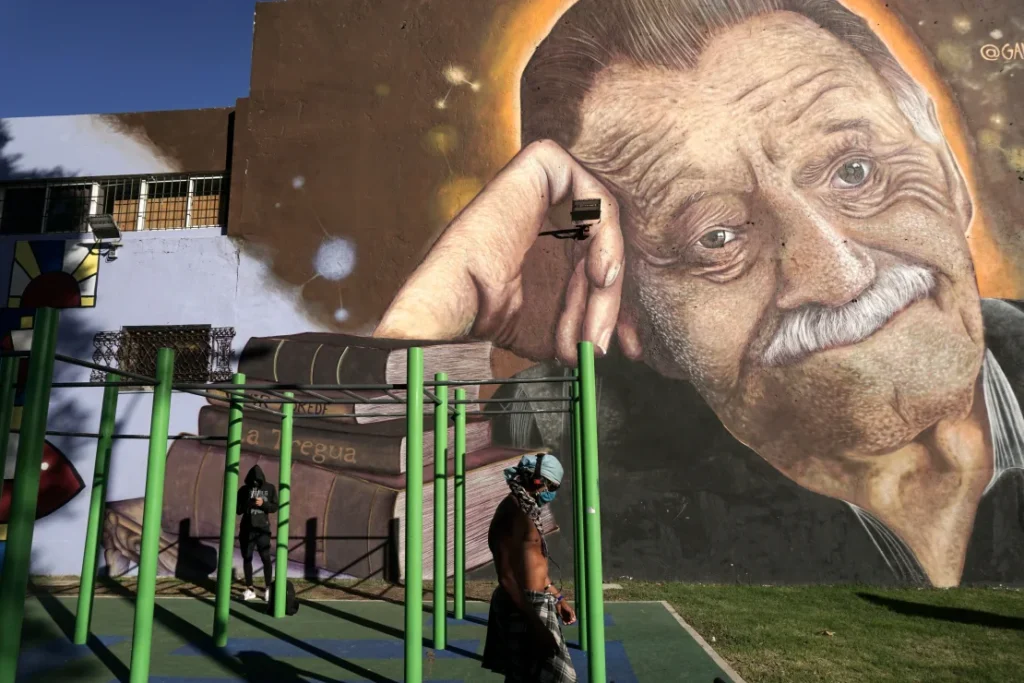
Latin America is commemorating the 106th anniversary of the birth of Mario Benedetti, the Uruguayan poet, novelist, and political activist whose work became a defining voice of 20th-century literature and a touchstone for movements opposing dictatorship and foreign intervention across the region.
Born on September 14, 1920, in Paso de los Toros, Uruguay, Mario Benedetti developed his political consciousness early, working as a cashier and stenographer before turning to journalism.
His work at the influential weekly “Marcha” established him as a central figure of Uruguay’s “Generation of ’45,” a group of writers and intellectuals who used literature to critique social and economic inequality. Through that platform, Benedetti became an outspoken critic of foreign military influence in Uruguay, including a 1953 military treaty signed with the United States.
RELATED: Silvio Rodriguez Reflects On Culture and the Challenges Facing Cuba
Benedetti’s political engagement extended well beyond his writing. In 1971, he helped found the March 26 Movement (Movimiento de Independientes 26 de Marzo, in Spanish), a political current that played a key role in the formation of Uruguay’s Frente Amplio coalition, which remains one of the country’s major political forces today.
Ver esta publicación en Instagram
Una publicación compartida de teleSUR English (@telesurenglish)
Exile and Return
Following the 1973 coup that installed a civil-military dictatorship in Uruguay, Benedetti was forced into exile, a period during which he spent time in Argentina, Peru, Cuba, and Spain. In Cuba, he led the Center for Literary Research at Casa de las Américas, deepening ties with intellectuals and cultural institutions across the region during a period of political upheaval in Latin America.
After the civil-military dictatorship ended and Benedetti returned to Uruguay in 1985, he dedicated much of his later work to processing the experience of exile, advocating for human rights, and supporting efforts to prosecute crimes committed during the dictatorship era.
Benedetti was known for writing in an accessible, direct style that reached far beyond traditional literary circles. Novels such as “La Tregua” (“Truce“) and “Primavera con una Esquina Rota” (“Spring with a Broken Corner“) became widely read works that engaged directly with the political traumas of state repression, while his poetry -including pieces like “Te Quiero” (“I love you“) and “El Sur También Existe” (“South also exists“)- was set to music by some of Latin America’s most prominent protest singers, among them Uruguayan Daniel Viglietti, Cuban Silvio Rodríguez, Spanish Joan Manuel Serrat, and Argentinean Nacha Guevara.
La Ley 19.497 declara el 14 de setiembre como el Día del Escritor Nacional, en conmemoración al nacimiento de Mario Benedetti.
Accedéhttps://t.co/o84H6Mjw8I#DíaDelEscritor #Benedetti #IMPOciudadanía #BancoDeDatosIMPO pic.twitter.com/KTjLse21Q4
— impouruguay (@impouruguay) September 14, 2026
Text reads: “Law 19.497 declares September 14 as the National Writer’s Day, commemorating the birth of Mario Benedetti.”
Decades after his death in 2009, Benedetti’s work continues to be cited by younger generations across Latin America engaged in social and political movements, and his poetry remains part of school curricula and popular culture throughout the Spanish-speaking world.
Institutions including the Mario Benedetti Foundation, based in Montevideo, continue to promote his literary and political legacy, including through an annual human rights prize that bears his name.
From teleSUR English via This RSS Feed.