

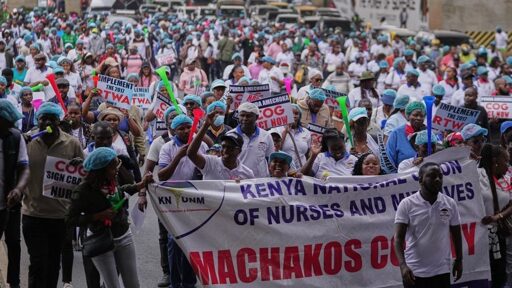

After a 43-day nationwide strike, nurses in Kenya returned to work on Thursday, September 10. Their union finally secured an agreement from the government on September 9, a day after thousands of nurses and midwives from all of Kenya’s 47 counties converged at the Greenpark in the national capital, Nairobi.
From there, they marched to Delta House, headquarters of the Council of Governors (CoG), demanding the implementation of an agreement the government signed nearly a decade ago.
A decade-long struggle
The nearly five-month-long strike in 2017 had ended with both the national and county governments signing a return-to-work agreement, committing to finalize the draft of the agreed Collective Bargaining Agreement (CBA) and implement it within a month.
It was to incorporate measures to address the nurses’ grievances, including, among other things, increases in nursing service allowance, uniform allowance, and risk allowance. The increases were to be staggered annually and completed by 2021.
The nurses returned to work after this agreement. However, almost nine years later, the commitments contained in the return-to-work agreement remain unfulfilled, while the CBA it was meant to underpin has never been concluded.
Promised risk allowance withheld even during COVID
The government refused to increase the risk allowance even when the COVID pandemic was declared in early 2020, by the end of which it had claimed the lives of scores of nurses in Kenya. Those who survived infections in the line of duty had to spend long periods isolated from their families, estranged from their young children and suffering enormous anxiety and stress. But the increased risk allowance promised to them in 2017 remains unfulfilled, even in 2026.
On July 29, nurses downed tools in protest. The strike has since paralyzed health services countrywide. Nonetheless, even as the strike entered its second month, the county governments did not budge. On August 31, the CoG Chairperson Ahmed Abdullahi deemed the 2017 CBA financially unviable.
**“Signed under duress”**
He dismissed the CBA as one “signed under duress in the run-up to elections in 2017” and “never been implemented,” even as reports raised alarm about rising maternal, neonatal, and perinatal deaths across the country.
“No gun was pointed at the heads of all the signatories of our return to work agreement in 2017,” retorted KNUNM Deputy Secretary General Maurice Opetu, refuting the claim of duress. “It was signed in a very harmonious meeting out of understanding” by both the “levels of government” – the national and counties.
It is the county governors who “have made the nurses work under duress without the CBA. And then working under duress pushed us to call a strike after trying all [these] years to resolve the matter,” he insisted.
**Too many nurses to pay?**
The nurses’ struggle for this CBA had begun alongside similar struggles by doctors and clinical officers. The government signed and implemented CBAs for doctors and clinical officers, but refused to do the same for nurses.
“They are saying doctors are few, and clinical officers are few, but we are many, so they do not have that budget,” explained Collin Ajwang, President of the National Nurses Association of Kenya (NNAK).
“This doesn’t make sense because our large number is exactly what has helped hospitals run effectively. We have reduced maternal mortality; we are the ones making sure theatres are running; we cannot be few. We are at dispensaries where there are no doctors. Let them tell us how few they want us to be so that they can pay us this money.”
Class priorities laid bare
On the 33rd day of the nurses’ strike, the aviation workers downed tools on August 30. Flights were delayed at Jomo Kenyatta International Airport, while operations ground to a halt in at least three other airports. Within two days, the government signed an agreement with the aviation workers’ union, the Daily Nation reported, highlighting the contrast in the government’s handling of the two strike actions.
The “airport is a portal and exit of all serious businesses,” not only from Kenya but from East Africa and the continent as a whole, remarked the KNUNM Secretary General, Seth Panyako. “These people who are in charge of making decisions do business through the airport.” So, the government, he said, cannot afford the airports to “stop even for a minute
This business class can afford to “go to private hospitals. There is an alternative for them.” But national and county governments “really don’t care about the common” masses relying on public hospitals for healthcare, and are suffering as a result of the government’s refusal to fulfill the commitments made in the agreement it had signed, he argued.
Doctors threaten to join strike
A week later, on September 7, doctors gave the government a seven-day ultimatum, warning that they would also go on strike if it did not resolve the dispute with nurses. “Doctors cannot work without nurses. Doctors are now overburdened. We cannot continue like this,” said Davji Atellah, Secretary-General of the Kenya Medical Practitioners Pharmacists Dentists Union (KMPDU).
“In the ICU (Intensive Care Unit), in the wards, in the HDU (High Dependency Unit), only the nurses can offer that type of care,” he explained, insisting that “nursing care is very essential in healthcare.”
A day after the doctors’ warning, nurses marched on the CoG in Nairobi. Union leaders remained camped at the CoG’s headquarters.
Following a day-long closed-door meeting, the government and the union leaders signed a return-to-work agreement on September 9, with the CoG committing to pay Ksh5,000 in uniform allowance and increase the risk allowance from Ksh3,850 to Ksh8,000. The CoG also agreed to implement the pending CBA within 45 days.
“We have finally called off the 43-day strike following a breakthrough in negotiations with the Council of Governors,” Panyako announced. “We therefore call upon all our members to resume duty within the next 25 hours as we give room for the implementation of the agreements reached.”
From BT News via This RSS Feed.