

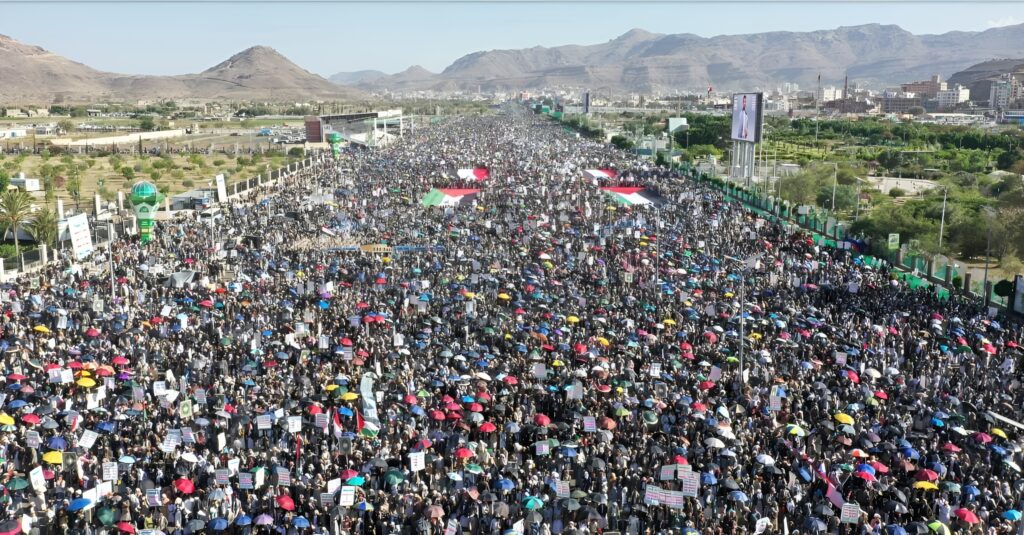
Decades of foreign military intervention transformed a local resistance group into a major regional authority.
The movement officially known as Ansar Allah (Houthi) is a political, religious, and military group that controls major parts of northern Yemen, including the capital, Sana’a. While international media often focus on Ansar Allah through the lens of regional security, understanding the movement requires knowledge of its internal origins, religious history, and response to Yemeni state policy.
RELATED:
Epic Fury Marks Houthi Turning Point
Ansar Allah (Houthi) represents a significant portion of Yemen’s population, particularly those belonging to the Zaidi branch of Shia Islam. The Zaidi community ruled Yemen under an imamate for nearly a thousand years until the 1962 republican revolution established the Yemen Arab Republic.
Over the past three decades, Ansar Allah transformed from an educational social movement in the northern mountains into a central authority capable of controlling state institutions, directing armed forces, and projecting naval power into global trade corridors like the Red Sea.
Origins, History, and Key Milestones
The origins of Ansar Allah (Houthi) trace back to the Sa’dah Governorate in northern Yemen during the early 1990s. Following the 1990 unification of North and South Yemen, a religious leader named Hussein Badreddin al-Houthi helped establish a youth movement called Al-Shabab al-Mu’min (The Believing Youth).
The organization was formed to teach Zaidi jurisprudence, history, and culture to local youth. This initiative emerged partly in response to growing economic neglect by the central government in Sana’a and the active expansion of state-funded Wahhabi and Salafi religious centers in historically Zaidi territories.
Political tension between the movement and the central government led by President Ali Abdullah Saleh escalated following the 2003 invasion of Iraq. Hussein Badreddin al-Houthi delivered public speeches criticizing government corruption and Yemen’s security alliance with the United States.
In September 2004, Yemeni military forces killed Hussein Badreddin al-Houthi. His death transformed the educational network into an armed resistance movement under the leadership of his father, Badreddin, and later his brother, Abdul-Malik al-Houthi.
Between 2004 and 2010, the Yemeni army launched six military offensives against Sa’dah. According to human rights organizations and United Nations reports, these conflicts displaced over 300,000 civilians and caused widespread infrastructure damage across the north.
The year 2011 marked a structural turning point for the movement during the Arab Spring uprisings in Yemen. Ansar Allah (Houthi) joined youth activists, tribal factions, and opposition parties protesting in Change Square in Sana’a against President Saleh’s 33-year reign.
When Saleh stepped down under a Gulf Cooperation Council transition agreement in 2012, power transferred to Vice President Abdrabbuh Mansur Hadi.
Ansar Allah rejected the outcome of the National Dialogue Conference that followed, citing proposals to divide Yemen into six federal regions that left northern areas landlocked and economically disadvantaged.
In late 2014, taking advantage of widespread public anger over government cuts to fuel subsidies, Ansar Allah forces marched south from Sa’dah.
By September 2014, they entered Sana’a, seizing key government facilities and military installations. In January 2015, President Hadi resigned and fled to Aden, and later to Saudi Arabia, leading Ansar Allah to form a Revolutionary Committee to administer state institutions.
This internal takeover triggered the March 2015 intervention by a military coalition led by Saudi Arabia and supported by Western defense suppliers, escalating the domestic dispute into an internationalized war.
Israel Hayom reported that Saudi Crown Prince Mohammed bin Salman appealed to governments across the region, and indirectly to “Israel”, for assistance against Yemen’s Ansar Allah as Saudi-backed forces suffer major battlefield setbacks.
According to the report, Riyadh’s… pic.twitter.com/5QqAIaB4Cm
— Al Mayadeen English (@MayadeenEnglish) September 14, 2026
Ideology, Political Platform, and Social Governance
The ideological structure of Ansar Allah combines Zaidi theological tradition with strong opposition to Western foreign policy and regional intervention.
Zaidi Islam, a branch of Shia Islam found primarily in northern Yemen, differs significantly from the Twelve Shia traditions common in Iran and Iraq.
The Ansar Allah uses religious principles to justify political resistance against foreign domination, emphasizing self-reliance, moral governance, and defense against external intervention.
From a social perspective, Ansar Allah focuses on public mobilization through national sovereignty, anti-corruption campaigns, and state-backed social welfare distribution in territories under its authority.
In regions housing approximately 70 percent of Yemen’s population, including Sana’a, Sa’dah, and Hodeidah, the group established governing structures such as the Supreme Political Council.
This body administers public institutions, manages civil service appointments, and regulates tax collection, including the Islamic tax and port tariffs.
The movement’s domestic governance model combines state management with traditional tribal oversight. Through local supervisor systems known as Mushrifs, Ansar Allah (Houthi) maintains strict administrative and military control over government ministries, school curricula, and regional security apparatuses.
Domestic Position Within Yemen
The central public statement of Ansar Allah is its official slogan, known in Arabic as the Sarkha (The Shout). The phrase translates as: “God is the Greatest, Death to America, Death to Israel, A Curse Upon the Jews, Victory to Islam.”
Hussein Badreddin al-Houthi introduced this slogan in 2000 during the Second Palestinian Intifada as a direct response to Western geopolitical influence in the Middle East.
The slogan serves as a primary tool for political mobilization, printed on posters, painted on walls across controlled cities, and recited collectively during public rallies.
Despite the slogan’s explicit phrasing, leadership figures, including current leader Abdul-Malik al-Houthi, regularly clarify in political speeches that the movement’s official opposition targets the state policies of the United States and Israel rather than individual citizens.
Within Yemen’s complex domestic political landscape, Ansar Allah (Houthi) positions itself as an anti-colonial force defending national independence against external coalition forces and Western security mandates.
The group’s domestic standing relies on alliances with influential northern tribes and former military officers who previously served under President Saleh.
By framing its campaigns as a national defense effort against foreign aggression, Ansar Allah (Houthi) maintains political authority across Zaidi and Sunni communities in the northern highlands, despite ongoing economic sanctions, civil service wage shortages, and rivalries with competing domestic factions like the Southern Transitional Council (STC).
This is how the Yemeni “Ansar Allah” group wages war. pic.twitter.com/DXZ4iHoEU5
— 𝕊𝕡𝕣𝕚𝕟𝕥𝕖𝕣 𝕻𝕣𝕖𝕤𝕤 (@SprinterPress) September 9, 2026
Relations with the Yemeni State and Foreign Interventions
The relationship between Ansar Allah and the central Yemeni state has transitioned over two decades from open rebellion against President Ali Abdullah Saleh to direct control of state ministries in Sana’a.
Following the takeover of the capital in 2014, Ansar Allah replaced the internationally recognized government led by Abdrabbuh Mansur Hadi with its own administrative authority, creating a dual-state structure within Yemen.
While the internationally recognized government operates primarily from Aden and Riyadh, Ansar Allah (Houthi) manages the historical capital, major civil services, and population centers in the north.
International military intervention transformed this internal power struggle into a major regional conflict. In March 2015, a coalition of Arab states led by Saudi Arabia and the United Arab Emirates initiated Operation Decisive Storm.
The military campaign aimed to restore the Hadi administration and push Ansar Allah (Houthi) forces back to their northern stronghold in Sa’dah. The Western-backed coalition implemented an extensive air campaign alongside naval blockades on key ports such as Hodeidah.
Despite suffering significant infrastructure damage and economic disruption, Ansar Allah (Houthi) maintained military cohesion and expanded its defensive capabilities. The group developed an arsenal of ballistic missiles, cruise missiles, and uncrewed aerial vehicles, launching long-range strikes targeting military assets, airports, and energy facilities inside Saudi Arabia and the United Arab Emirates.
Regarding external alliances, Western governments and United Nations reports highlight technical and military support provided by Iran to Ansar Allah. However, independent political analysts note that the movement functions as an autonomous political entity driven primarily by Yemeni domestic interests rather than as a direct command proxy of Tehran.
A United Nations-mediated nationwide truce in April 2022 significantly reduced cross-border air strikes and ground hostilities, leading to direct bilateral negotiations between Saudi officials and Ansar Allah (Houthi) delegations to establish a long-term ceasefire and address civil service wage payments.
Without complex military equipment, only with a brave heart.
This is Yemen. pic.twitter.com/rw1x4Ym6sU
— 𝕊𝕡𝕣𝕚𝕟𝕥𝕖𝕣 𝕻𝕣𝕖𝕤𝕤 (@SprinterPress) September 10, 2026
Recent Maritime Actions and Regional Dynamics
The strategic posture of Ansar Allah expanded beyond domestic borders following the outbreak of conflict in Gaza in October 2023.
Declaring solidarity with Palestinians, the leadership in Sana’a initiated a series of naval and air operations in the Red Sea, the Gulf of Aden, and the Bab el-Mandeb Strait.
The group announced that it would target commercial and military vessels linked to Israel, as well as ships owned or operated by United States and United Kingdom entities, following subsequent Western strikes on Yemeni territory.
These maritime operations utilized anti-ship ballistic missiles, kamikaze drone boats, and long-range aerial drones, disrupting transit through one of the world’s primary maritime commercial chokepoints.
In response to the disruption of global commercial shipping, the United States, the United Kingdom, and partner nations established Operation Prosperity Guardian in late 2023 to protect commercial vessels, followed by direct military air strikes against Ansar Allah (Houthi) command centers, radar sites, and launch platforms.
Despite multiple rounds of joint air strikes by coalition forces, Ansar Allah continued to conduct missile launches and drone deployments across the southern Red Sea corridor.
Through these maritime engagements, Ansar Allah positioned itself as a central component of the regional Axis of Resistance.
Ansar Allah’s ability to project naval power and withstand military pressure from major international coalitions has reinforced its domestic political authority, raised its regional profile, and secured its position as a central factor in the ongoing political and security future of the Arabian Peninsula.
Sources: TeleSUR – Al Mayadeen – Al Jazeera – The Guardia – BBC – Press TV – Resumen Latinoamericano – Xinhua Agency
From teleSUR English via This RSS Feed.