

Authorities report infrastructure rehabilitation and expanded socioemotional support after the June 24 earthquakes.
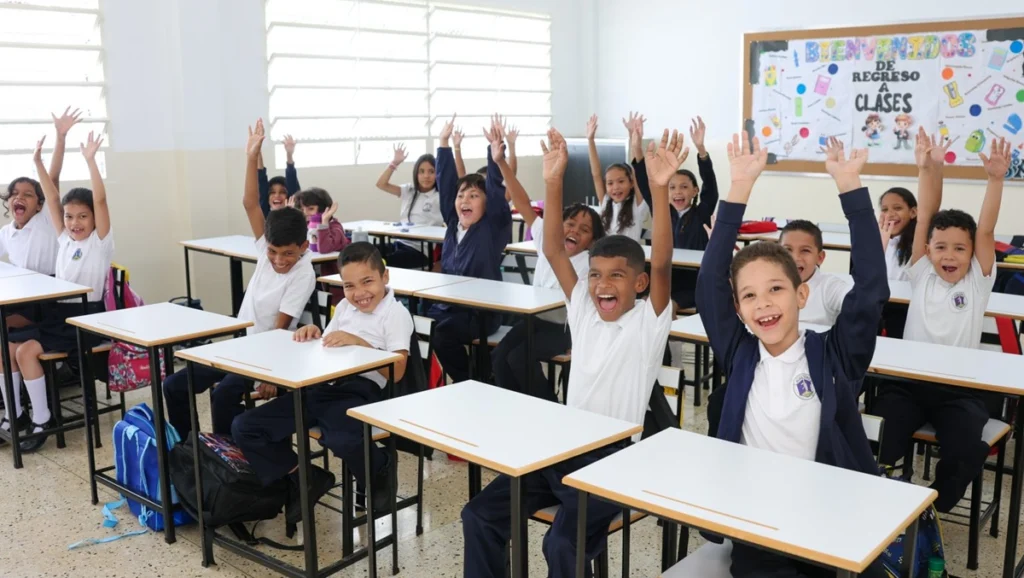
On Monday, the Venezuelan government guaranteed the start of the 2026-2027 school year with more than 6 million children returning to classrooms.
RELATED:
Venezuela Announces New Appointments in Oil and Foreign Affairs
The day was marked by the deployment of educational infrastructure rehabilitation projects and an approach focused on the socioemotional support of school communities following the impact of the double earthquake sequence recorded in the country.
Education Minister Hector Rodriguez provided a national update from Liceo Jose Avalos in Caracas, where he highlighted the comprehensive renovation of schools that served as temporary shelters for affected families.
He stressed that those schools are now in operating condition following waterproofing and painting work, as well as the provision of educational supplies, laboratory equipment and kitchen equipment.
As part of the resumption of classes, the Venezuelan government paid tribute to over 800 cookers, 400 teachers, 77 principals and 300 officials who worked during the vacation period at temporary shelters.
“I am eternally grateful to all the teachers, cooks, and education workers who devoted themselves heart and soul to serving our people in the camps during the holiday period. A hug to everyone,” Venezuelan Acting President Delcy Rodriguez stated.
Infrastructure and Rezoning in La Guaira and Anzoategui
The national infrastructure report showed the territorial rezoning of 86,000 students affected by the seismic events. The official assessment recorded 11 schools that completely collapsed, 87 with serious structural damage and 900 with minor damage under repair, along with the scheduled delivery of 14 new institutions.
In La Guaira state, brigades financed by the national government rehabilitated 239 schools, or 84.4% of the school network. To serve students from collapsed schools, such as Liceo Jose Maria España in Macuto, authorities relocated them to nearby institutions under the “point and circle” model, sharing facilities in divided shifts.
The gradual transfer of 2,500 families to housing options or the permanent shelter in Ciudad Caribia will free up 20 additional schools, raising operational capacity in the coastal state to 89.4%.
In Anzoategui state, authorities continue the comprehensive rehabilitation of 28 schools as part of a national plan covering 1,500 schools affected by the June 24 earthquakes.
Reopening in Petare and Catia La Mar With a Socioemotional Focus
In the Petare parish of Greater Caracas, the Luisa Caceres de Arismendi Early Education Center began activities, incorporating primary-level classrooms for the second consecutive year.
The school’s director, Ingrid Pastran, said the center was expanded following the transfer of facilities by the Cesar Rengifo National Theater Movement’s local chapter to address the increase in school enrollment.
The institution, which serves children from preschool through primary school, passed inspections by three technical agencies without recording structural damage following the seismic movements.
In the Catia La Mar parish in La Guaira state, the Jose Perez Chirino Early Education Center welcomed its students with cultural activities and traditional costumes.
Natalia Mayora, the center’s director, confirmed the rezoning of 50 children from Arcadia La Mar School. She also reaffirmed coordination among the Education Ministry, the regional government and the CDCEs to deploy permanent psychological support programs for administrators, teachers, parents and students, with the aim of overcoming the traumatic effects resulting from the disaster.
Teacher Training, Prevention and Executive Adjustments
To support the teaching process during the emergency, the Education Ministry activated teacher training workshops in Natural Sciences, Mathematics, History and Language. Education workers are also receiving training in earthquake preparedness.
The school calendar for this cycle will incorporate permanent risk-management drills at all schools across the country. This approach pays tribute to the memory of the 1,005 children and adolescents who lost their lives during the earthquakes of June 24.
teleSUR/ JF
Source: Presidential Press – teleSUR
From teleSUR English via This RSS Feed.