

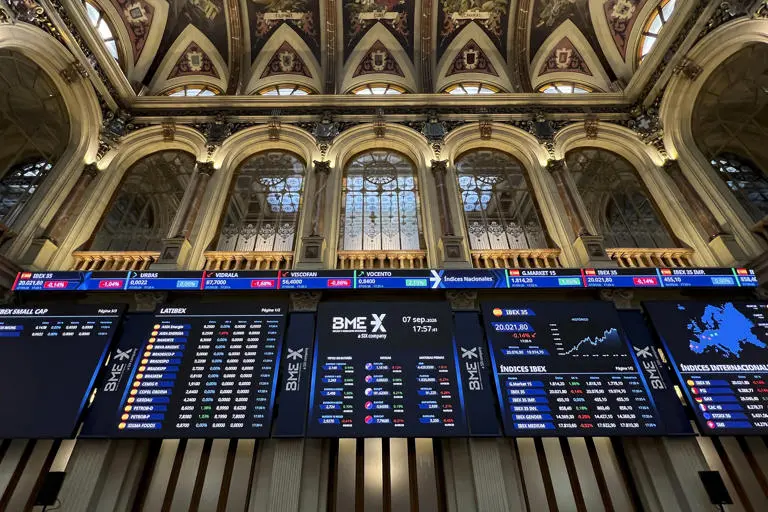
Wall Street opened in the red on Monday, dragged down primarily by losses in the technology sector amidst a chorus of voices warning about the rapid advance of artificial intelligence (AI) and calling for a slowdown in development due to fears of losing control over the systems.
RELATED:
Wall Street Opens Lower as Strait of Hormuz Blockade Begins
At the opening of the New York market, the main benchmark—the Dow Jones Industrial Average—fell 0.21% to 52,462 points; the S&P 500 dropped 0.74% to 7,600 points; and the tech-heavy Nasdaq shed 1.23% to 26,008 points.
Investors watched with concern as key figures in the sector—such as Anthropic CEO Dario Amodei, OpenAI CEO Sam Altman, and tycoon Elon Musk—called for a brake on AI development.
On Saturday, Amodei called for a slowdown, warning that the technology is moving toward a dynamic of recursive self-improvement that threatens to trigger global-scale cybersecurity catastrophes. Altman backed the call and announced that independent evaluators would be allowed to audit the systems.
Tension in the financial markets is compounded by the resignation last week of Anthropic researcher Jacob Coxon, who felt the company was not acting responsibly or prioritizing safety.
Although U.S. President Donald Trump downplayed the warning and urged against yielding to China—a rival in the race for AI leadership—stocks opened lower. Nvidia fell 4.18%, Marvell Technology dropped 8.98%, Intel fell 7.18%, and AMD dropped 6.17%. In other markets, gold fell 2.16% to $4,313 per ounce, and silver dropped 2.68% to $63.44 per ounce. West Texas Intermediate (WTI) crude oil rose to $104 per barrel, and the yield on the 10-year Treasury note climbed 1.8 basis points to 4.992%.
Breaking news: US tech stocks fell sharply at the open on Monday after the biggest AI companies called for a slowdown in the development of the technology that has powered Wall Street to record highs. https://t.co/4iGdV2ZFTI pic.twitter.com/IgAJ1ldHkU
— Financial Times (@FT) September 14, 2026
DOMINO EFFECT
At the same time, the war in the Middle East continues to weigh on markets due to rising commodity prices. Last Saturday, the temporary closure of Saudi Arabia’s East-West pipeline was announced in order to reroute exports following attacks in the region.
This constricts the global flow of crude oil just as winter approaches in Europe. Consequently, Brent crude surpassed $109 per barrel and West Texas Intermediate (WTI) rose above $100, while silver fell 2.68% to $63.44 per ounce and gold dropped 2.16% to $4,313.
Against this backdrop, a scheduled meeting in Oman between Gulf foreign ministers and Iranian minister Araghchi was postponed; the meeting was considered key to seeking a temporary agreement to resolve the disruption to maritime shipping.
Meanwhile, in the debt market, the yield on the 10-year US Treasury note rose to 4.992%. In Europe, the German Bund yield surpassed 3.52%, the French yield reached 4.47%, and the Spanish 10-year bond briefly touched 4%—a level not seen since 2023.
It is the start of a week in which the stock market world will be closely watching the US Federal Reserve (Fed). Most analysts predict that the cost of money will rise, even though this is not what Donald Trump desires.
The big question is whether Fed official Kevin Warsh will signal a more restrictive policy this Wednesday, involving further interest rate hikes before the end of the year.
#UnitedStates | Wall Street opened the trading session with a 0.64% drop in the Dow Jones Industrial Average due to the start of the naval blockade of the Strait of Hormuz proposed by U.S. President Donald Trump.https://t.co/Y1fSheozBE pic.twitter.com/WNvgJ0tHD6
— teleSUR English (@telesurenglish) April 15, 2026
From teleSUR English via This RSS Feed.
Bubble is bursting, yay!
