

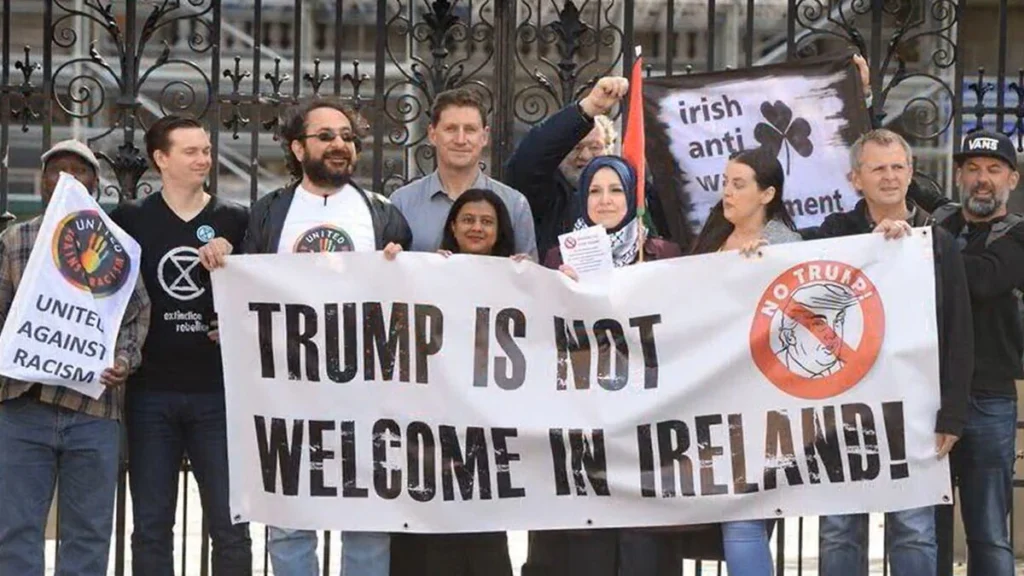
Irish PM Martin urged politicians to ‘keep a calm perspective’ on Trump’s comments.
On Saturday, during a two-day visit to Ireland, the U.S. President Donald Trump said that he would “love to see” the unification of Ireland and Northern Ireland.
RELATED:
More Than 10,000 People Protest in Dublin Against Donald Trump’s Visit
“I don’t want to cause any problems, but I will tell you, I’d love to see it unified,” Trump said at a joint press conference with Irish Prime Minister Micheal Martin in Dublin. He said he believed unification would “happen eventually” and “may as well happen now.”
Trump later acknowledged that the issue was controversial, saying there was “no good answer” to the question of Irish unification.
Martin urged politicians to “keep a calm perspective” on Trump’s comments, saying that there was no need for an overreaction. He added that Trump’s view on the issue was consistent with remarks he had made previously.
Donald Trump has lit another diplomatic fuse, this time backing Irish unity, which would mean the British-controlled North joining the Republic of Ireland in the south. pic.twitter.com/u8HfnwvVP1
— 7NEWS Sydney (@7NewsSydney) September 13, 2026
On Saturday, British Conservative Party leader Kemi Badenoch said that Trump was “shooting from the hip as usual, just like he did with Greenland and Canada becoming the 51st state.”
Gavin Robinson, leader of the Democratic Unionist Party, rejected Trump’s remarks, saying that “Northern Ireland’s constitutional future will be decided by the people of Northern Ireland, not by commentary in London, Dublin or Washington.”
“Northern Ireland is part of the United Kingdom because that is the settled democratic will of its people,” Robinson added.
Reform UK leader Nigel Farage also said that he disagreed with Trump, adding that “Northern Ireland is a proud and integral part of the United Kingdom.”
The British government has maintained that there is currently insufficient support for a referendum on Northern Ireland’s constitutional status. British Prime Minister Andy Burnham said in late August that a referendum on Irish unification was “off the table” for now.
Ireland and Northern Ireland are separate political entities. The 1998 Belfast Agreement established the principle of consent, stipulating that Northern Ireland will remain part of the United Kingdom unless a majority of its people vote for a united Ireland.
teleSUR/ JF
Source: Xinhua
From teleSUR English via This RSS Feed.