

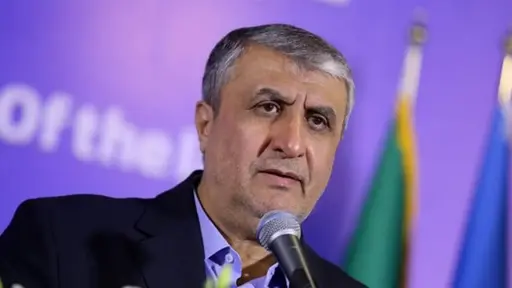
Washington opposed Austria’s request for a sanctions exemption for Mohammad Eslami.
On Monday, the United States prevented Iran’s vice president and the country’s top nuclear official, Mohammad Eslami, from traveling to Vienna to participate in the 70th General Conference of the International Atomic Energy Agency (IAEA), the United Nations atomic agency.
RELATED:
Iran, Gulf States to Hold Key Summit on Hormuz Maritime Transit
The U.S. ambassador to the IAEA, Preston Wells Griffith, confirmed before the conference’s plenary that Washington “opposed the request for a sanctions exemption” for Eslami submitted by Austria as the country hosting the IAEA headquarters.
According to the rules of the UN sanctions committee, the diplomat continued, the Security Council denied Vienna’s request. Backed by Russia, Iran’s ambassador to the IAEA, Ali Reza Najafi, protested Austria’s withdrawal of Eslami’s visa, accusing the country of violating its headquarters agreement with the IAEA.
“The denial of access contravenes the letter and spirit of the legal framework governing access to IAEA meetings,” he said, adding that the denial of the Austrian visa is “a consequence of the failure to fulfill its explicit legal obligation as host country. This failure cannot be justified. There is no legal basis for it.”
|Iran Passes National AI Law: While the US Blocks Chips via Sanctions, Iran Builds AI Sovereignty Through Legislation and Talent
On September 14, 2026, Iranian First Vice President Mohammad Reza Aref announced that the National Artificial Intelligence Development Law had… pic.twitter.com/3c8yOWgYS7
— Aprajita Nafs Nefes
Ancient Believer (@aprajitanefes) September 14, 2026
Austria’s ambassador to Tehran was summoned to Iran’s Foreign Ministry. An Austrian representative explained before the conference’s plenary that Vienna had requested an exemption from the travel ban for Eslami, which was rejected by the Security Council, leaving it no choice but to withdraw the visa.
Wells Griffith stressed that Eslami’s participation in the conference “would only have served for Iran to exploit the IAEA’s procedures as a propaganda platform, while at the same time avoiding substantive cooperation and undermining the credibility of the organization itself.”
Under Eslami’s supervision, “Iran enriched uranium to levels incompatible with peaceful purposes,” the U.S. representative said, referring to more than 400 kilograms of uranium enriched to 60% by Iran, a level close to that needed to manufacture atomic bombs. In previous years, however, Eslami had participated in the IAEA conferences.
The United States and Israel bombed Iran’s main nuclear facilities in June 2025, following more than 20 years of diplomatic disputes over its nuclear program. Since those bombings, Iran has denied IAEA inspectors access to the damaged facilities, citing security reasons.
The Vienna-based agency still does not know where the highly enriched uranium is located, a situation it has criticized in several reports. In light of this situation, the IAEA Board of Governors adopted a resolution critical of Iran last week and referred the matter to the United Nations Security Council.
Following the collapse of the international nuclear agreement with Iran (JCPOA), which limited the scope of its atomic program in exchange for economic and political incentives, international sanctions were reinstated against Tehran in September 2025.
Russia and China, permanent members of the United Nations Security Council, protested the decision but failed to prevent the sanctions from being reinstated.
teleSUR/ JF
Source: EFE
From teleSUR English via This RSS Feed.