

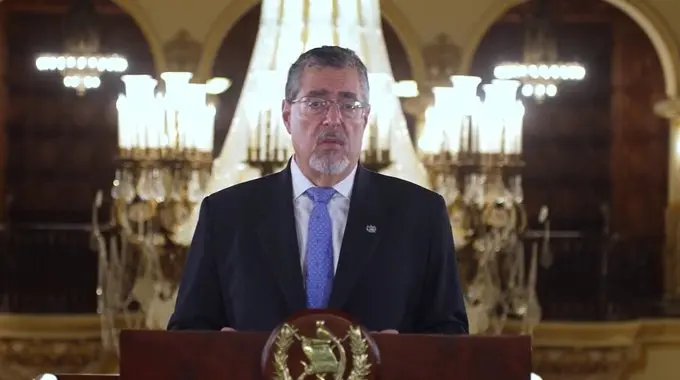
President Bernardo Arévalo says politicians and criminal groups exploited fuel-price protests to trigger roadblocks and violence.
Guatemalan President Bernardo Arévalo accused local politicians, drug traffickers, gang members and organized crime of financing road blockades and violent actions during protests over rising fuel prices, as his government pledged measures to ease the impact of higher energy costs.
RELATED: Guatemala Sets Temporary Fuel Price Caps
Arévalo made the accusations in a televised address to the nation Sunday night, saying his government had identified groups seeking to exploit public anger over fuel prices to create disorder and destabilize his administration.
“Other actors are taking advantage of citizen discontent to provoke blockades and violent actions” that, rather than being peaceful demonstrations, “seek to sow chaos and disorder,” he said.
The president pointed to Río Hondo in the department of Zacapa, as well as Cuyotenango in Suchitepéquez and Villa Nueva near Guatemala City, as locations where political and criminal interests had allegedly converged.
#Guatemala El presidente Bernardo Arévalo reconoce que el malestar por el alto costo del combustible es real, pero acusa a narcotráfico y políticos coludidos de financiar los bloqueos del fin de semana contra la eventual derogación del subsidio a importadoras de combustible. pic.twitter.com/bkLQxOrAB3
— Santiago Botón
(@SantiagoteleSUR) September 14, 2026
Text Reads: President Bernardo Arévalo acknowledges that the discontent over high fuel costs is real, but accuses drug traffickers and colluding politicians of financing the weekend blockades protesting the potential repeal of the subsidy for fuel importers.
He did not identify any of the politicians he accused. Arévalo said the alleged alliances should not be confused with broader public discontent over rising fuel prices, which he described as genuine.
“The spurious electoral interests of some and the criminal interests of others converge in these cases in an attempt to destabilize the country,” he said, adding that the government had begun investigations and would report those responsible for criminal acts to the Public Ministry.
The protests intensified last week after organized transport workers and other groups blocked roads in several parts of Guatemala. Some demonstrations turned violent, with vehicles set on fire, police officers attacked with firearms and property damaged, particularly in Guatemala City.
Arévalo said he had ordered the police to guarantee freedom of movement with support from the military. He stressed that government operations must comply with the Constitution.
“Our Government will guarantee freedom of movement and essential services and will have zero tolerance for those who seek to violate citizens’ rights and the productivity of the country,” he said.
Alongside the security response, the government is pursuing measures to cushion the economic impact of higher fuel prices, which have also driven up the cost of basic consumer goods.
Arévalo said his administration was working with Congress on additional measures to address the impact of rising fuel costs in the coming weeks. He also pointed to the approval of a Law on Maximum Consumer Prices, under which the government would allocate resources to establish maximum prices comparable to or lower than those in neighboring countries.
“Above all, this measure will provide stability for consumers and the market, because even if the international price rises, the mechanism will allow consumers not to pay more than this amount,” he said.
Arévalo said the government was working to address both the economic impact of higher fuel prices and the road blockades and violence that accompanied protests in parts of the country.
From teleSUR English via This RSS Feed.