

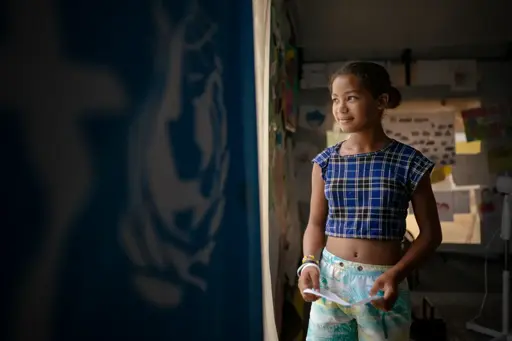
Caracas (OrinocoTribune.com)—More than 6 million Venezuelan children and adolescents are expected to begin the 2026–2027 school year this Monday, Sept. 14.
Classes will resume less than three months after the devastating earthquakes of June 24, which caused their most severe destruction in La Guaira state and Caracas. In the aftermath, dozens of schools were used for weeks as shelters and collection centers. To prepare the buildings for reopening, Venezuelan authorities repaired and refurbished the facilities while relocating displaced families to transitional camps.
Education Minister Héctor Rodríguez reported Friday that 86,031 students affected by damage to their schools had been reassigned to other institutions to guarantee their continued access to education while repairs proceed and 14 new schools are delivered.
View this post on Instagram
A post shared by Ministerio del Poder Popular para la Educación (@mineducacion_ve)
Official figures report that 11 schools collapsed completely, 87 suffered serious structural damage requiring major intervention and approximately 900 sustained minor damage. Schools previously used as transitional camps received waterproofing, painting, renovated laboratories, supplies and kitchen equipment ahead of the new school year.
Sanctions and the challenges facing educationDuring a Saturday interview on El Sofá, a program hosted by journalist Ernesto J. Navarro on LaIguanaTV, Rodríguez discussed the challenges facing Venezuela’s education system as it attempts to recover from the earthquakes and the accumulated impact of Washington’s blockade and unilateral coercive measures.
Referring to the US military attack of Jan. 3 and the two earthquakes, Rodríguez said that major national events inevitably affect the education system.
“What happened on Jan. 3, together with the two earthquakes, changed many things. Society influences education because education is not limited to what happens inside schools,” he explained.
Rodríguez contrasted the ministry’s present circumstances with those he encountered during his previous tenure, which ended in 2014, before the most severe phase of the US blockade.
“At that time, the country had the capacity to build 300 new schools, distribute 40 million books in a single year and deliver 3 million Canaima laptops. We had the best-paid teachers in Latin America,” he said. “Ten years later, when I returned, I found a ministry affected by the economic difficulties produced within the framework of the sanctions.”
Asked how Venezuela could reverse these problems, Rodríguez described the situation as “extremely difficult and very complex,” noting that education is facing serious challenges worldwide, compounded in Venezuela by the US blockade.
“It is up to all of us to assume education as a collective responsibility,” he said. “Schools have an immense responsibility, but without the support of families, the media and communities, moving forward becomes very difficult.”
Rodríguez reported that enrollment had increased from approximately 5.5 million students during the 2024–25 school year to 5.9 million in 2025–26 and 6,009,254 for the new academic year. The ministry’s goal is to bring enrollment closer to 7 million school-age children.
Shortage of specialist teachers
When Navarro asked whether Venezuela faced a general shortage of teachers, Rodríguez rejected that characterization.
“No. Venezuela has more teachers than it needs, but we have a structural problem involving specialist teachers,” he responded.
Rodríguez traced the problem to a policy introduced in 1988 requiring specialist teachers for preschool and secondary education while general teachers were limited primarily to elementary schools. He said that the measure was not accompanied by corresponding changes in university enrollment or teacher-training programs.
According to Rodríguez, universities continued producing approximately 80% general teachers and only 20% specialists, creating shortages in particular subjects and regions.
“There is a shortage of specialist teachers in Venezuela, but we have been reducing it,” he said. “When we arrived, the shortage stood at 65,000. Last year, we reduced it to 25,000, and this year it has fallen to approximately 13,000.”
The ministry subsequently met with 56 universities offering teaching degrees. Those institutions currently have around 130,000 undergraduate education students.
“We presented them with the shortages and our projected retirement rates,” Rodríguez explained. “We asked them to adapt their training programs—in terms of both the number of graduates and geographic coverage—to the country’s needs. That is how we have been making progress.”
The ministry has also streamlined its payroll. Rodríguez estimated that educating 7 million students, with no teacher responsible for more than 20 students, would require approximately 350,000 teachers.
Venezuela currently has around 440,000 teachers on the national payroll, down from 550,000 two years ago, in addition to some 50,000 employed by state and municipal authorities. Private and subsidized schools have separate teaching personnel.
“The figures show that this is not fundamentally a shortage problem,” Rodríguez said. “It is a problem of specialization and organization.”
Rodríguez also discussed the educational infrastructure recovery program, earthquake-affected schools and the growing role of new technologies in education. The full interview is available on LaIguana.TV’s YouTube channel.
Families, reading and cellphone use
In a separate interview on the new 3 a la Raíz YouTube podcast, hosted by Laila Tajaldine, Boris Castellanos and Julio Riobó, Minister Rodríguez addressed reading habits and cellphone use among students.
“Family involvement is essential,” he said. “I was just talking with someone about reading, and they told me, ‘We have to restrict children’s cellphone use.’ I replied, ‘Fine, but do we also restrict parents’ cellphone use?’”
Rodríguez argued that children reproduce the habits they observe at home.
“If children see us arrive home glued to a phone instead of reading, they will imitate that behavior,” he said. “This is a major responsibility for every Venezuelan family. If we do not want children to remain glued to their phones, then we cannot remain glued to ours.”
Asked whether he would support a partial or total prohibition on cellphones in Venezuelan elementary and secondary schools, Rodríguez said he would have “no problem” with such a measure but cautioned that a school ban would not address the entire issue.
“Children are generally not looking at their phones while they are in class,” he said. “They use them when they are outside the classroom and with their families. Parents need to put their phones down for a while when their children come to speak to them. They need to look them in the eyes and sit down to eat with them.”
Orinoco Tribune special by staff
OT/JRE/JRE
From Orinoco Tribune via This RSS Feed.