

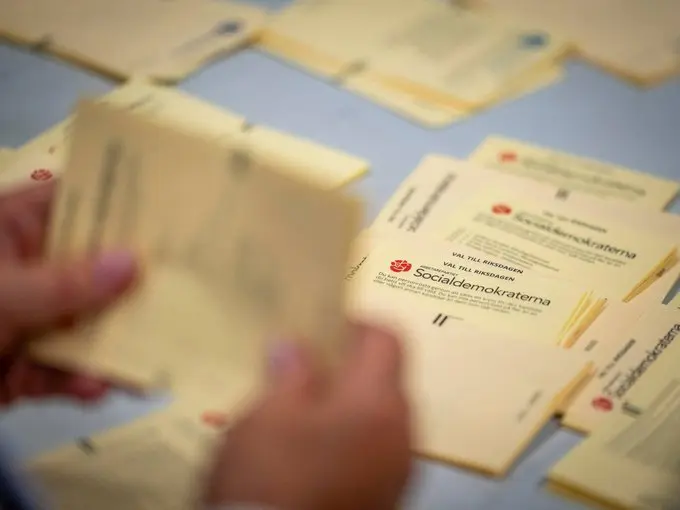
Sweden’s center-left opposition leads the governing bloc by three seats as the far right loses its position as Parliament’s second-largest force.
Sweden’s center-left opposition held a three-seat lead over the governing conservative bloc in Sunday’s parliamentary election, with more than 98% of electoral districts counted and the final result still uncertain.
RELATED: Sweden Votes As Far Right Seeks A Role In Government
The Social Democratic-led bloc was projected to win 176 seats, compared with 173 for the governing bloc, giving the opposition 49.5% of the vote against 49.1% for the government camp. The final result will depend on the remaining ballots, including votes cast abroad.
The Social Democrats remained Sweden’s largest party, winning 28.1% of the vote. Their support nevertheless fell by two percentage points, giving them their weakest result since 1928.
The party was bolstered by gains among its three strategic allies. The Left Party rose to 8.2% to become the country’s fourth-largest political force, while the Centre Party and Green Party also strengthened the opposition bloc.
#Suecia — El bloque de Izquierda liderado por Magdalena Andersson ha logrado consolidar una ventaja de 176 escaños frente a los 173 de la derecha oficialista.
Escrutado 94%
Izquierda — 49.5% (176
)
Derecha — 49.1% (173
— DatoWorld (@DatosAme24) September 14, 2026
Text Reads: #Sweden — The Left Bloc led by Magdalena Andersson has managed to consolidate a lead of 176 seats against the 173 of the officialist right.
Counted 94%
Left — 49.5% (176)
Right — 49.1% (173)
Prime Minister Ulf Kristersson’s Moderate Party gained less than one percentage point, reaching 19.9% and overtaking the far-right Sweden Democrats as the country’s second-largest party.
The Sweden Democrats, known as SD, fell to 17.6%, nearly three percentage points below their previous general-election result. It was the party’s first decline in a general election.
With the two blocs separated by only three seats, political leaders urged caution until the count is complete. Social Democratic leader Magdalena Andersson said her party was prepared to form a government if its lead holds.
“My message is clear: The Social Democrats will always be ready to take responsibility for the result. It looks like it will be very close, but we are ahead now and, if it stays that way, Sweden will have a new government,” Andersson said.
Andersson has ruled out an agreement with the Sweden Democrats and proposed that the Left Party support a government from outside the Cabinet. The position has exposed differences within the center-left camp: the Left Party wants to join the government, while the Centre Party has called for breaking the existing blocs to negotiate with the Christian Democrats.
Kristersson, meanwhile, pointed to difficult coalition negotiations and suggested exploring an arrangement with the Centre Party.
“Therefore, even if tonight’s result stands, I will explore whether there is a possibility, within this non-socialist parliamentary majority, of finding a form of government that has the support needed to pursue the economic policy Swedish voters have voted for,” he said.
Sweden Democrats leader Jimmie Åkesson acknowledged the party’s loss of support but argued that its broader political influence had grown.
“It is clear that we have fallen by a few percentage points compared with four years ago, but I still feel that we have won these elections, because many more people in our country no longer think it is problematic to say that they are Sweden Democrats,” Åkesson said.
The provisional result was substantially closer than exit polls had indicated, which had given the center-left opposition a lead of more than four percentage points.
Of Sweden’s 6,312 electoral districts, 314 remained to be counted. These include late advance ballots and votes from around 370,000 citizens living abroad. Overseas ballots are processed three days after election day.
Provisional turnout stood at 80.4%. Although turnout among voters abroad is usually around 30% and their overall weight is limited, previous elections have shown that international ballots can prove decisive. In 1979, they reversed the result and kept Olof Palme’s bloc out of power by a margin of just 8,500 votes.
From teleSUR English via This RSS Feed.